
Catalogue Search | MBRL


Are you sure you want to remove the book from the shelf?

{{itemTitle}}
164
result(s) for
"Moral education Europe."
Sort by:

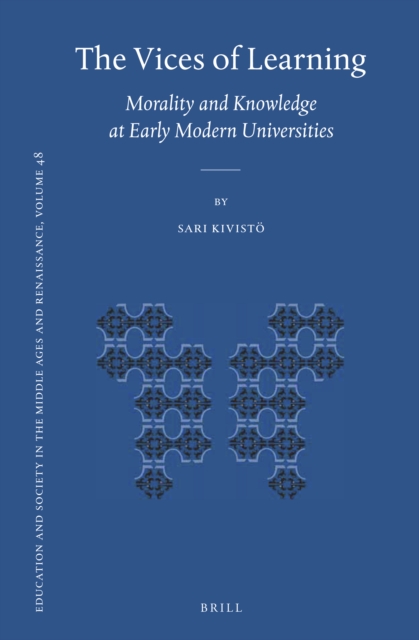
The Vices of Learning
In The Vices of Learning Sari Kivistö examines scholarly vices, such as pride, plagiarism and the desire for fame, in over one hundred Latin dissertations and treatises from the late Baroque and early Enlightenment periods.
eBook

Morality and masculinity in the Carolingian empire
\"What did it mean to be a Frankish nobleman in an age of reform? How could Carolingian lay nobles maintain their masculinity and their social position, while adhering to new and stricter moral demands by reformers concerning behaviour in war, sexual conduct and the correct use of power? This book explores the complex interaction between Christian moral ideals and social realities, and between religious reformers and the lay political elite they addressed. It uses the numerous texts addressed to a lay audience (including lay mirrors, secular poetry, political polemic, historical writings and legislation) to examine how Biblical and patristic moral ideas were reshaped to become compatible with the realities of noble life in the Carolingian empire. This innovative analysis of Carolingian moral norms demonstrates how gender interacted with political and religious thought to create a distinctive Frankish elite culture, presenting a new picture of early medieval masculinity\"-- Provided by publisher.
Book
The anatomy of murder
This is the first comprehensive account of \"Anatomy in National Socialism\". Traces the gradual escalation of ethical transgressions in anatomy during National Socialism from the traditional anatomical work with the dead to human experimentation, and points to the need for vigilance against similar gradual ethical compromise in contemporary medical ethics. Demonstrates the manner in which anatomists became complicit in the complete annihilation of the perceived \"enemies\" of the Nazi-government. Demands the full reconstruction of the biographies and memorialization of Nazi-victims, whose bodies were used for anatomical purposes.
eBook

Promoting Children’s Rights in European Schools
Promoting Children’s Rights in European Schools explores how facilitators, teachers and educators can adopt and use a dialogic methodology to solicit children’s active participation in classroom communication. The book draws on a research project, funded by the European Commission (Erasmus +, Key-action 3, innovative education), coordinated by the University of Modena and Reggio Emilia, Italy, with the partnership of the University of Suffolk, UK, and the University of Jena, Germany. The author team bring together the analysis of activities in 48 classes involving at least 1000 children across England, Germany and Italy. These activities have been analysed in relation to the sociocultural context of the involved schools and children, a facilitative methodology and the use of visual materials in the classroom, and engaging children in active participation and the production of their own narratives. Each chapter looks at reflection on practice, outcomes, and reaction to facilitation of both teachers and children, drawing out the complex comparative lessons within and between classrooms across the three countries.
eBook

A Multilevel Model Examining the Relationships Between Workplace Spirituality, Ethical Climate and Outcomes: A Social Cognitive Theory Perspective
The role and influence of workplace spirituality on individual and organisational outcomes continue to draw attention among management scholars. Despite this increased attention, extant literature has yielded limited insights particularly into the impact and influence processes of workplace spirituality on performance outcomes at both the individual and unit levels of analysis. Addressing this gap in research, we proposed and tested a multilevel model, underpinned by social cognitive theory, that examines the processes linking perceptions of workplace spirituality and performance outcomes at the individual and organisational level of analysis. Data were obtained from 51 branches of a retail organisation in the United Kingdom. Results from structural equation modelling analysis revealed three salient findings. First, workplace spirituality was positively related to ethical climate, prosocial motivation, and moral judgment. Second, ethical climate partially mediated the relationship between workplace spirituality and prosocial motivation and moral judgment, respectively. Third, aggregated ethical climate significantly relates to branch-level helping behaviour and service performance.
Journal Article

Morality and Masculinity in the Carolingian Empire
What did it mean to be a Frankish nobleman in an age of reform? How could Carolingian lay nobles maintain their masculinity and their social position, while adhering to new and stricter moral demands by reformers concerning behaviour in war, sexual conduct and the correct use of power? This book explores the complex interaction between Christian moral ideals and social realities, and between religious reformers and the lay political elite they addressed. It uses the numerous texts addressed to a lay audience (including lay mirrors, secular poetry, political polemic, historical writings and legislation) to examine how biblical and patristic moral ideas were reshaped to become compatible with the realities of noble life in the Carolingian empire. This innovative analysis of Carolingian moral norms demonstrates how gender interacted with political and religious thought to create a distinctive Frankish elite culture, presenting a new picture of early medieval masculinity.
eBook

Moral Injury and the Global Health Workforce Crisis — Insights from an International Partnership
Moral Injury and the Global Health Workforce CrisisWith health care workforces in the United States and Europe shrinking at unsustainable rates, it’s vital to understand the drivers of moral injury so that solutions can be developed.
Journal Article
“We’re Just Geeks”: Disciplinary Identifications Among Business Students and Their Implications for Personal Responsibility
This research shows how business students’ disciplinary specializations can affect their sense of personal responsibility by providing rationalizations for moral disengagement. It thereby conceptualizes business students’ disciplinary specializations as a key dimension of the business school responsibility learning environment. Students use four main rationalizations to displace responsibility variously away from their own disciplinary specializations, to claim responsibility as the prerogative of their specialization, and to shift irresponsibility onto disciplinary out-groups. Yet despite their disciplinary identifications, students largely rationalized that their sense of responsibility was an individual matter that was unlikely to be affected by contextual influences, and they attributed irresponsible behavior to incorrigible ‘bad apples.’ A theoretical model is offered which illustrates these dynamics by combining Bandura’s social cognitive theory with social identity theory. The research is based on secondary data, specifically focus-group interviews conducted with undergraduate students at a major Scandinavian business school in connection with the implementation of the UN Principles for Responsible Management Education (PRME) initiative. The implications for management education include the need to strengthen students’ ‘disciplinary reflexivity,’ and to explicitly address the tension between students’ disciplinary solidarities and their faith in their own individual moral infallibility.
Journal Article

White paper defining optimal palliative care in older people with dementia: A Delphi study and recommendations from the European Association for Palliative Care
Background:
Dementia is a life-limiting disease without curative treatments. Patients and families may need palliative care specific to dementia.
Aim:
To define optimal palliative care in dementia.
Methods:
Five-round Delphi study. Based on literature, a core group of 12 experts from 6 countries drafted a set of core domains with salient recommendations for each domain. We invited 89 experts from 27 countries to evaluate these in a two-round online survey with feedback. Consensus was determined according to predefined criteria. The fourth round involved decisions by the core team, and the fifth involved input from the European Association for Palliative Care.
Results:
A total of 64 (72%) experts from 23 countries evaluated a set of 11 domains and 57 recommendations. There was immediate and full consensus on the following eight domains, including the recommendations: person-centred care, communication and shared decision-making; optimal treatment of symptoms and providing comfort (these two identified as central to care and research); setting care goals and advance planning; continuity of care; psychosocial and spiritual support; family care and involvement; education of the health care team; and societal and ethical issues. After revision, full consensus was additionally reached for prognostication and timely recognition of dying. Recommendations on nutrition and dehydration (avoiding overly aggressive, burdensome or futile treatment) and on dementia stages in relation to care goals (applicability of palliative care) achieved moderate consensus.
Conclusion:
We have provided the first definition of palliative care in dementia based on evidence and consensus, a framework to provide guidance for clinical practice, policy and research.
Journal Article