
Catalogue Search | MBRL


Are you sure you want to remove the book from the shelf?

{{itemTitle}}
420
result(s) for
"Moralia"
Sort by:


Energeia in the Magna Moralia
There is no clear consensus among scholars about the authenticity of the Magna Moralia . Here I present a new case for thinking that the work was composed by a later Peripatetic, and is not, either directly or indirectly, the work of Aristotle. My argument rests on an analysis of the author’s usage of ἐνέργεια , which is a fruitful way to investigate the date of the work: the term was apparently coined by Aristotle but in later antiquity came to be used in ways inconsistent with Aristotle’s own usage. I argue that in several passages from the Magna Moralia the term is used in this distinctively late sense and that it is not plausible to think that this innovation could have occured in Aristotle’s own lifetime or shortly thereafter.
Journal Article

Rileggendo i Minima moralia a cinquantun anni dalla scomparsa di Adorno. Nota pedagogica
The Adornian theories are still a relevant theoretical and educational model, even fifty years after his death. The article develops exactly this aspect in many directions and it lingers on one of the masterpieces of the master of Frankfurt, Minima moralia, making use of hermeneutic critical thinking. Keywords. Adorno - Minima Moralia - Critical Theory - Frankfurt School - Utopy
Journal Article

Anecdotal Remains
Readers of Adorno’s Minima Moralia have often asked and debated how this collection of aphorisms, many of which record Adorno’s personal experiences with American society, can claim any degree of objective or scientific validity. This article finds an answer to this perennial question in the peculiar way the book employs the anecdotal as a mode of presenting “actual experience.” After reviewing Adorno’s attitude toward the use of empirical methods in social research, the article contrasts the treatment of anecdotes in Adorno’s contributions to The Authoritarian Personality, an empirical study published in 1950, with his use of fragmentary anecdotal elements – brief descriptions of trivial occurrences, vignettes, highly condensed mini-narratives – in the Minima Moralia. I argue that these “anecdotal remains” constitute a form of empiricism. Seeing them as such allows us to better understand Adorno’s puzzling acknowledgment of empirical research as a needed corrective to traditional philosophy.
Journal Article
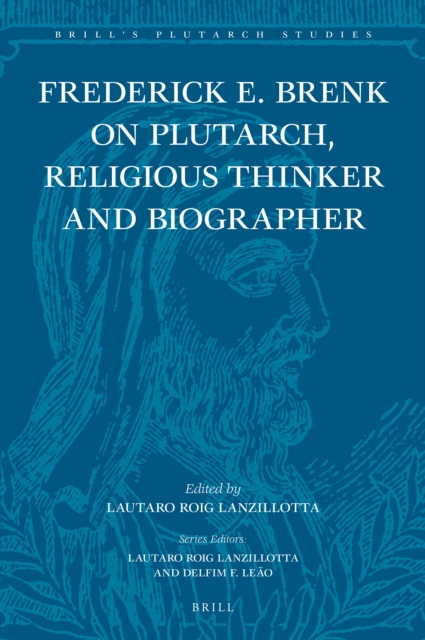
Frederick E. Brenk on Plutarch, Religious Thinker and Biographer
Frederick E. Brenk, Plutarch, Religious Thinker and Biographer: \"The Religious Spirit of Plutarch of Chaironeia\" and \"The Life of Mark Antony\" includes the updated and revised version of two seminal articles on Plutarch's Lives and Moralia by F. E. Brenk originally published in ANRW.
eBook

Mínima Moralia y la vivencia de lo tardío
Con la intención de realizar una interpretación que haga justicia a la particularidad metodológica de Minima Moralia, este artículo plantea la necesidad de repensar la relación dialéctica entre forma y contenido en la obra de Adorno. La dilucidación del funcionamiento particular de tal relación en el interior de cada texto es considerada en estas páginas como una de las claves insoslayables para una correcta intelección de los textos adornianos. Así, por una parte, en este artículo se hace una lectura de Minima Moralia que trata de activar la crítica inmanente a la forma-sujeto moderna a través de sus formas de expresión alienadas, utilizando en gran medida la categoría de «estilo tardío». Por otra parte, esta lectura de Minima Moralia trata de ganar la visibilidad de la continuidad fundamental de unas mismas condiciones de subjetivización a lo largo de toda la modernidad capitalista, basados en la hegemonía de la ley del valor como forma general de la socialización.
Journal Article

LAS REDACCIONES TARDÍAS DE LA VISIO TAIONIS (DE INUENTIONE LIBRORUM MORALIUM IN IOB): ESTUDIO Y EDICIÓN CRÍTICA
La Visio Taionis narra el hallazgo milagroso en Roma, por parte del obispo Tajón (s. VII), de los Moralia in Iob de Gregorio Magno, que, según el relato, no podían encontrarse en el reino visigodo. Este relato procede de un capítulo de la Crónica mozárabe de 754 (s. VIII) y circuló a la cabeza de varios códices de los Moralia. En el siglo XII se realizó una reescritura de la leyenda, publicada en 1705 con el nombre del De inuentione librorum Moralium (PL 75, cols. 507– 10). Sin embargo, el examen de la tradición manuscrita revela que en el siglo XII se realizaron al menos seis redacciones distintas, y que el texto editado en PL es en realidad una contaminación de dos de ellas realizada a finales del siglo XV. En este artículo presento un primer catálogo del más de medio centenar de testimonios existentes, una edición crítica de las seis redacciones y un estudio en el que sitúo el origen más probable de las seis en Claraval o en alguna abadía cisterciense del norte de Francia.
Journal Article

Through Other Continents
What we call American literature is quite often a shorthand, a simplified name for an extended tangle of relations.\" This is the argument of Through Other Continents, Wai Chee Dimock’s sustained effort to read American literature as a subset of world literature. Inspired by an unorthodox archive--ranging from epic traditions in Akkadian and Sanskrit to folk art, paintings by Veronese and Tiepolo, and the music of the Grateful Dead--Dimock constructs a long history of the world, a history she calls \"deep time.\" The civilizations of Mesopotamia, India, Egypt, China, and West Africa, as well as Europe, leave their mark on American literature, which looks dramatically different when it is removed from a strictly national or English-language context. Key authors such as Thoreau, Margaret Fuller, Ezra Pound, Robert Lowell, Gary Snyder, Leslie Silko, Gloria Naylor, and Gerald Vizenor are transformed in this light. Emerson emerges as a translator of Islamic culture; Henry James’s novels become long-distance kin to Gilgamesh; and Black English loses its ungrammaticalness when reclassified as a creole tongue, meshing the input from Africa, Europe, and the Americas.
eBook
Solon of Athens as a Precedent for Plutarch's Authorial Persona
Solon is the subject of both a Plutarchan biography (Solon) and a philosophical dialogue (Convivium septem sapientium). In this article I argue that Plutarch creates a precedent for his authorial persona of wise but modest adviser of the ruling class under the Roman empire in the figure of the Athenian sage Solon, presumably inspired by the fact that Herodotus used Solon as a text-internal alter ego. To this end I analyze in particular how Plutarch represents Solon's way of dealing with rulers and tyrants (Pisistratus, Philocyprus, Croesus, Periander). I ask whether in this Solon can be considered successful or not, and why. I submit that Plutarch's representation of Solon aims to provide authority to some of the remarkable aspects of his authorial persona, in particular its emphatic modesty and pragmatism with regard to absolute rule. Plutarch does this in particular by showing that it was a time-honoured and respectable practice for wise Greeks to act as advisor to rulers, even tyrants.
Journal Article

The Origins of Criticism
By \"literary criticism\" we usually mean a self-conscious act involving the technical and aesthetic appraisal, by individuals, of autonomous works of art. Aristotle and Plato come to mind. The word \"social\" does not. Yet, as this book shows, it should--if, that is, we wish to understand where literary criticism as we think of it today came from. Andrew Ford offers a new understanding of the development of criticism, demonstrating that its roots stretch back long before the sophists to public commentary on the performance of songs and poems in the preliterary era of ancient Greece. He pinpoints when and how, later in the Greek tradition than is usually assumed, poetry was studied as a discipline with its own principles and methods. The Origins of Criticism complements the usual, history-of-ideas approach to the topic precisely by treating criticism as a social as well as a theoretical activity. With unprecedented and penetrating detail, Ford considers varying scholarly interpretations of the key texts discussed. Examining Greek discussions of poetry from the late sixth century B.C. through the rise of poetics in the late fourth, he asks when we first can recognize anything like the modern notions of literature as imaginative writing and of literary criticism as a special knowledge of such writing.
eBook