
Catalogue Search | MBRL


Are you sure you want to remove the book from the shelf?

{{itemTitle}}
7
result(s) for
"Morgan, J. Pierpont (John Pierpont), 1837-1913"
Sort by:


Gentlemen Bankers
Gentlemen Bankers focuses on the social and economic circles of one of America's most renowned and influential financiers, J. P. Morgan, to tell a closely focused story of how economic and political interests intersected with personal rivalries and friendships among the Wall Street aristocracy during the first half of the twentieth century.
eBook
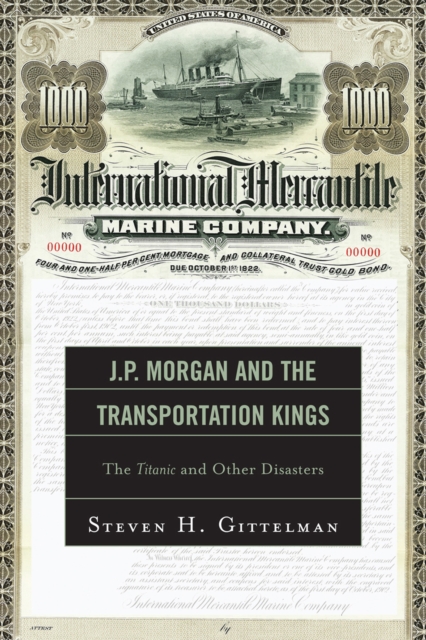
J.P. Morgan and the Transportation Kings
The concept was simple, to link American railroads and global dominance of the seas with a railroad line through China and Russia, enter the back door of Europe, and create new royalty: the Transportation Kings. Vanderbilt, Hill, Morgan, and Harriman all pursued the grand dream. They were America’s industrial princes, poised for their greatest accomplishments, only to find that they had not considered the gauntlet awaiting them in the courts of kings and Kaisers, parliaments and congress. They awoke John Bull and helped precipitate revolution in China. They brought about the building of Lusitania and, in reaction, they owned and built the Titanic. We all know how the disaster story ends; this is how the story came about.
eBook

Gentlemen bankers : the world of J.P. Morgan
Gentlemen Bankers focuses on the social and economic circles of one of America's most renowned and influential financiers, J. P. Morgan, to tell a closely focused story of how economic and political interests intersected with personal rivalries and friendships among the Wall Street aristocracy during the first half of the twentieth century.
eBook

Gentlemen Bankers
Intro -- Contents -- Introduction -- 1. Gentlemen Banking Before 1914 -- 2. The Social World of Private Bankers -- 3. Anti-Semitism in Economic Networks -- 4. Disrupting the Balance: The Great War -- 5. The Significance of Social Ties: Harvard -- 6. Complex International Alliances: Japan -- 7. The End of Private Banking at the Morgans -- Conclusion: Writing the History of Networks -- Notes -- Acknowledgments -- Index.
Book


ART VIEW; DECORATIVE WORKS TO J.P. MORGAN'S TASTE
In almost every other domain - in majolica, goldsmiths' work and ivory - the level of the collection is remarkably high. Nor does it rely only upon names long consecrated. No one knows who commissioned the ivory carving of the ''Fall of Man'' that was made by an unidentified artist for an unidentified patron somewhere in south Germany or Austria in the second third of the mid-17th century. It is our eye that talks to us, in this context, and not the reference books. Some collectors might have been deterred by this, but either Morgan had the right kind of self assurance or he was very well advised. Either way, he bought what is by common agreement one of the great postmedieval ivories - a group in high relief that gives definitive expression to what might be called the most crucial event in history. Even so, [J. PIERPONT MORGAN] in his lifetime was for many people the man they loved to hate. Sometimes the people in question could be said to know what they were talking about. When Roger Fry, the foremost English critic of his day, was serving an uncomfortable and finally quite ineffective term of duty as head of European paintings at the Metropolitan Museum, he said of Morgan that ''a crude historical imagination is the only flaw in his otherwise perfect insensibility.'' When Morgan became president of the Metropolitan Museum in 1904, The New York Times headline ran, ''Fear for Europe Art Gems,'' and a later story told of pressure in France, Germany and Italy to stave off the threat that such a man, in such an office, must represent. As to that, Jean Strouse's long-awaited biography of J. Pierpont Morgan will doubtless give a definitive account. But in the catalogue of the current show, which includes 89 color plates and costs $29 in paperback, Neil Harris has much that is pertinent to say. He tells us, for instance, that in 1911 Wilhelm von Bode, at that time one of the most powerful figures in the European museum world, said during a visit to the United States he had ''seen quite enough to explode the myth, cherished so commonly in Europe, that Americans are actuated by sheer snobbery in seeking to possess themselves of Old Masters.''
Newspaper Article