
Catalogue Search | MBRL


Are you sure you want to remove the book from the shelf?

{{itemTitle}}
144
result(s) for
"Moriscos."
Sort by:


The handless maiden
In 1502, a decade of increasing tension between Muslims and
Christians in Spain culminated in a royal decree that Muslims in
Castile wanting to remain had to convert to Christianity. Mary
Elizabeth Perry uses this event as the starting point for a
remarkable exploration of how Moriscos, converted Muslims and their
descendants, responded to their increasing disempowerment in
sixteenth- and early-seventeenth-century Spain. Stepping beyond
traditional histories that have emphasized armed conflict from the
view of victors, The Handless Maiden focuses on Morisco
women. Perry argues that these women's lives offer vital new
insights on the experiences of Moriscos in general, and on how the
politics of religion both empowers and oppresses.
Drawing on archival documents, legends, and literature, Perry
shows that the Moriscas carried out active resistance to cultural
oppression through everyday rituals and acts. For example, they
taught their children Arabic language and Islamic prayers, dietary
practices, and the observation of Islamic holy days. Thus the home,
not the battlefield, became the major forum for Morisco-Christian
interaction. Moriscas' experiences further reveal how the Morisco
presence provided a vital counter-identity for a centralizing state
in early modern Spain. For readers of the twenty-first century,
The Handless Maiden raises urgent questions of how we
choose to use difference and historical memory.
eBook
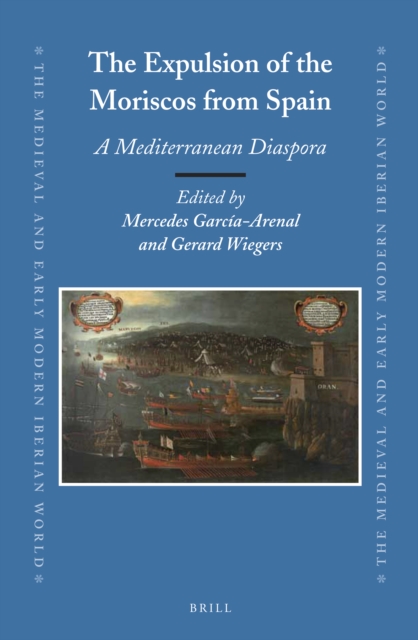
The Expulsion of the Moriscos from Spain
The Expulsion of the Moriscos from Spain offers a multi-perspective study of the forced migration and diaspora of the crypto-Muslim minority in the Mediterranean in the first half of the 17th century.
eBook

\Moors dressed as Moors\ : clothing, social distinction, and ethnicity in early modern Iberia
\"In early modern Iberia, Moorish clothing was not merely a cultural remnant from the Islamic period, but an artefact that conditioned discourses of nobility and social preeminence. In Moors Dressed as Moors, Javier Irigoyen-Garcia draws on a wide range of sources: archival, legal, literary, and visual documents, as well as tailoring books, equestrian treatises, and festival books to reveal the currency of Moorish clothing in early modern Iberian society. Irigoyen-García's insightful and nuanced analyses of Moorish clothing production and circulation shows that as well as being a sign of status and a marker of nobility, it also served to codify social tensions by deploying apparent Islamophobic discourses. Such luxurious value of clothing also sheds light on how sartorial legislation against the Moriscos was not only a form of cultural repression, but also a way to preclude their full integration into Iberian society. Moors Dressed as Moors challenges the traditional interpretations of the value of Moorish clothing in sixteenth and seventeenth-century Spain and how it articulated the relationships between Christians and Moriscos.\"-- Provided by publisher.
Book

Between Christians and Moriscos : Juan de Ribera and religious reform in Valencia, 1568-1614
Ehler's sophisticated yet accessible study of the pluralist diocese of Valencia is a valuable contribution to the study of Catholic reform, moriscos, Christian-Muslim relations in early modern Spain, and early modern Europe.
eBook


Forbidden Passages
During the sixteenth and seventeenth centuries, Spanish authorities restricted emigration to the Americas to those who could prove they had been Catholic for at least three generations. In doing so, they hoped to instill religious orthodoxy in the colonies and believed Muslim converts, or Moriscos, would hamper efforts to convert indigenous people to Catholicism. Nevertheless, Moriscos secretly made the treacherous journey across the ocean, settling in the forbidden territories and influencing the nature of Spanish colonialism. Once landed, Morisco men and women struggled to define and practice their religion or pursue their trades, all while experiencing increasing anxiety about their place in the emerging Spanish empire. Many Moriscos were accused by authorities of descending from Muslims or practicing Islam in secret and turned to the courts to assert their legitimacy.
Forbidden Passagesis the first book to document and evaluate the impact of Moriscos in the early modern Americas. Through close examination of sources that few historians have used-some one hundred cases of individuals brought before the secular, ecclesiastical, and inquisitorial courts-Karoline P. Cook shows how legislation and attitudes toward Moriscos in Spain assumed new forms and meanings in colonial Spanish America. Moriscos became not simply individuals struggling to join a community that was increasingly hostile to them but also symbols that sparked authorities' fears about maintaining religious purity in the face of territorial expansion. Cook reveals how Morisco emigrants shined a light on the complicated question of what it meant to be Spanish in the New World.
eBook


EL BANDOLERISMO MORISCO EN ARAGÓN LOS LLAMADOS “MOROS DE LA VENGANZA” (1588-1589)
El presente artículo analiza el surgimiento, trayectoria y desaparición de la única cuadrilla bandolera morisca que existió en el reino de Aragón, llamada por las autoridades de la época “los moros de la venganza”. Además de la reconstrucción de la historia de este grupo, los objetivos de la investigación han sido, por una parte, dilucidar las causas de su singularidad, en comparación con la proliferación del bandolerismo morisco en otras regiones españolas como Granada o Valencia, y, por otra parte, al mismo tiempo, relativizar la excepcionalidad desde la que se ha tendido a interpretar las acciones de esta peculiar banda.
This article analyses the emergence, trajectory and disappearance of the only Morisco bandit gang that existed in Aragon, known by the Modern Age authorities as “los moros de la venganza”. In addition to reconstructing the history of this group, the aims of the research have been, on the one hand, to elucidate the causes of its singularity, in comparison with the proliferation of Morisco banditry in other Spanish regions such as Granada or Valencia, and, on the other hand, at the same time, to relativize the exceptional nature from which the actions of this gang have tended to be interpreted.
Journal Article