
Catalogue Search | MBRL


Are you sure you want to remove the book from the shelf?

{{itemTitle}}
28
result(s) for
"Mormon authors"
Sort by:


The Columbia sourcebook of Mormons in the United States
This anthology offers rare access to key original documents illuminating Mormon history, theology, and culture in the United States from the nineteenth century to today. Brief introductions describe the theological significance of each text and its reflection of the practices, issues, and challenges that have defined and continue to define the Mormon community. These documents balance mainstream and peripheral thought and religious experience, institutional and personal perspective, and theoretical and practical interpretation, representing pivotal moments in LDS history and correcting decades of misinformation and stereotype. The authors of these documents, male and female, not only celebrate but speak critically and question mainline LDS teachings on sexuality, politics, gender, race, polygamy, and other issues. Selections largely focus on the Salt Lake–based LDS tradition, with a section on the post–Joseph Smith splintering and its creation of a variety of similar yet different Mormon groups. The documents are arranged chronologically within specific categories to capture both the historical and doctrinal development of Mormonism in the United States.
eBook

Faithful Transgressions In The American West
The central issue Bush finds in these works is how their authors have dealt with the authority of Mormon Church leaders. As she puts it in her preface, \"I use the phrase 'faithful transgression' to describe moments in the texts when each writer, explicitly or implicitly, commits herself in writing to trust her own ideas and authority over official religious authority while also conceiving of and depicting herself to be a 'faithful' member of the Church.\" Bush recognizes her book as her own act of faithful transgression. Writing it involved wrestling, she states, \"with my own deeply ingrained religious beliefs and my equally compelling education in feminist theories that mean to liberate and empower women.\" Faithful Transgressions examines a remarkable group of authors and their highly readable and entertaining books. In producing the first significant book-length study of Mormon women's autobiographical writing, Bush rides a wave of memoir publishing and academic interest in autobiography and other life narratives. As she elucidates these works in relation to the religious tradition that played a major role in shaping them, she not only positions them in relation to feminist theory and current work on women's life writings but ties them to the long literary tradition of spiritual autobiography.
eBook

Diné dóó Gáamalii
\"Navajo Latter-day Saints are Diné dóó Gáamalii,\" writes Farina
King, in this deeply personal collective biography. \"We are Diné
who decided to walk a Latter-day Saint pathway, although not always
consistently or without reappraising that decision.\"
Diné dóó Gáamalii is a history of twentieth-century
Navajos, including author Farina King and her family, who have
converted and joined the Church of Jesus Christ of Latter-day
Saints (LDS), becoming Diné dóó Gáamalii-both Diné and LDS. Drawing
on Diné stories from the LDS Native American Oral History Project,
King illuminates the mutual entanglement of Indigenous identity and
religious affiliation, showing how their Diné identity made them
outsiders to the LDS Church and, conversely, how belonging to the
LDS community made them outsiders to their Native community. The
story that King tells shows the complex ways that Diné people
engaged with church institutions in the context of settler colonial
power structures. The lived experiences of Diné in church programs
sometimes diverged from the intentions and expectations of those
who designed them.
In this empathetic and richly researched study, King explores
the impacts of Navajo Latter-day Saints who seek to bridge
different traditions, peoples, and communities. She sheds light on
the challenges and joys they face in following both the Diné
teachings of Si'ąh Naagháì Bik'eh Hózhǫ́ -\"live to old age
in beauty\"-and the teachings of the church.
eBook

Moderata Fonte's Floridoro: Invoking Dante to Refashion the Myth of Circe
In Floridoro (1581), Moderata Fonte exposes literary tropes that undermine women. She revises the narrative of Ulysses so that the original misdeed comes not from Circe but rather from Ulysses himself, who seizes the sorceress's powers and abandons both her and their daughter Circetta. In refashioning the myth, Fonte relies on Dante's representation of Ulysses as fraudulent and cunning in order to challenge the trope of the heroic knight, and she presents the island of Ithaca as another locus of hell, purgatory, and paradise. Her aim is to raise consciousness about the subjugating mechanisms that oppress women, and thus possibly break an ever-repeating infernal cycle.
Journal Article

Seeking Sanctuary
Seeking Sanctuary brings together poignant life stories
from fourteen lesbian, gay, bisexual and transgender (LGBT)
migrants, refugees and asylum seekers living in Johannesburg. The
stories, diverse in scope, chronicle each narrator's arduous
journey to South Africa, and their corresponding movement towards
self-love and self-acceptance. The narrators reveal their personal
battles to reconcile their faith with their sexuality and gender
identity, often in the face of violent persecution, and how they
have carved out spaces of hope and belonging in their new home
country. In these intimate testimonies, the narrators' resilience
in the midst of uncertain futures reveal the myriad ways in which
LGBT Africans push back against unjust and unequal systems.
Seeking Sanctuary makes a critical intervention by showing
the complex interplay between homophobia and xenophobia in South
Africa, and of the state of sexual orientation and gender identity
(SOGI) rights in Africa. By shedding light on the fraught
connections between sexuality, faith and migration, this
ground-breaking project also provides a model for religious
communities who are working towards justice, diversity and
inclusion.
Seeking Sanctuary brings together poignant life stories
from fourteen lesbian, gay, bisexual and transgender (LGBT)
migrants, refugees and asylum seekers living in Johannesburg. The
stories, diverse in scope, chronicle each narrator's arduous
journey to South Africa, and their corresponding movement towards
self-love and self-acceptance. The narrators reveal their personal
battles to reconcile their faith with their sexuality and gender
identity, often in the face of violent persecution, and how they
have carved out spaces of hope and belonging in their new home
country. In these intimate testimonies, the narrators' resilience
in the midst of uncertain futures reveal the myriad ways in which
LGBT Africans push back against unjust and unequal systems.
Seeking Sanctuary makes a critical intervention by showing
the complex interplay between homophobia and xenophobia in South
Africa, and of the state of sexual orientation and gender identity
(SOGI) rights in Africa. By shedding light on the fraught
connections between sexuality, faith and migration, this
ground-breaking project also provides a model for religious
communities who are working towards justice, diversity and
inclusion.
eBook
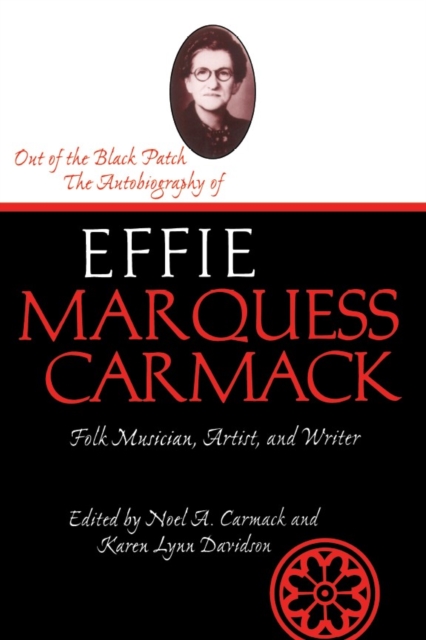
Out Of The Black Patch
Effie Marquess Carmack (1885-1974) grew up in the tobacco-growing region of southern Kentucky known as the Black Patch. As an adult she moved to Utah, back to Kentucky, to Arizona, and finally to California. Economic necessity primarily motivated Effie and her husband's moves, but her conversion to the Mormon Church in youth also was a factor. Throughout her life, she was committed to preserving the rural, southern folkways she had experienced as a child. She and other members of her family were folk musicians, at times professionally, and she also became a folk poet and artist, teaching herself to paint. In the 1940s she began writing her autobiography and eventually also completed a verse adaptation of it and an unpublished novel about life in the Black Patch.
Much of Effie's story is a charming memoir of her vibrant childhood on a poor tobacco farm. She describes a wide variety of folk practices, from healing and crafts to children's games. Her family's life included the backbreaking labor and economic trials of raising tobacco, but it was enriched by a deep familial heritage, communal music, creative play, and traditional activities of many kinds. After the family converted to the Mormon Church, religious study and devotion became another important dimension. Effie's account of Mormon missions contributes to the little-known record of Latter-day Saint attempts to establish a presence in the South.
After marrying, the Carmacks moved west, eventually landing in the Arizona desert, where Effie took up painting in earnest. Her art began to attract modest attention, which brought exhibits, awards, and a new career teaching others what she had taught herself. After the Carmacks later retired to Atascadero, California, Effie became a more active and public folk singer as well.
eBook

Out of the Black Patch
Effie Marquess Carmack (1885-1974) grew up in the tobacco-growing region of southern Kentucky known as the Black Patch. As an adult she moved to Utah, back to Kentucky, to Arizona, and finally to California. Economic necessity primarily motivated Effie and her husband's moves, but her conversion to the Mormon Church in youth also was a factor. Throughout her life, she was committed to preserving the rural, southern folkways she had experienced as a child. She and other members of her family were folk musicians, at times professionally, and she also became a folk poet and artist, teaching herself to paint. In the 1940s she began writing her autobiography and eventually also completed a verse adaptation of it and an unpublished novel about life in the Black Patch.Much of Effie's story is a charming memoir of her vibrant childhood on a poor tobacco farm. She describes a wide variety of folk practices, from healing and crafts to children's games. Her family's life included the backbreaking labor and economic trials of raising tobacco, but it was enriched by a deep familial heritage, communal music, creative play, and traditional activities of many kinds. After the family converted to the Mormon Church, religious study and devotion became another important dimension. Effie's account of Mormon missions contributes to the little-known record of Latter-day Saint attempts to establish a presence in the South.After marrying, the Carmacks moved west, eventually landing in the Arizona desert, where Effie took up painting in earnest. Her art began to attract modest attention, which brought exhibits, awards, and a new career teaching others what she had taught herself. After the Carmacks later retired to Atascadero, California, Effie became a more active and public folk singer as well.
eBook
A Newly Discovered Greek Father
A critical edition an ancient manuscript, which has resulted in discovery of Cassian the Sabaite, whom Medieval forgery extinguished, by attributing heavily interpolated Latin translations of this Greek original to a figment called 'John Cassian'. This erudite Sabaite intellectual is Pseudo-Caesarius and the author of Pseudo Didymus' De Trinitate.
eBook

Strategies of Representation, Relationship, and Resistance: British Women Travelers and Mormon Plural Wives, ca. 1870-1890
During the 1870s and 1880s, several British women writers traveled by transcontinental railroad across the American West via Salt Lake City, Utah, the capital of the Church of Jesus Christ of Latter-day Saints, or Mormons. These women subsequently wrote books about their travels for a home audience with a taste for adventures in the American West, and particularly for accounts of Mormon plural marriage, which was sanctioned by the Church before 1890. \"The plight of the Mormon woman,\" a prominent social reform and literary theme of the period, situated Mormon women at the center of popular representations of Utah during the second half of the nineteenth century. \"The Mormon question\" thus lends itself to an analysis of how a stereotyped subaltern group was represented by elite British travelers. These residents of western American territories, however, differed in important respects from the typical subaltern subjects discussed by Victorian travelers. These white, upwardly mobile, and articulate Mormon plural wives attempted to influence observers' representations of them through a variety of narrative strategies. Both British women travel writers and Mormon women wrote from the margins of power and credibility, and as interpreters of the Mormon scene were concerned to established their representational authority.
Journal Article