
Catalogue Search | MBRL


Are you sure you want to remove the book from the shelf?

{{itemTitle}}
18
result(s) for
"Mormons Utah Biography."
Sort by:


Emma Lee
Now in its eighth printing,EmmaLee is the classic biography of one of John D. Lee's plural wives. Emma experienced the best and worst of polygamy and came as near to the Mountain Meadows Massacre as anyone could without participating firsthand.
eBook

Before the Manifesto
Mary Lois Walker Morris was a Mormon woman who challenged both American ideas about marriage and the U.S. legal system. Before the Manifesto provides a glimpse into her world as the polygamous wife of a prominent Salt Lake City businessman, during a time of great transition in Utah. This account of her life as a convert, milliner, active community member, mother, and wife begins in England, where her family joined the Mormon church, details her journey across the plains, and describes life in Utah in the 1880s. Her experiences were unusual as, following her first husband's deathbed request, she married his brother, as a plural wife, in the Old Testament tradition of levirate marriage.Mary Morris's memoir frames her 1879 to 1887 diary with both reflections on earlier years and passages that parallel entries in the day book, giving readers a better understanding of how she retrospectively saw her life. The thoroughly annotated diary offers the daily experience of a woman who kept a largely self-sufficient household, had a wide social network, ran her own business, wrote poetry, and was intellectually curious. The years of \"the Raid\" (federal prosecution of polygamists) led Mary and Elias Morris to hide their marriage on \"the underground,\" and her to perjury in court during Elias's trial for unlawful cohabitation. The book ends with Mary Lois's arrival at the Salt Lake Depot after three years in exile in Mexico with a polygamist colony.
eBook

Alma Richards
Alma Richards, as an unsung high school student, surprisingly set an Olympic record for the high jump in the 1912 Stockholm Olympics. He was the only native Utahn and member of the LDS church to win an Olympic gold medal in the twentieth century. After a stellar collegiate track career that saw him lead Cornell to three national championships, Richards for two decades reigned as America’s most accomplished multiple-event track and field athlete, winning national titles in five different events. Despite his prominence in the history of American sports, this is the first treatment of his athletic career and personal life. The book traces Richards from his boyhood in rural Parowan, Utah, to Cornell and through his service as an officer in World War I and his teaching career in Los Angeles. His story is that of a remarkable athlete, but also that of a man struggling for personal fulfillment while endeavoring to retain his Mormon heritage amid his changing religious circumstances and participation. More than a century has passed since Alma Richards won an Olympic gold medal, yet this story about man and sport—the drive to excel, victory as validation of hard work, the quest for public recognition and, ultimately, the achievement of self-identity and self-satisfaction—still resonates today.
eBook

\Liberty to the Downtrodden\
Thomas L. Kane (1822-1883), a crusader for antislavery, women's rights, and the downtrodden, rose to prominence in his day as the most ardent and persuasive defender of Mormons' religious liberty. Though not a Mormon, Kane sought to defend the much-reviled group from the \"Holy War\" waged against them by evangelical America. His courageous personal intervention averted a potentially catastrophic bloody conflict between federal troops and Mormon settlers in the now nearly forgotten Utah War of 1857-58.
Drawing on extensive, newly available archives, this book is the first to tell the full story of Kane's extraordinary life. The book illuminates his powerful Philadelphia family, his personal life and eccentricities, his reform achievements, his place in Mormon history, and his career as a Civil War general. Further, the book revises previous understandings of nineteenth-century reform, showing how Kane and likeminded others fused Democratic Party ideology, anti-evangelicalism, and romanticism.
eBook

Gravity Hill
“The sound of parenthood is the sigh.” So begins Gravity Hill, written from the perspective of a new father seeking hope, beauty, and meaning in an uncertain world. Many memoirs recount the author’s experiences of growing up and struggling with demons; Werner’s shows how old demons sometimes return on the heels of something as beautiful as children. Werner’s memoir is about growing up, getting older, looking back, and wondering what lies ahead—a process that becomes all the more complicated and intense when parenting is involved. Moving backward and forward between past, present, and future, Gravity Hill does not delineate time so much as collapse it.
Werner narrates his struggle growing up in suburban Utah as anon-Mormon and what it took for him, his siblings, and his friends to feel like they belonged. Bonding in separation, they indulged in each other, in natural and urban landscapes, and sometimes in the destructive behaviors that are the native resort of outsidersincluding promiscuous and occasionally violent sexual behavior—and for some, paths to death and suicide. Gravity Hill is the story of the author’s descent into and eventual emergence from his dysfunction and into a newfound life. Infused with humor, honesty, and reflection, this literary memoir will resonate with readers young and old.
eBook

The Guardian Poplar
When Barney Clark received the Jarvik-7 artificial heart in 1983 and Cold Fusion came under fire in 1989, Chase Peterson, as the University of Utah president, was inevitably pulled into these campus events. While these episodes may be the best known in Peterson’s professional history, they are certainly not the only stories that make his autobiography worth reading.
The Guardian Poplar tells of a man who grew up in small-town Utah and carried his pioneer and Mormon heritage to a New England prep school and later to Harvard. He then returned to Utah as a doctor, but unexpectedly found himself back at Harvard as its dean of admissions, handling issues such as the Vietnam War and racial and gender reform. The book explains how Peterson’s home state recruited him back to become an administrator at the University of Utah and how he would eventually become the university president, taking on new issues and challenges. Peterson recounts these years by drawing on anecdotes that recall the people he served and the moments that brought his life meaning.
This autobiography is a compelling account of how Peterson has managed to balance family and career, handle the tensions that have arisen between his faith and his scientific training, and remain solid in the face of his newest challenge—cancer. The book’s engaging prose and honest reflections are sure to intrigue and inspire readers who know the man well, as well as those readers who simply want to know a man who can be described as dedicated, faithful, hardworking, and hopeful about the future.
“When I first met Chase Peterson as a Harvard freshman—along with our joint friend and brother David Evans—something deeply touched me. It was not only his sincere smile and open embrace but also a sense that here was a kind and courageous man comfortable in his own skin, secure in who he was yet eager to encounter new persons, new experiences, and new challenges. . . . He was from Utah but in New England, a Mormon in old Harvard, and a medical doctor in the deanship of admissions. Little did I know that his journey would enhance and enrich my own—owing to his critical allegiance to his family, his faith, his friends, and to his citizenship of country and world. His prophetic witness at Harvard in the turbulent ‘60s and ‘70s, his promotion of black priesthood in the Mormon church, his support of antiapartheid protests in the ‘80s, and his steadfast defense of academic freedom in the Cold Fusion controversy in the early ‘90s all express his quiet and humble effort to be true to himself—a self grounded in, but
not limited by, a rich Mormon tradition.”—from the foreword by Cornel West
eBook

Navajo Tradition, Mormon Life
Born in the early 1940s in northern Arizona’s high country desert, Jim Dandy began life imbued with the traditions of the Navajo people. Raised by his father and grandfather—both medicine men—and a grandmother steeped in Navajo practices, he embraced their teachings and followed in their footsteps. But attending the LDS Placement program in northern Utah changed his life’s course when he became a member of the Mormon Church. Following graduation from high school, Jim served an LDS mission among his people, obtained a bachelor’s degree, and entered the work force in southeastern Utah as a career counselor, teacher, and community advocate who improved educational opportunities on the Navajo Reservation.
Jim has led a life of service and teaching. He maintains the traditional philosophy with which he was raised and the Mormon beliefs that he learned and continues to follow; his life reflects the values inherent in these two different worlds. Readers interested in Navajo philosophy will find his blend of these two distinct views fascinating, while others will better understand the effects of the controversial placement program on the life of one individual. However, this is primarily the warm story of a man’s life among his people and his love for them and their culture.
eBook

Shifting Borders and a Tattered Passport
The life of a Mormon intellectual in the secular academic community is likely to include some contradictions between belief, scholarship, and the changing times. In his memoir, Armand L. Mauss recounts his personal and intellectual struggles—inside and outside the LDS world—from his childhood to his days as a graduate student at UC Berkeley in the 1960s through his many years as a professor.
As an important and influential observer and author in the Mormon intellectual world, Mauss has witnessed how, in attempting to suppress independent and unsponsored scholarship during the final decades of the twentieth century, LDS leaders deliberately marginalized important intellectual support and resources that could have helped, in the twenty-first century, to refurbish the public image of the church. As a sociologist, he notes how the LDS Church, as a large, complex organization, strives to adjust its policies and practices in order to maintain an optimal balance between unique, appealing claims on the one hand and public acceptance on the other. He also discusses national and academic controversies over the New Religious Movements of the 1960s and 1970s. Writing in clear language, Mauss shows how he has navigated the boundaries where his faith and academic life intersect, and reveals why a continuing commitment to the LDS Church must be a product of choice more than of natural or supernatural “proof.”
eBook
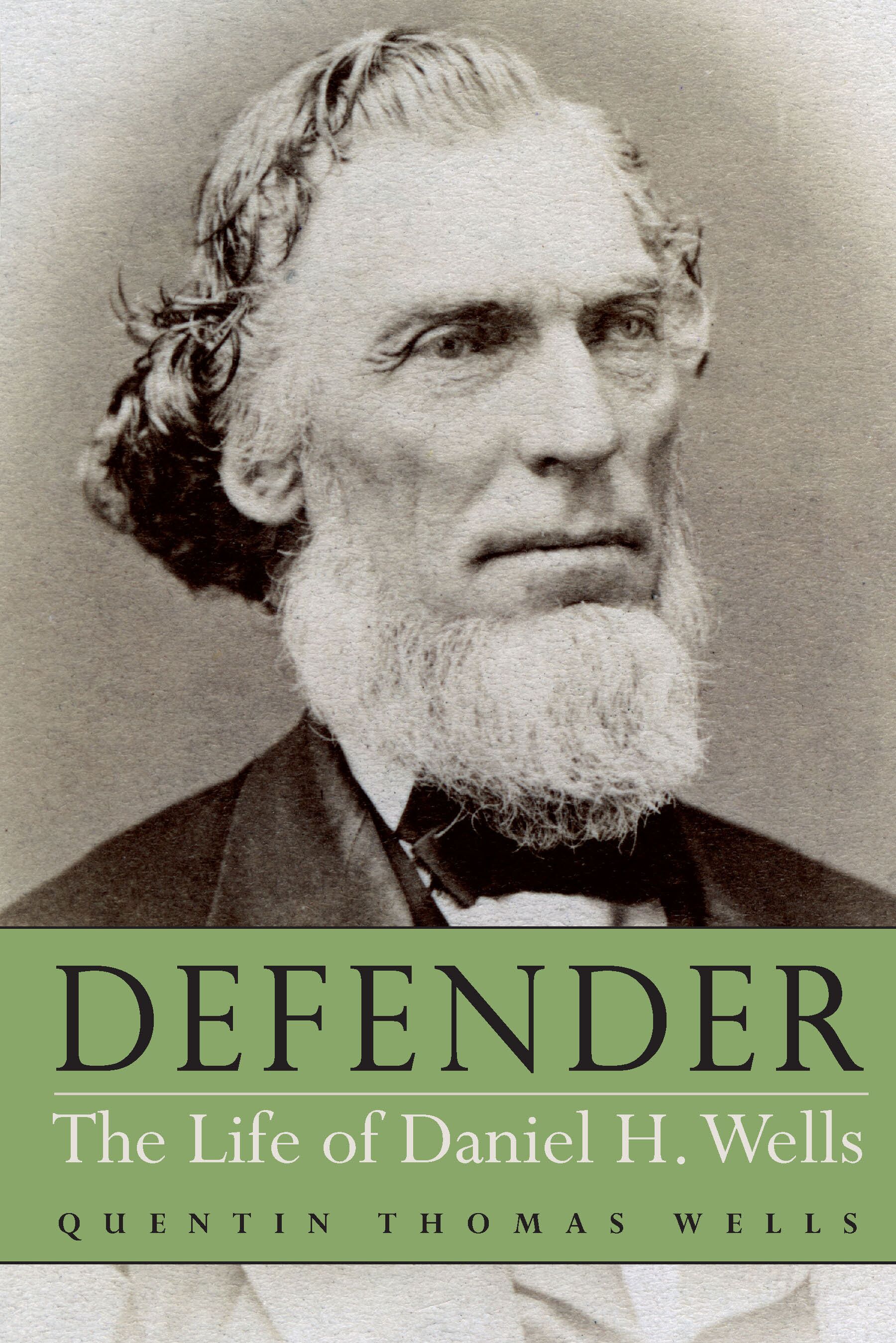
Defender
Defenderis the first and only scholarly biography of Daniel H. Wells, one of the important yet historically neglected leaders among the nineteenth-century Mormons-leaders like Heber C. Kimball, George Q. Cannon, and Jedediah M. Grant. An adult convert to the Mormon faith during the Mormons' Nauvoo period, Wells developed relationships with men at the highest levels of the church hierarchy, emigrated to Utah with the Mormon pioneers, and served in a series of influential posts in both church and state.
Wells was known especially as a military leader in both Nauvoo and Utah-he led the territorial militia in four Indian conflicts and a confrontation with the US Army (the Utah War). But he was also the territorial attorney general and obtained title to all the land in Salt Lake City from the federal government during his tenure as the mayor of Salt Lake City. He was Second Counselor to Brigham Young in the LDS Church's First Presidency and twice served as president of the Mormon European mission. Among these and other accomplishments, he ran businesses in lumbering, coal mining, manufacturing, and gas production; developed roads, ferries, railroads, and public buildings; and presided over a family of seven wives and thirty-seven children.
Wells witnessed and influenced a wide range of consequential events that shaped the culture, politics, and society of Utah in the latter half of the nineteenth century. Using research from relevant collections, sources in public records, references to Wells in the Joseph Smith papers, other contemporaneous journals and letters, and the writings of Brigham Young, Quentin Thomas Wells has created a serious and significant contribution to Mormon history scholarship.
eBook