
Catalogue Search | MBRL


Are you sure you want to remove the book from the shelf?

{{itemTitle}}
5,431
result(s) for
"Mort"
Sort by:


Capital Punishment, Clemency and Colonialism in Papua New Guinea, 1954–65
This study builds on a close examination of an archive of files that advised the Australian Commonwealth Executive on Papua New Guineans found guilty of capital offences in PNG between 1954 and 1965. These files provide telling insight into conceptions held by officials at different stages of the justice process into justice, savagery and civilisation, and colonialism and Australia's role in the world. The particular combination of idealism and self-interest, liberalism and paternalism, and justice and authoritarianism axiomatic to Australian colonialism becomes apparent and enables discussion of Australia’s administration of PNG in the lead-up to the acceptance of independence as an immediate policy goal. The files show Australia gathering the authority to grant mercy into the hands of the Commonwealth and then devolving it back to the territories. In these transitions, the capital case review files show the trajectory of Australian colonialism during a period when the administration was unsure of the duration and nature of its future relationship with PNG.
eBook

Death note
Light Yagami is an ace student with great prospects--and he's bored out of his mind. But all that changes when he finds the Death Note, a notebook dropped by a rogue Shinigami (death god). Any human whose name is written in the notebook dies, and now Light has vowed to use the power of the Death Note to rid the world of evil. Will Light's noble goal succeed, or will the Death Note turn him into the very thing he fights against?
BOOK

The Gothic and death
The Gothic and death offers the first ever published study
devoted to the subject of the Gothic and death across the
centuries. It investigates how the multifarious strands of the
Gothic and the concepts of death, dying, mourning and
memorialisation ('the Death Question') - have intersected and been
configured cross-culturally to diverse ends from the mid-eighteenth
century to the present day. Drawing on recent scholarship in such
fields as Gothic Studies, film theory, Women's and Gender Studies
and Thanatology Studies, this interdisciplinary collection of
fifteen essays by international scholars combines an attention to
socio-historical and cultural contexts with a rigorous close
reading of works, both classic and lesser known. This area of
enquiry is considered by way of such popular and uncanny figures as
corpses, ghosts, zombies and vampires, and across various cultural
and literary forms such as Graveyard Poetry, Romantic poetry,
Victorian literature, nineteenth-century Italian and Russian
literature, Anglo-American film and television, contemporary Young
Adult fiction and Bollywood film noir.
eBook

Nothing to fear : demystifying death to live more fully
\"What if we didn't consider death the worst possible outcome? What if we discussed it honestly, embraced hospice care, and prepared for the end of our lives with hope and acceptance? In this compassionate and knowledgeable guide, TikTok star Julie McFadden--known online as 'Hospice Nurse Julie'--shares the valuable lessons she's learned in her fifteen years as an RN in the ICU and in hospice\"-- Provided by publisher.
Book
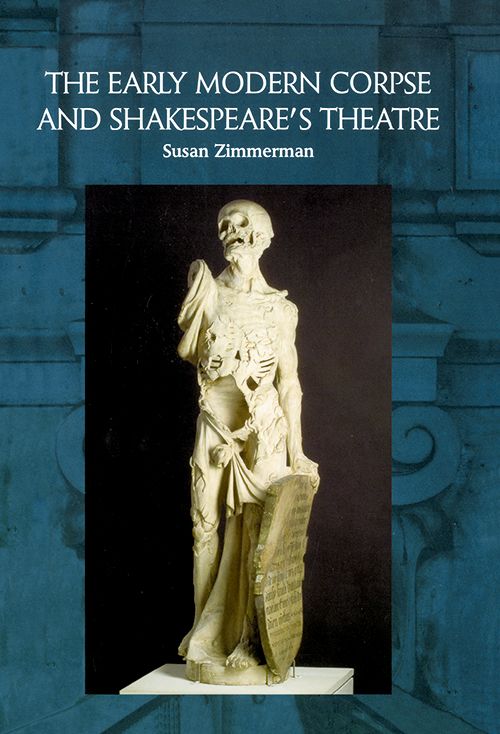
The Early Modern Corpse and Shakespeare's Theatre
Within a theoretical framework that makes use of history, psychoanalysis and anthropology, The Early Modern Corpse and Shakespeare's Theatre explores the relationship of the public theatre to the question of what constituted the 'dead' in early modern English culture.Susan Zimmerman argues that concepts of the corpse as a semi-animate, generative and indeterminate entity were deeply rooted in medieval religious culture. Such concepts ran counter to early modern discourses that sought to harden categorical distinctions between body/spirit, animate/inanimate - in particular, the attacks of Reformists on the materiality of 'dead' idols, and the rationale of the new anatomy for publicly dissecting 'dead' bodies. Zimmerman contends that within this context, theatrical representations of the corpse or corpse/revenant - as seen here in the tragedies of Shakespeare and his contemporaries - uniquely showcased the theatre's own ideological and performative agency. Features*Original in its conjunction of critical theory (Bataille, Kristeva, Lacan, Benjamin) with an historical account of the shifting status of the corpse in late medieval and early modern England.*The first study to demonstrate connections between the meanings attached to the material body in early modern Protestantism, the practice of anatomical dissection, and the English public theatre.*Strong market appeal to scholars and graduate students with interests in the theatre of Shakespeare and his contemporaries, early modern religion and science, and literary theory. *Relevant to advanced undergraduates taking widely taught courses in Shakespeare and in Renaissance drama.
eBook

Death in classical Hollywood cinema
Boaz Hagin carries out a philosophical examination of the issue of death as it is represented and problematized in Hollywood cinema of the classical era (1920s-1950s) and in later mainstream films, looking at four major genres: the Western, the gangster film, melodrama and the war film.
Book

The Final Curtain
This is a book about dying, or, more accurately, about the representation of dying in the theatre. Its chief concern is how actors undertook to translate words and concepts into forms legible and significant to an audience. It deals with the ways in which playwrights wrote about death and attitudes towards death in their cultures. Nevertheless, the emphasis is on the practice of acting.
Before the nineteenth century, when death began to be confined behind closed doors, it was widely available as a spectacle. Death and the suffering that preceded it were in plain sight; no effort was made to hide the diseased and moribund. The absence of medical means of alleviating pain or of hygienic measures meant that the most distressing and abhorrent aspects of dying were out in the open. The contempt for human life shown by the law-courts and the death penalty for the slightest offence occasioned frequent and enthusiastically attended public executions. In addition, the Church and religion generally hoped, through elaborate rites and ceremonies, both before and after death, to invest it with an edifying value that could be extended for the greater good. The sacred and social ceremony makes a transition into an aesthetic and political performance, marking a more modern frame of mind.
Neoclassic decorum eschewed such displays; and, after a heyday of spectacular dying on the nineteenth-century stage, critics again began to insist on more moderate displays. This conformed to the growing emphasis on mental processes and psychological complexity. However, it runs counter to the theatre’s need for high color, extreme situations and fanciful invention. Denied house-room in literary drama, these desiderata found a welcome haven in the various manifestations of performance art.
eBook