
Catalogue Search | MBRL


Are you sure you want to remove the book from the shelf?

{{itemTitle}}
227
result(s) for
"Motherhood Fiction"
Sort by:

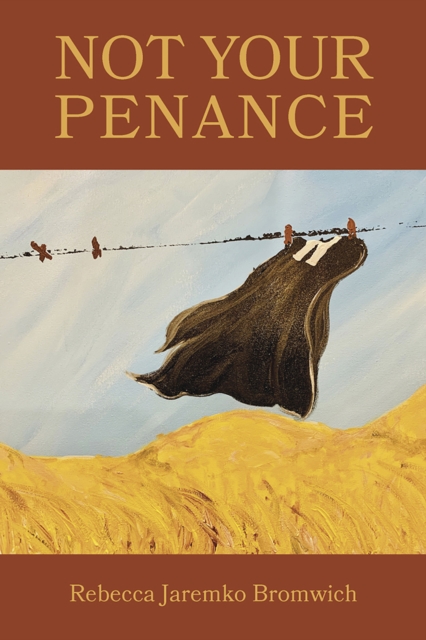
Not Your Penance
One quiet October morning, in a suburban neighbourhood of Cincinnati, Ohio, after awakening from a recurring nightmare, 41-year-old stay-at-home mom and social media aficionado Enid Kimble receives two messages, one a disquieting phone call about her mother, and the other a newspaper clipping in a plain envelope in her mailbox, that start to unravel her carefully woven-together world. These two startling messages force Enid to grapple with her past and future in new ways. In a story that weaves together crime, legal drama, romance, adolescence, and motherhood, Enid Kimble struggles to come to terms with her past and makes life-altering decisions about her future. This tense, layered novel debut by lawyer and legal scholar Rebecca Jaremko Bromwich, with the gifted and troubled character of Enid at its centre, spins an intriguing story about motherhood, love, law, coming to terms with the complexities of our pasts, and claiming our futures. In doing so, the author offers invigorating and original engagements with law, mythology, feminism, and motherhood that will resonate with legal professionals, academics, and the general public alike. Poignant and funny, the story weaves together scrupulously accurate legal narrative and compelling personal drama.th law, mythology, feminism, and motherhood that will resonate with legal professionals, academics, and the general public alike. Poignant and funny, the story weaves together scrupulously accurate legal narrative and compelling personal drama.th law, mythology, feminism, and motherhood that will resonate with legal professionals, academics, and the general public alike. Poignant and funny, the story weaves together scrupulously accurate legal narrative and compelling personal drama.th law, mythology, feminism, and motherhood that will resonate with legal professionals, academics, and the general public
alike. Poignant and funny, the story weaves together scrupulously accurate legal narrative and compelling personal drama.
eBook

The birth of love : a novel
In Vienna, 1865, a phyisican is ridiculed for his claim that unwashed doctor's hands are the cause of childhood fever. In present day London, a young woman plans for a home birth, unprepared for the trials she is about to endure. Somewhere in 2153, when humans are birthed and raised in breeding farms, a woman is on trial for concealing a pregnancy.--from publisher's description.
Book


Our Mothers, Our Powers, Our Texts
\"Washington writes supple and thoughtful prose and creatively integrates African and African-derived terminology, which never distract the reader. I consider Our Mothers, Our Powers, Our Texts not only a brilliant study, but also a model to be emulated.\" -- Ousseynou B. Traore, William Patterson UniversityÀjé is a Yoruba word that signifies a spiritual power of vast potential, as well as the human beings who exercise that power. Although both men and women can have Àjé, its owners and controllers are women, the literal and cosmic Mothers who are revered as the gods of society. Because of its association with female power, its invisibility and profundity, Àjé is often misconstrued as witchcraft. However, as Teresa N. Washington points out in Our Mothers, Our Powers, Our Texts, Àjé is central to the Yoruba ethos and cosmology. Not only does it underpin the concepts of creation and creativity, but as a force of justice and retribution, Àjé is essential to social harmony and balance. As Africans were forced into exile and enslavement, they took Àjé with them and continued its work of creating, destroying, harming, and healing in the New World.Washington seeks out Àjé's subversive power of creation and re-creation in a diverse range of Africana texts, from both men and women, from both oral and contemporary literature, and across space and time. She guides readers to an understanding of the symbolic, methodological, and spiritual issues that are central to important works by Africana writers but are rarely elucidated by Western criticism. She begins with an examination of the ancient forms of Àjé in Yoruba culture, which creates a framework for innovative readings of important works by Africana writers, including Zora Neale Hurston, Toni Morrison, Ben Okri, Wole Soyinka, Jamaica Kincaid, and Ntozake Shange. This rich analysis will appeal to readers of
Africana literature, African religion and philosophy, feminist studies, and comparative literature.
eBook

The leftover woman : a novel
\"An evocative family drama and a riveting mystery about the ferocious pull of motherhood for two very different women in New York City\"-- Provided by publisher.
Book

On the Limits of \Playing Crazy\: Madness and Motherhood in Toni Morrison's Beloved
This essay contributes to scholarship on twentieth-century African American literature which thematizes Black women's madness. In interrogating antebellum Black madness as at once threatening and emancipatory, I undermine marginalization of the \"mad Black woman\" and the associated occlusions she represents, necessarily expanding the interpretive frameworks by which we most commonly account for Black women's political consciousness. One such mode of consciousness—\"playing crazy\"—entails a bevy of activities and behaviors discharged by historically disempowered groups to alter, even if temporarily, existing terms of intra-racial and interracial belonging. Analyzing Toni Morrison's neo-slave narrative Beloved (1988) as a site of departure from representations of \"playing crazy\" in contemporary African American vernacular traditions, drama, short and long fiction, I draw attention to contexts and consequences of gendered performances of \"affliction.\" In Morrison's hands, the persona of the \"mad Black woman\" contributes to a unique legacy of Black struggle and Black being.
Journal Article

Charlotte Markham and the House of Darkling
\"When the nanny to the young Darrow boys is found mysteriously murdered on the outskirts of the village of Blackfield, Charlotte Markham, the recently hired governess, steps in to take over their care. During an outing in the forest, they find themselves crossing over into The Ending, \"the place for the Things Above Death,\" where Lily Darrow, the late mother of the children, has been waiting. She invites them into the House of Darkling, a wondrous place filled with enchantment, mystery, and strange creatures that appear to be, but are not quite, human. However, everything comes with a price, and as Charlotte begins to understand the unspeakable bargain Mrs. Darrow has made for a second chance at motherhood, she uncovers a connection to the sinister occurrences in Blackfield and enters into a deadly game with the master of Darkling -- one whose outcome will determine the fate of not just the Darrows, but the world itself ...\" P. [4] of cover.
Book

Representaciones del rol de la (no)maternidad en la literatura femenina coreana contemporánea: “la madre sin hijo”
En Corea, donde dar a luz a un hijo varón era, tradicionalmente, la principal obligación de la mujer, indagar en la imagen de la “madre sin hijo” permite exponer los prejuicios sobre los que se asienta la institución de la maternidad. El presente trabajo plantea el análisis de la representación de la (no)maternidad en la obra de dos escritoras coreanas del siglo XX, Lee Sun-hee y O Jeonghui, en cuyos textos aparecen madres que han perdido a su hijo y las repercusiones que ello conlleva en las vidas que se ven privadas del rol que la misma sociedad les impone.
Journal Article