
Catalogue Search | MBRL


Are you sure you want to remove the book from the shelf?

{{itemTitle}}
9
result(s) for
"Motion picture industry -- Social aspects -- China -- History"
Sort by:

Art, Politics, and Commerce in Chinese Cinema
Art, politics, and commerce are intertwined everywhere, but in China the interplay is explicit, intimate, and elemental, and nowhere more so than in the film industry. Understanding this interplay in the era of market reform and globalization is essential to understanding mainland Chinese cinema. This interdisciplinary book provides a comprehensive reappraisal of Chinese cinema, surveying the evolution of film production and consumption in mainland China as a product of shifting relations between art, politics, and commerce. Within these arenas, each of the twelve chapters treats a particular history, development, genre, filmmaker or generation of filmmakers, adding up to a distinctively comprehensive rendering of Chinese cinema. The book illuminates China’s changing state-society relations, the trajectory of marketization and globalization, the effects of China’s stark historical shifts, Hollywood’s role, the role of nationalism, and related themes of interest to scholars of Asian studies, cinema and media studies, political science, sociology, comparative literature and Chinese language. Contributors include Ying Zhu, Stanley Rosen, Seio Nakajima, Zhiwei Xiao, Shujen Wang, Paul Clark, Stephen Teo, John Lent, Ying Xu, Yingjin Zhang, Bruce Robinson, Liyan Qin, and Shuqin Cui.
eBook

China on film
Leading scholar Paul G. Pickowicz traces the dynamic history of Chinese filmmaking and discusses its course of development from the early days to the present. Moving decade by decade, he explores such key themes as the ever-shifting definitions of modern marriage in 1920s silent features, East-West cultural conflict in the movies of the 1930s, the strong appeal of the powerful melodramatic mode of the 1930s and 1940s, the polarizing political controversies surrounding Chinese filmmaking under the Japanese occupation of Shanghai in the 1940s, and the critical role of cinema during the bloody civil war of the late 1940s. Pickowicz then considers the challenging Mao years, including chapters on legendary screen personalities who tried but failed to adjust to the new socialist order in the 1950s, celebrities who made the sort of artistic and political accommodations that would keep them in the spotlight in the post-revolutionary era, and insider film professionals of the early 1960s who actively resisted the most extreme forms of Maoist cultural production. The book concludes with explorations of the highly cathartic films of the early post-Mao era, edgy postsocialist movies that appeared on the eve of the Tiananmen demonstrations of 1989, the relevance of the Eastern European “velvet prison” cultural production model, and the rise of underground and independent filmmaking beginning in the 1990s. Throughout its long history of film production, China has been embroiled in a seemingly unending series of wars, revolutions, and jarring social transformations. Despite daunting censorship obstacles, Chinese filmmakers have found ingenious ways of taking political stands and weighing in—for better or worse—on the most explosive social, cultural, and economic issues of the day. Exploring the often gut-wrenching controversies generated by their work, Pickowicz offers a unique and perceptive window on Chinese culture and society.
eBook


The poetics of Chinese cinema
This book examines the aesthetic qualities of particular Chinese-language films and the rich artistic traditions from which they spring.It brings together leading experts in the field, and encompasses detailed and wide-ranging case studies of films such as Hero , House of Flying Daggers , Spring in a Small Town , 24 City , and The Grandmaster.
eBook
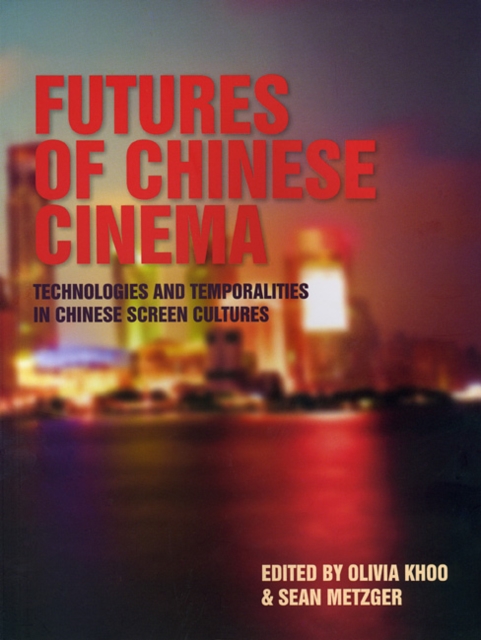
Futures of chinese cinema
In recent years, Chinese film has garnered worldwide attention, and this interdisciplinary collection investigates how new technologies, changing production constraints, and shifting viewing practices have shaped perceptions of Chinese screen cultures. For the first time, international scholars from film studies, media studies, history and sociology have come together to examine technology and temporality in Chinese cinema today.
Futures of Chinese Cinema takes an innovative approach, arguing for a broadening of Chinese screen cultures to account for new technologies of screening, from computers and digital video to smaller screens (including mobile phones). It also considers time and technology in both popular blockbusters and independent art films from mainland China, Taiwan, Hong Kong, and the Chinese diasporas. The contributors explore transnational connections, including little-discussed Chinese-Japanese and Sino-Soviet interactions. With an exciting array of essays by established and emerging scholars, Futures of Chinese Cinema represents a fresh contribution to film and cultural studies.
eBook
MoneyWatch Report
The family that owns the company that makes OxyContin is calling a Massachusetts' lawsuit false and misleading. This is the Sackler family's first court response to allegations that individual family members helped fuel the deadly opioid epidemic. Attorneys for the Sackler family say the claims must be dismissed. Massachusetts was among the first state government to sue the family as well as the company last year.
Transcript

Cinema, law, and the state in Asia
This book explores the intersections of film, justice, and the state in comparative perspective across a range of major Asian countries, including India, China, Japan, Korea, the Philippines, and Vietnam. The contributing authors cross the conventional border between the analysis of on-screen and off-screen intersections of law and cinema.
eBook

Cartography of Catastrophe: Pre-Colonial Surveys, Post-Colonial Vampires, and the Plight of Korean Modernity
This article takes a look at a trajectory of the South Korean cinema from its contentious emergence to its current global dissemination. The cinematic instances of the pre-colonial Great Han Empire (1897-1910) and contemporary post-colonial Republic of Korea (1948—present) will be compared and the negotiations between the national and the transnational, which have run from the catastrophic and the cartographical as South Korea maintains a state of emergency, will be discussed. This discourse is also a way in which we can revisit the scenes of the IMF crisis, arguably bear similarities to the shock experienced during the Great Han Empire, is cited as evidence of the threats that ((big countries\" such as China and America could pose to unification.
Journal Article

Transnationalism and Translocality in Chinese Cinema
In a short period, overseas sales of Chinese films grew from RMB 550 million in 2003 to 2.528 billion in 2008. [...] new box office records for domestic films were established one after another, in early 2002, Big Shot's Funeral Da wan; Feng Xiaogang, 2001 claimed an unprecedented RMB 42 million; in 2003, Hero ïngxiong; Zhang Yimou, 2002 raked in RMB 250 million in domestic exhibition.
Journal Article