
Catalogue Search | MBRL


Are you sure you want to remove the book from the shelf?

{{itemTitle}}
420,021
result(s) for
"Motion picture industry in motion pictures"
Sort by:

Casting a giant shadow : the transnational shaping of Israeli cinema
\"Film came to the territory that eventually became Israel not long after the medium was born. Casting a Giant Shadow is a collection of articles that embraces the notion of transnationalism to consider the limits of what is \"Israeli\" within Israeli cinema. As the State of Israel developed, so did its film industries. Moving beyond the early films of the Yishuv, which focused on the creation of national identity, the industry and its transnational ties became more important as filmmakers and film stars migrated out and foreign films, filmmakers, and actors came to Israel to take advantage of high-quality production values and talent. This volume, edited by Rachel Harris and Dan Chyutin, uses the idea of transnationalism to challenge the concept of a singular definition of Israeli cinema. Casting a Giant Shadow offers a new understanding of how cinema has operated artistically and structurally in terms of funding, distribution, and reception. The result is a thorough investigation of the complex structure of the transnational and its impact on national specificity when considered on the global stage\"-- Provided by publisher.
BOOK
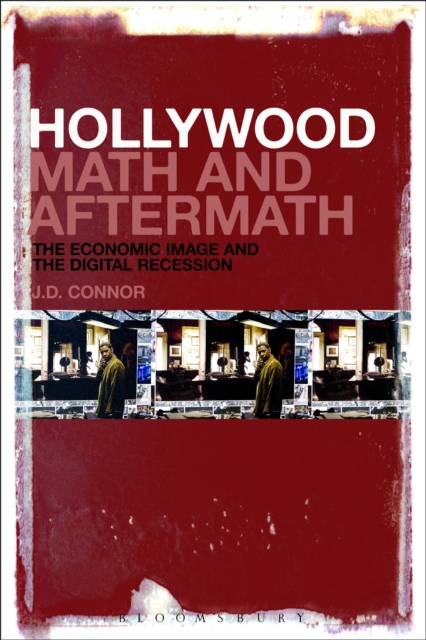
Hollywood Math and Aftermath
Money is Hollywood’s great theme—but money laundered into something else, something more. Money can be given a particular occasion and career, as box office receipts, casino winnings, tax credits, stock prices, lotteries, inheritances. Or money can become number, and numbers can be anything: pixels, batting averages, votes, likes. Through explorations of all these and more, J.D. Connor’s Hollywood Math and Aftermath provides a stimulating and original take on “the equation of pictures,” the relationship between Hollywood and economics since the 1970s. Touched off by an engagement with the work of Gilles Deleuze, Connor demonstrates the centrality of the economic image to Hollywood narrative. More than just a thematic study, this is a conceptual history of the industry that stretches from the dawn of the neoclassical era through the Great Recession and beyond. Along the way, Connor explores new concepts for cinema studies: precession and recession, pervasion and staking, ostension and deritualization. Enlivened by a wealth of case studies—from The Big Short and The Wolf of Wall Street to Equity and Blackhat, from Moneyball to 12 Years a Slave, Titanic to Lost, The Exorcist to WALLE, Déjà Vu to Upstream Color, Contagion to The Untouchables, Ferris Bueller to Pacific Rim, The Avengers to The Village—Hollywood Math and Aftermath is a bravura portrait of the industry coming to terms with its own numerical underpinnings
eBook


Beyond the looking glass
As living subjects rather than static icons, studio-era Hollywood actresses actively negotiated a balance between their public personas, film roles, and corporeal presence. The contemporary audience's engagement with the experience of these actresses unsettles the traditional model of narcissistic identification, which divides the off-screen spectator from his/her on-screen ideal. Exploring the fan's desire for a material connection to the performer - as well as the star's own dialogue between embodied experience and idealized image -Beyond the Looking Glasstraces on- and off-screen representations of narcissistic femininity in classical Hollywood through studies of stars like Greta Garbo, Ava Gardner, and Marilyn Monroe. Merging historical and theoretical concerns, with particular attention to the resonance of golden-age Hollywood in new media, this book explores the movie screen as a medium of shared experience between spectator and star.
eBook


Hanan al-cinema : affections for the moving image
An examination of experimental cinema and media art from the Arabic-speaking world that explores filmmakers' creative and philosophical inventiveness in trying times. In this book, Laura Marks examines one of the world's most impressive, and affecting, bodies of independent and experimental cinema from the last twenty-five years: film and video works from the Arabic-speaking world. Some of these works' creative strategies are shared by filmmakers around the world; others arise from the particular economic, social, political, and historical circumstances of Arab countries, whose urgency, Marks argues, seems to demand experiment and invention. Grounded in a study of infrastructures for independent and experimental media art in the Arab world and a broad knowledge of hundreds of films and videos, Hanan al-Cinema approaches these works thematically. Topics include the nomadism of the highway, nostalgia for '70s radicalism, a romance with the archive, algorithmic and glitch media, haptic and networked space, and cinema of the body. Marks develops an aesthetic of enfolding and unfolding to elucidate the different ways that cinema can make events perceptible, seek connections among them, and unfold in the bodies and thoughts of audiences. The phrase Hanan al-cinema expresses the way movies sympathize with the world and the way audiences feel affection for, and are affected by, them. Marks's clear and expressive writing conveys these affections in works by such internationally recognized artists and filmmakers as Akram Zaatari, Elia Suleiman, Hassan Khan, Mounir Fatmi, and Joana Hadjithomas and Khalil Joreige, and others who should be better known.
eBook


German Film after Germany
What is the work of film in the age of transnational production? To answer that question, Randall Halle focuses on the film industry of Germany, one of Europe's largest film markets and one of the world's largest film-producing nations. In the 1990s Germany experienced an extreme transition from a state-subsidized mode of film production that was free of anxious concerns about profit and audience entertainment to a mode dominated by private interest and big capital. At the same time, the European Union began actively drawing together the national markets of Germany and other European nations, sublating their individual significances into a synergistic whole. This book studies these changes broadly, but also focuses on the transformations in their particular national context. It balances film politics and film aesthetics, tracing transformations in financing along with analyses of particular films to describe the effects on the film object itself. Halle concludes that we witness currently the emergence of a new transnational aesthetic, a fundamental shift in cultural production with ramifications for communal identifications, state cohesion, and national economies.
eBook


Playing to the world's biggest audience
In this provocative analysis of screen industries in China, Hong Kong, Taiwan, and Singapore, Michael Curtin delineates the globalizing pressures and opportunities that since the 1980s have dramatically transformed the terrain of Chinese film and television, including the end of the cold war, the rise of the World Trade Organization, the escalation of democracy movements, and the emergence of an East Asian youth culture. Reaching beyond national frameworks, Curtin examines the prospect of a global Chinese audience that will include more viewers than in the United States and Europe combined. He draws on in-depth interviews with a diverse array of media executives plus a wealth of historical material to argue that this vast and increasingly wealthy market is likely to shake the very foundations of Hollywood's century-long hegemony.
eBook