
Catalogue Search | MBRL


Are you sure you want to remove the book from the shelf?

{{itemTitle}}
13
result(s) for
"Motion pictures Social aspects United States History 21st century."
Sort by:

Late Westerns : the persistence of a genre
\"Mitchell argues that the Western continues to engage us because recent films deliberately defy classic patterns yet still appeal to an implicit fondness for genre conventions. Narrative expectations are so deeply stamped on our consciousness that we cannot escape reimposing assumptions on materials that barely resemble the classic Western\" -- Provided by publisher.
Book

Martin Scorsese and the American Dream
More than perhaps any other major filmmaker, Martin Scorsese has grappled with the idea of the American Dream. His movies are full of working-class strivers hoping for a better life, from the titular waitress and aspiring singer of Alice Doesn’t Live Here Anymore to the scrappy Irish immigrants of Gangs of New York. And in films as varied as Casino, The Aviator, and The Wolf of Wall Street, he vividly displays the glamour and power that can come with the fulfillment of that dream, but he also shows how it can turn into a nightmare of violence, corruption, and greed. This book is the first study of Scorsese’s profound ambivalence toward the American Dream, the ways it drives some men and women to aspire to greatness, but leaves others seduced and abandoned. Showing that Scorsese understands the American dream in terms of a tension between provincialism and cosmopolitanism, Jim Cullen offers a new lens through which to view such seemingly atypical Scorsese films as The Age of Innocence, Hugo, and Kundun. Fast-paced, instructive, and resonant, Martin Scorsese and the American Dream illuminates an important dimension of our national life and how a great artist has brought it into focus.
eBook

Crossover stardom : popular male music stars in American cinema
\"Explores crossover stardom, from early sound cinema to today, by examining popular male music stars who have crossed from music to cinema\"-- Provided by publisher.
Book

White Terror
-- Russell Meeuf has a strong journalistic writing style that is well-suited to a trade audience. His research focuses on popular media and culture, semiotics and visual communication, critical and cultural studies of mass media, representations of crime and the criminal justice system in U.S. media, and the history of cinema. His work has resulted in four published books and articles in Cinema Journal, The Journal of Communication Inquiry, The Journal of Popular Film and Television, and Third Text, among other journals. -- The book fills a stark gap in existing horror literature while tackling a topic featured prominently in popular media by centering issues of racial resentment, white fragility, and white guilt in our examination of horror cinema. -- This is an exemplary crossover publication in film and media studies and builds our offerings in subjects including horror, popular culture, politics and the media, and issues of race, gender, and class. -- The trade audience for this book includes fans of the horror genre, popular culture enthusiasts, and people interested in intersections of politics and media and representations of race, gender, and class in the media. It could be used in related undergraduate courses in film and cultural studies.
eBook

American Cinema of the 2000s
The decade from 2000 to 2009 is framed, at one end, by the traumatic catastrophe of the 9/11 attacks on the World Trade Center and, at the other, by the election of the first African American president of the United States. In between, the United States and the world witnessed the rapid expansion of new media and the Internet, such natural disasters as Hurricane Katrina, political uprisings around the world, and a massive meltdown of world economies.
Amid these crises and revolutions, American films responded in multiple ways, sometimes directly reflecting these turbulent times, and sometimes indirectly couching history in traditional genres and stories. In American Cinema of the 2000s , essays from ten top film scholars examine such popular series as the groundbreaking Matrix films and the gripping adventures of former CIA covert operative Jason Bourne; new, offbeat films like Juno ; and the resurgence of documentaries like Michael Moore’s Fahrenheit 9/11 . Each essay demonstrates the complex ways in which American culture and American cinema are bound together in subtle and challenging ways. ]]>
eBook
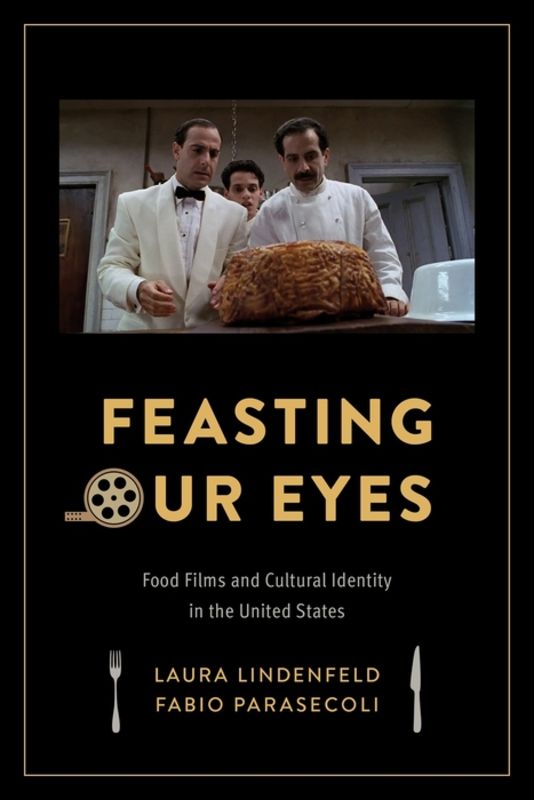
Feasting our eyes
Big Night(1996),Ratatouille(2007), andJulie and Julia(2009) are more than films about food-they serve a political purpose. In the kitchen, around the table, and in the dining room, these films use cooking and eating to explore such themes as ideological pluralism, ethnic and racial acceptance, gender equality, and class flexibility-but not as progressively as you might think.Feasting Our Eyestakes a second look at these and other modern American food films to emphasize their conventional approaches to nation, gender, race, sexuality, and social status. Devoured visually and emotionally, these films are particularly effective defenders of the status quo.
Feasting Our Eyeslooks at Hollywood films and independent cinema, documentaries and docufictions, from the 1990s to today and frankly assesses their commitment to racial diversity, tolerance, and liberal political ideas. Laura Lindenfeld and Fabio Parasecoli find women and people of color continue to be treated as objects of consumption even in these modern works and, despite their progressive veneer, American food films often mask a conservative politics that makes commercial success more likely. A major force in mainstream entertainment, American food films shape our sense of who belongs, who has a voice, and who has opportunities in American society. They facilitate the virtual consumption of traditional notions of identity and citizenship, reworking and reinforcing ingrained ideas of power.
eBook
God + country
Looks at the implications of Christian Nationalism and how it distorts not only the constitutional republic, but Christianity itself.
Streaming Video

South asians on the u.s. screen
How does the media influence society? How do media representations of South Asians, as racial and ethnic minorities, perpetuate stereotypes about this group? How do advancements in visual media, from creative storytelling to streaming technology, inform changing dynamics of all non-white media representations in the 21st century? Analyzing audience perceptions of South Asian characters from The Simpsons, Slumdog Millionaire, Harold and Kumar, The Office, Parks and Recreation, The Big Bang Theory, Outsourced, and many others, Bhoomi K. Thakore argues for the importance of understanding these representations as they influence the positioning of South Asians into the 21st century U.S. racial hierarchy. On one hand, increased acceptance of this group into the entertainment fold has informed audience perceptions of these characters as \"just like everyone else.\" However, these images remain secondary on the U.S. Screen, and are limited in their ability to break out of traditional stereotypes. As a result, a normative and assimilated white American identity is privileged both on the Screen, and in our increasingly multicultural society.
eBook

Reframing 9/11
September 11th, 2001 remains a focal point of American consciousness, a site demanding ongoing excavation, a site at which to mark before and after “everything” changed. In ways both real and intangible the entire sequence of events of that day continues to resonate in an endlessly proliferating aftermath of meanings that continue to evolve. Presenting a collection of analyses by an international body of scholars that examines America's recent history, this book focuses on popular culture as a profound discursive site of anxiety and discussion about 9/11 and demystifies the day's events in order to contextualize them into a historically grounded series of narratives that recognizes the complex relations of a globalized world. Essays in Reframing 9/11 share a collective drive to encourage new and original approaches for understanding the issues both within and beyond the official political rhetoric of the events of the “The Global War on Terror” and issues of national security.
eBook

Post-9/11 cinema
In contemporary society, cinema has become a primary way in which people gain knowledge about events taking place in the world. Films often go beyond news reports by showing in-depth, behind-the-scenes footage, whether in a documentary or recreated in fictional features. More than fleeting scenes of events shown on the nightly news, a film can influence people's feelings about war and what our political leaders should do about it. This has certainly been the case since the attack on 9/11 and the subsequent incursions into Iraq and Afghanistan. In Post-9/11 Cinema: Through a Lens Darkly, John Markert takes a close look at the films depicting these events. Covering cinematic portrayals of 9/11 and the attacks that followed, this book examines both dramas and documentaries that depict what some have termed \"Bush's war,\" as well as rebuttal films, films about terrorist activities, and films seen from the vantage point of journalists and military personnel. Post-9/11 Cinema not only shows how motion pictures reflect societal values but also how such works can influence social attitudes and thus promote change. In addition, Markert appraises the film industry and critiques how images are manipulated to sway the viewer to appreciate the side being advocated. Examining such dramas as The Messenger, Stop-Loss, The Lucky Ones, In the Valley of Elah, and The Hurt Locker, as well as documentaries including Fahrenheit 9/11, Soldiers of Conscience, and Taxi to the Dark Side, Post-9/11 Cinema is a valuable read for professors of media and mass communication, popular culture, and film studies, as well as cultural sociologists.
eBook