
Catalogue Search | MBRL


Are you sure you want to remove the book from the shelf?

{{itemTitle}}
416
result(s) for
"Motion pictures Soviet Union."
Sort by:

The cinema of the Soviet thaw : space, materiality, movement
Following Joseph Stalin's death in 1953, the Soviet Union experienced a dramatic resurgence in cinematic production. The period of the Soviet Thaw became known for its relative political and cultural liberalization; its films, formally innovative and socially engaged, were swept to the center of international cinematic discourse. In 'The Cinema of the Soviet Thaw', Lida Oukaderova provides an in-depth analysis of several Soviet films made between 1958 and 1967 to argue for the centrality of space - as both filmic trope and social concern - to Thaw-era cinema\"-- Provided by publisher.
Book

Not According to Plan
InNot According to Plan, Maria Belodubrovskaya reveals the limits on the power of even the most repressive totalitarian regimes to create and control propaganda. Belodubrovskaya's revisionist account of Soviet filmmaking between 1930 and 1953 highlights the extent to which the Soviet film industry remained stubbornly artisanal in its methods, especially in contrast to the more industrial approach of the Hollywood studio system. Not According to Plan shows that even though Josef Stalin recognized cinema as a \"mighty instrument of mass agitation and propaganda\" and strove to harness the Soviet film industry to serve the state, directors such as Eisenstein, Alexandrov, and Pudovkin had far more creative control than did party-appointed executives and censors.
The Stalinist party-state, despite explicit intent and grandiose plans to build a \"Soviet Hollywood\" that would release a thousand features per year, failed to construct even a modest mass propaganda cinema. Belodubrovskaya's wealth of evidence shows that the regime's desire to disseminate propaganda on a vast scale was consistently at odds with its compulsion to control quality and with Stalin's intolerance of imperfection.Not According to Planis a landmark in Soviet cultural history and the global history of cinema.
eBook


Screening Soviet Nationalities
Was World War II really the ‘Good War’? In the years since the declaration of peace in 1945 many myths have sprung up around the conflict in the victorious nations. In this book, Peter Hitchens deconstructs the many fables which have become associated with the narrative of the ‘Good War’. Whilst not criticising or doubting the need for war against Nazi Germany at some stage, Hitchens does query whether September 1939 was the right moment, or the independence of Poland the right issue. He points out that in the summer of 1939 Britain and France were wholly unprepared for a major European war and that this quickly became apparent in the conflict that ensued. He also rejects the retroactive claim that Britain went to war in 1939 to save the Jewish population of Europe. On the contrary, the beginning and intensification of war made it easier for Germany to begin the policy of mass murder in secret as well as closing most escape routes. In a provocative, but deeply-researched book, Hitchens questions the most common assumptions surrounding World War II, turning on its head the myth of Britain's role in a ‘Good War’.
eBook

The voice of technology : Soviet cinema's transition to sound, 1928-1935
\"As cinema industries around the globe adjusted to the introduction of synch-sound technology, the Soviet Union was also shifting culturally, politically, and ideologically from the heterogeneous film industry of the 1920s to the centralized industry of the 1930s, and from the avant-garde to Socialist Realism. In The Voice of Technology: Soviet Cinema's Transition to Sound, 1928-1935, Lilya Kaganovsky explores the history, practice, technology, ideology, aesthetics, and politics of the transition to sound within the context of larger issues in Soviet media history. Industrialization and centralization of the cinema industry greatly altered the way movies in the Soviet Union were made, while the introduction of sound radically influenced the way these movies were received. Kaganovsky argues that the coming of sound changed the Soviet cinema industry by making audible, for the first time, the voice of State power, directly addressing the Soviet viewer. by exploring numerous examples of films from this transitional period, the author demonstrates the importance of the new technology of sound in producing and imposing the 'Soviet Voice'.\"-- Provided by publisher.
Book

Stalin's Final Films
Stalin's Final Films explores
a neglected period in the history of Soviet cinema, breathing new
life into a body of films long considered moribund as the pinnacle
of Stalinism. While film censorship reached its apogee in
this period and fewer films were made, film attendance also peaked
as Soviet audiences voted with their seats and distinguished a
clearly popular postwar cinema.
Claire Knight examines the tensions between official ideology
and audience engagement, and between education and entertainment,
inherent in these popular films, as well as the financial
considerations that shaped and constrained them. She explores how
the Soviet regime used films to address the major challenges faced
by the USSR after the Great Patriotic War (World War II), showing
how war dramas, spy thrillers, Stalin epics, and rural comedies
alike were mobilized to consolidate an official narrative of the
war, reestablish Stalinist orthodoxy, and dramatize the rebuilding
of socialist society. Yet, Knight also highlights how these same
films were used by filmmakers more experimentally, exploring a
diverse range of responses to the ideological crisis that lay at
the heart of Soviet postwar culture, as a victorious people were
denied the fruits of their sacrificial labor. After the war, new
heroes were demanded by both the regime and Soviet audiences, and
filmmakers sought to provide them, with at times surprising
results.
Stalin's Final Films mines Soviet cinema as an
invaluable resource for understanding the unique character of
postwar Stalinism and the cinema of the most repressive era in
Soviet history.
eBook

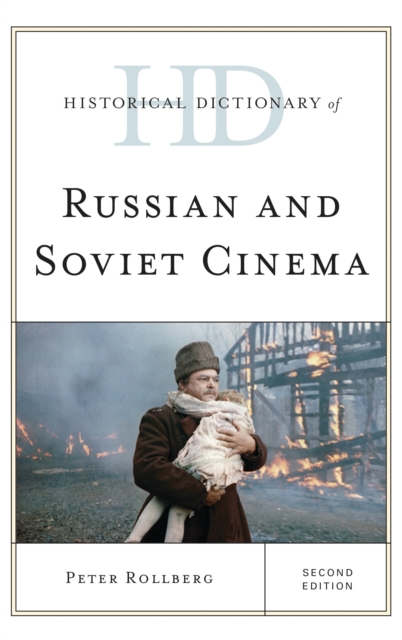
Historical dictionary of Russian and Soviet cinema
Russian and Soviet cinema occupies a unique place in the history of world cinema.Legendary filmmakers such as Sergei Eisenstein, Vsevolod Pudovkin, Dziga Vertov, Andrei Tarkovsky, and Sergei Paradjanov have created oeuvres that are being screened and studied all over the world.
eBook


Sound, Speech, Music in Soviet and Post-Soviet Cinema
This innovative volume challenges the ways we look at both cinema and cultural history by shifting the focus from the centrality of the visual and the literary toward the recognition of acoustic culture as formative of the Soviet and post-Soviet experience. Leading experts and emerging scholars from film studies, musicology, music theory, history, and cultural studies examine the importance of sound in Russian, Soviet, and post-Soviet cinema from a wide range of interdisciplinary perspectives. Addressing the little-known theoretical and artistic experimentation with sound in Soviet cinema, changing practices of voice delivery and translation, and issues of aesthetic ideology and music theory, this book explores the cultural and historical factors that influenced the use of voice, music, and sound on Soviet and post-Soviet screens.
eBook