
Catalogue Search | MBRL


Are you sure you want to remove the book from the shelf?

{{itemTitle}}
35
result(s) for
"Motion pictures Spain History 20th century."
Sort by:


Avant-Garde Cultural Practices in Spain (1914–1936)
This book offers a critical reinterpretation of the Spanish avant-garde, focusing on narrative, transculturality, and intermediality. Narrative, because it prioritizes the analysis of prose over poetry, against the traditional use of critical literature on the subject up to this point. Transculturality, because the Spanish avant-garde simply cannot be understood without the acknowledgement of its multi-linguistic reality and the transnational scope of the experience of Modernism in Europe - of which Spain was an integral yet underexposed component. And intermediality, because the interrelations of painting, photography, film, and literature articulate a correlation and mutual affect among different media, creating a rich cultural tapestry that needs to be addressed. Contributors: Rosa Berland, Jennifer Duprey, Marcos Eymar, Regina Galasso, Eduardo Gregori, Juan Herrero-Senés, John McCulloch, Andrés Pérez-Simón, Lynn Purkey, Domingo Ródenas de Moya, Evelyn Scaramella and Antonio Sáez Delgado.
eBook

The Politics of Age and Disability in Contemporary Spanish Film
The Politics of Age and Disability in Contemporary Spanish Film examines the onscreen construction of adolescent, elderly, and disabled subjects in Spanish cinema from 1992 to the present. Applying a dual lens of film analysis and theory drawn from the allied fields of youth, age, and disability studies, this study is set both within and against a conversation on cultural diversity-with respect to gender, sexual, and ethnic identity-which has driven not only much of the past decade's most visible and fruitful scholarship on representation in Spanish film, but also the broader parameters of discourse on post-Transition Spain in the humanities. Presenting an engaging, and heretofore under-explored, interdisciplinary approach to images of multiculturalism in what has emerged as one of recent Spain's most vibrant areas of cultural production, this book brings a fresh, while still complementary, critical sensibility to the field of contemporary Peninsular film studies through its detailed discussion of six contemporary films (by Salvador García Ruiz, Achero Mañas, Santiago Aguilar & Luis Guridi, Marcos Carnevale, Alejandro Amenábar, and Pedro Almodóvar) and supporting reference to the production of other prominent and emerging filmmakers.
eBook

Inhabiting the in-between : childhood and cinema in Spain's long transition
\"Although children have proliferated in Spain's cinema since its inception, nowhere are they privileged and complicated in quite the same way as in the films of the 1970s and early 1980s, a period of radical political and cultural change for the nation as it emerged from almost four decades of repressive dictatorship under the rule of General Francisco Franco. In Inhabiting the In-Between: Childhood and Cinema in Spain's Long Transition, Sarah Thomas analyzes the cinematic child within this complex historical conjuncture of a nation looking back on decades of authoritarian rule and forward to an uncertain future. Examining films from several genres by four key directors of the Transition--Carlos Saura, Antonio Mercero, Víctor Erice, and Jaime de Armiñán--Inhabiting the In-Between explores how the child is represented as both subject and object, self and other, and consistently cast in a position between categories or binary poles. Its readings demonstrate how the cinematic child that materializes in this period is a fundamentally shifting, oscillating, ambivalent figure that points toward the impossibility of fully comprehending the historical past and the figure of the other, while inviting an ethical engagement with each.\"-- Provided by publisher.
BOOK


Spanish Queer Cinema
There is a lot more to Spanish Queer Cinema than Pedro Almodóvar or the gay comedies of the 1990s. A wealth of short films, documentaries and features -- many by, for, or about lesbians -- is at the core of a creative culture responding to exceptionally intense social changes. The country has moved from institutionalising same-sex unions at the regional civic level (from 1998) to legal recognition of same-sex marriage (in 2005). Moving images and the debates and conversations around them have made a stand against homophobia and exclusion, responded to health and welfare crises, questioned or affirmed the value of same-sex marriage, and constructed new forms of love and community. They, and their audiences, build a new Spanish queer imagination. The book opens all this up, and shows some of the wider social contexts and forms of communication which underpin it.
eBook

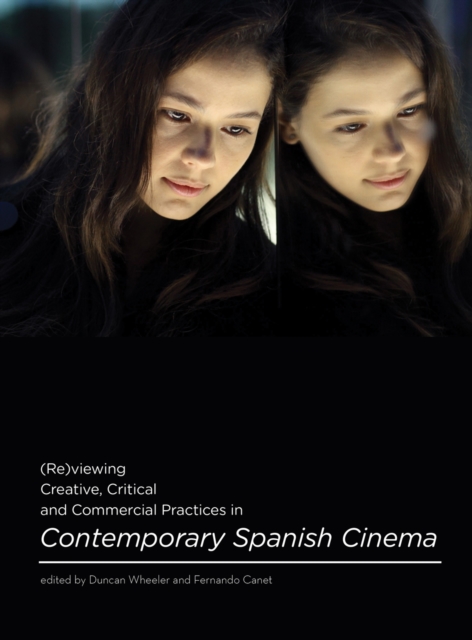
(Re)viewing creative, critical and commercial practices in contemporary spanish cinema
This volume is a reassessment of contemporary Spanish cinema from 1992 to 2012, bringing leading academics from a broad range of disciplinary and geographical backgrounds into dialogue with critically and commercially successful practitioners to suggest the need to redefine the parameters of one of the world's most creative national cinemas.
eBook