
Catalogue Search | MBRL


Are you sure you want to remove the book from the shelf?

{{itemTitle}}
14,886
result(s) for
"Motor fuels."
Sort by:


Desulfurization of Transportation Fuels with Zeolites under Ambient Conditions
Deep desulfurization of transportation fuels (gasoline, diesel, and jet fuels) is being mandated by U.S. and foreign governments and is also needed for future fuel cell applications. However, it is extremely difficult and costly to achieve with current technology, which requires catalytic reactors operated at high pressure and temperature. We show that Cu+and Ag+zeolite Y can adsorb sulfur compounds from commercial fuels selectively and with high sulfur capacities (by π complexation) at ambient temperature and pressure. Thus, the sulfur content was reduced from 430 to < 0.2 parts per million by weight in a commercial diesel at a sorbent capacity of 34 cubic centimeters of clean diesel produced per gram of sorbent. This sulfur selectivity and capacity are orders of magnitude higher than those obtained by previously known sorbents.
Journal Article

Fuels and fuel-additives
Examines all stages of fuel production, from feedstocks to finished products Exploring chemical structures and properties, this book sheds new light on the current science and technology of producing energy efficient and environmentally friendly fuels. Moreover, it explains the role of fuel-additives in the production cycle. This expertly written and organized guide to fuels and fuel-additives also presents requirements, rules and regulations, including US and EU standards governing automotive emissions, fuel quality and specifications, alternate fuels, biofuels, antioxidants, deposit control detergents/dispersants, stabilizers, corrosion inhibitors, and polymeric fuel-additives. Fuels and Fuel-Additives covers all stages and facets of the production of engine fuels as well as heating and fuel oils. The book begins with a quick portrait of the future of fuels and fuel production. Then, it sets forth the regulations controlling exhaust gas emissions and fuel quality from around the world. Next, the book covers: -Processing of engine fuels derived from crude oil, including the production of blending components -Production of alternative fuels -Fuel-additives for automotive engines -Blending of fuels -Key properties of motor fuels and their effects on engines and the environment -Aviation fuels The final chapter of the book deals with fuel oils and marine fuels. Each chapter is extensively referenced, providing a gateway to the primary and secondary literature in the field. At the end of the book, a convenient glossary defines all the key terms used in the book. Examining the full production cycle from feedstocks to final products, Fuels and Fuel-Additives is recommended for students, engineers, and scientists working in fuels and energy production.
eBook


Production of Motor Fuel Components by Processing Vegetable Oils Using a CoMo/Al2O3 Hydrotreating Catalyst and a ZSM-5 Zeolite Catalyst
Nowadays, there is a need to search for new renewable energy sources from which it is possible to obtain hydrocarbons that are similar in composition and properties to hydrocarbons of petroleum origin. This is due to a significant increase in demand for natural minerals and, as a consequence, the depletion of their reserves. Today, the most promising alternative renewable energy sources are various vegetable oils, which are used both in their pure form, adding them to commercial mineral fuels, and as products of catalytic processing using various catalysts. However, most studies in the field of alternative energy show that the use of fuels obtained from vegetable oils is limited by their properties as well as the climatic conditions of the areas where biofuels can be used. In this work, we propose an integrated approach to the processing of vegetable oils, which allows us to obtain products of a wide fractional composition with improved operational properties. This approach consists of sequential processing of vegetable oils, first using a CoMo/Al2O3 hydrotreating catalyst in order to obtain classical long-chain hydrocarbons with unsatisfactory properties, and then using a zeolite catalyst, ZSM-5 type, which is characterized by the active occurrence of cracking, isomerization, and aromatization reactions, which are accompanied by a decrease in the length of the hydrocarbon chain of the hydrocarbons obtained during the hydrotreating process and, as a result, improving the physicochemical and low-temperature properties of the resulting processed products.
Journal Article

Reducing climate impacts in the transportation sector
\"This book will be of interest to professionals in government, academic, environmental organizations, the automotive and energy industries, and the knowledgeable and engaged public.\"--Jacket.
Book

A dual-tube model for gas dynamics in fractured nanoporous shale formations
Gas flow through fractured nanoporous shale formations is complicated by a hierarchy of structural features (ranging from nanopores to microseismic and hydraulic fractures) and by several transport mechanisms that differ from the standard viscous flow used in reservoir modelling. In small pores, self-diffusion becomes more important than advection; also, slippage effects and Knudsen diffusion might become relevant at low densities. We derive a nonlinear effective diffusion coefficient that describes the main transport mechanisms in shale-gas production. In dimensionless form, this coefficient depends only on a geometric factor (or dimensionless permeability) and on the kinetic model that describes the gas. To simplify the description of the complex structure of fractured shales, we observe that the production rate is controlled by the flow from the shale matrix (which has the smallest diffusivity) into the fracture network, which is assumed to produce instantaneously. Therefore, we propose to model the flow in the shale matrix and estimate the production rate with a simple bundle-of-dual-tubes model (BoDTM), in which each tube is characterized by two diameters (one for transport and the other for storage). The solution of a single tube is approximately self-similar at early time, but not at late time, when the gas flux decays exponentially owing to the finite length of the tube. To construct a BoDTM, a reliable estimate of the joint statistics of the matrix-porosity parameters is required. This can be either inferred from core measurements or postulated on the basis of some a priori assumptions when information from laboratory and field measurements is scarce. By comparison with field production data from the Barnett shale-gas field, we demonstrate that BoDTM can be calibrated to estimate structural parameters of the shale formation and to predict the cumulative production of shale gas. Our framework has enough flexibility to construct models of increasing complexity that can be employed in the presence of a complex dataset or when more information is available.
Journal Article

Regular solution model for asphaltene precipitation from bitumens and solvents
A regular solution theory liquid‐liquid equilibrium model was developed to predict asphaltene precipitation from Western Canadian bitumens. The input parameters for the model are the mole fraction, molar volume, and solubility parameters for each component. Bitumens were divided into four main pseudo‐components corresponding to SARA fractions: saturates, aromatics, resins, and asphaltenes. Asphaltenes were divided into fractions of different associated molar mass based on a Schultz‐Zimm molar mass distribution. Asphaltene self‐association was accounted for through the average molar mass of the distribution. The molar volumes and solubility parameters of the pseudo‐components were calculated using solubility, density, and molar mass measurements. The model successfully predicted the effect of solvent type and associated molar mass on asphaltene precipitation for model oil and n‐alkane systems. The model also predicted the onset and amount of asphaltene precipitation from bitumens.
Journal Article
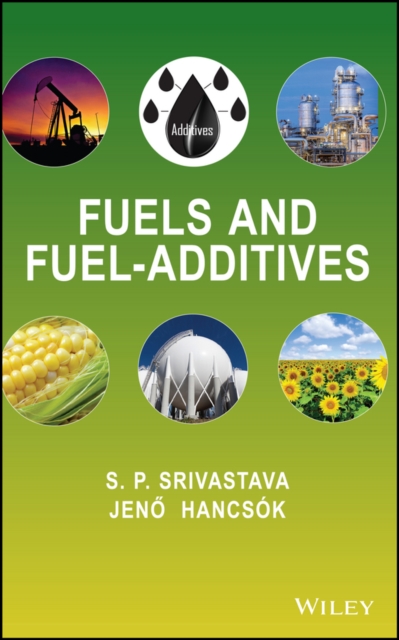
Fuels and fuels-additives
Examines all stages of fuel production, from feedstocks to finished products Exploring chemical structures and properties, this book sheds new light on the current science and technology of producing energy efficient and environmentally friendly fuels. Moreover, it explains the role of fuel-additives in the production cycle. This expertly written and organized guide to fuels and fuel-additives also presents requirements, rules and regulations, including US and EU standards governing automotive emissions, fuel quality and specifications, alternate fuels, biofuels, antioxidants, deposit control detergents/dispersants, stabilizers, corrosion inhibitors, and polymeric fuel-additives. Fuels and Fuel-Additives covers all stages and facets of the production of engine fuels as well as heating and fuel oils. The book begins with a quick portrait of the future of fuels and fuel production. Then, it sets forth the regulations controlling exhaust gas emissions and fuel quality from around the world. Next, the book covers: Processing of engine fuels derived from crude oil, including the production of blending components Production of alternative fuels Fuel-additives for automotive engines Blending of fuels Key properties of motor fuels and their effects on engines and the environment Aviation fuels The final chapter of the book deals with fuel oils and marine fuels. Each chapter is extensively referenced, providing a gateway to the primary and secondary literature in the field. At the end of the book, a convenient glossary defines all the key terms used in the book. Examining the full production cycle from feedstocks to final products, Fuels and Fuel-Additives is recommended for students, engineers, and scientists working in fuels and energy production.
eBook