
Catalogue Search | MBRL


Are you sure you want to remove the book from the shelf?

{{itemTitle}}
2,511
result(s) for
"Motor vehicles History."
Sort by:

The complete history of wheeled transportation : from cars and trucks to buses and bikes
Provides information of an assortment of wheeled vehicles throughout history, including the evolution of roads, the design of different vehicles, and how vehicles were used.
Book

Two prime movers of globalization : the history and impact of diesel engines and gas turbines
The many books on globalization published over the past few years range from claims that the world is flat to an unlikely rehabilitation of Genghis Khan as a pioneer of global commerce. Missing from these accounts is a consideration of the technologies behind the creation of the globalized economy. What makes it possible for us to move billions of tons of raw materials and manufactured goods from continent to continent? Why are we able to fly almost anywhere on the planet within twenty-four hours? In Prime Movers of Globalization, Vaclav Smil offers a history of two key technical developments that have driven globalization: the high-compression non-sparking internal combustion engines invented by Rudolf Diesel in the 1890s and the gas turbines designed by Frank Whittle and Hans-Joachim Pabst von Ohain in the 1930s. The massive diesel engines that power cargo ships and the gas turbines that propel jet engines, Smil argues, are more important to the global economy than any corporate structure or international trade agreement. Smil compares the efficiency and scale of these two technologies to prime movers of the past, including the sail and the steam engine. The lengthy processes of development, commercialization, and diffusion that the diesel engine and the gas turbine went through, he argues, provide perfect examples of gradual technical advances that receive little attention but have resulted in epochal shifts in global affairs and the global economy.
eBook

Land and water transportation
\"Describes the progression of technology that makes land and water travel possible, from the earliest vehicles powered by animals and humans to today's high-speed trains and sophisticated sea vessels\"--Provided by publisher.
Book

Prime Movers of Globalization
The story of how diesel engines and gas turbines, used to power cargo ships and jet airplanes, made today's globally integrated economy possible.The many books on globalization published over the past few years range from claims that the world is flat to an unlikely rehabilitation of Genghis Khan as a pioneer of global commerce.
eBook

Innovations in transportation
\"Imagine a street filled with horses and buggies, or the skies without airplanes! You might not realize that, before vehicles, it used to take days--even weeks--to visit friends or family! This title looks at major innovations in transportation over the years, and the ingenious inventors, scientists, and engineers who made them. With a little inventive thinking, what might you create to help us change the way we travel?\"--Provided by publisher.
Book
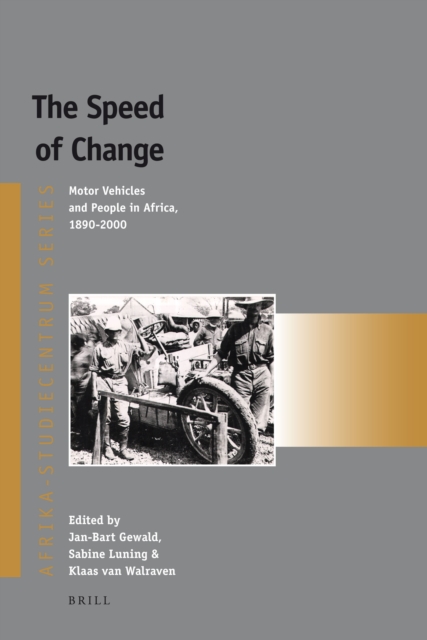
The Speed of Change
In the early 1900s the motor-vehicle (car, bus, lorry or motor-cycle) was introduced in sub-Saharan Africa This edited volume of eleven contributions by historians, anthropologists, social and political scientists explores aspects of the social history and anthropology of the motor-vehicle in Africa.
eBook

Improving transportation to fight climate change
\"Describes the history of different types of transportation, their effects on the environment, and possible changes for cleaner transportation in the future\"-- Provided by publisher.
Book

Weather, Geography, and Vehicle-Related Hyperthermia in Children
Vehicle-related hyperthermia is an unfortunate tragedy that leads to the accidental deaths of children each year. This research utilizes the most extensive dataset of child vehicle-related hyperthermia deaths in the United States, including 414 deaths between 1998 and 2008. Deaths follow a seasonal pattern, with a peak in July and no deaths in December or January. Also, deaths occurred over a wide range of temperature and radiation levels and across virtually all regions, although most of them took place across the southern United States. In particular, the Phoenix, Houston, Dallas, and Las Vegas metropolitan areas had the greatest number of deaths. We utilize our vehicle hyperthermia index (vhi) to compare expected deaths versus actual deaths in a metropolitan area, based on the number of children in the area who are under the age of five and on the frequency of hot days in the area. The vhi indicates that the Memphis, West Palm Beach-Boca Raton, and Las Vegas metropolitan areas are the most dangerous places for vehicle-related hyperthermia. We conclude by discussing several recommendations with public health policy implications.
Journal Article

