
Catalogue Search | MBRL


Are you sure you want to remove the book from the shelf?

{{itemTitle}}
10,442
result(s) for
"Mountain biodiversity."
Sort by:

Biodiversity of alpine zones
\"Discusses the variety of living things in the ecosystem of alpine regions\"--Provided by publisher.
Book

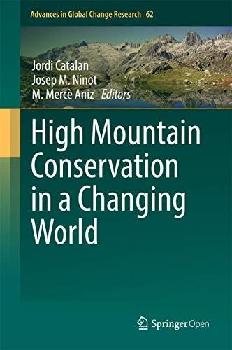
High mountain conservation in a changing world
\"This book aims to provide case studies and a general view of the main processes involved in the ecosystem shifts occurring in the high mountains, and to analyse the implications for nature conservation. Although case studies from the Pyrenees are preponderant, conclusions are aimed at any mountain range surrounded by highly populated lowland areas. The chapters give emphasis to approaches from environmental geography, functional ecology, biogeography, and paleoenvironmental reconstructions. The introductory and closing chapters summarize the main challenges that nature conservation may face in mountain areas under the environmental shifting conditions. This interdisciplinary book will appeal to researchers in mountain ecosystems, students and nature professionals.\"--Page [4] of cover.
Book


Environmental heterogeneity and spatial variation mediates plant diversity and ecosystem stability in mountain ecosystems of the Mediterranean Andes
Globally, mountains are highly diverse ecosystems that serve as natural laboratories for testing ecological theories, while providing vital ecosystem services. Their biodiversity arises from the interaction between elevational gradients and topographic complexity, which generate strong variation in environmental conditions across short spatial scales. These gradients, in turn, influence the maintenance of ecosystem functions, such as vegetation productivity, over time. However, how topography influences ecosystem stability and its relation with different facets of biodiversity in naturally‐assembled communities remains relatively unexplored. Here, we evaluated how environmental heterogeneity and spatial variation influence taxonomic and phylogenetic plant diversity, and how these components together affect ecosystem stability. Using a highly replicated fractal sampling design, we estimated plant taxonomic and phylogenetic diversity locally and across space. We estimated the temporal stability of vegetation productivity with a high‐resolution, remotely sensed time series in the Mediterranean Andes of central Chile. We assessed how environmental heterogeneity and spatial variation (i.e. spatial autocorrelation, spatial structure, and distance) mediate relationships between topography, plant diversity, and ecosystem stability using generalized linear and structural equation models. As expected, taxonomic and phylogenetic diversity declined with elevation, and both diversity and ecosystem stability varied along gradients in environmental heterogeneity. Our structural equation models revealed that spatial variation was the main factor directly stabilizing vegetation productivity, while species turnover had only minor effects. When spatial variation was excluded, diversity components influenced stability but explained less variation, emphasizing the key role of spatial processes captured by spatial variation in maintaining ecosystem stability. Our findings indicate that diversity–stability relationships in naturally assembled plant communities emerge from spatial processes governing patterns of plant diversity and ecosystem stability. We provide empirical evidence that spatially structured ecosystems should be prioritized for biodiversity conservation and the maintenance of key ecosystem functions in mountain ecosystems.
Journal Article

Alpine butterflies want to fly high
Despite sometimes strong codependencies of insect herbivores and plants, the responses of individual taxa to accelerating climate change are typically studied in isolation. For this reason, biotic interactions that potentially limit species in tracking their preferred climatic niches are ignored. Here, we chose butterflies as a prominent representative of herbivorous insects to investigate the impacts of temperature changes and their larval host plant distributions along a 1.4-km elevational gradient in the German Alps. Following a sampling protocol of 2009, we revisited 33 grassland plots in 2019 over an entire growing season. We quantified changes in butterfly abundance and richness by repeated transect walks on each plot and disentangled the direct and indirect effects of locally assessed temperature, site management, and larval and adult food resource availability on these patterns. Additionally, we determined elevational range shifts of butterflies and host plants at both the community and species level. Comparing the two sampled years (2009 and 2019), we found a severe decline in butterfly abundance and a clear upward shift of butterflies along the elevational gradient. We detected shifts in the peak of species richness, community composition, and at the species level, whereby mountainous species shifted particularly strongly. In contrast, host plants showed barely any change, neither in connection with species richness nor individual species shifts. Further, temperature and host plant richness were the main drivers of butterfly richness, with change in temperature best explaining the change in richness over time. We concluded that host plants were not yet hindering butterfly species and communities from shifting upwards. However, the mismatch between butterfly and host plant shifts might become a problem for this very close plant–herbivore relationship, especially toward higher elevations, if butterflies fail to adapt to new host plants. Further, our results support the value of conserving traditional extensive pasture use as a promoter of host plant and, hence, butterfly richness.
Journal Article

Think globally, measure locally: The MIREN standardized protocol for monitoring plant species distributions along elevation gradients
Climate change and other global change drivers threaten plant diversity in mountains worldwide. A widely documented response to such environmental modifications is for plant species to change their elevational ranges. Range shifts are often idiosyncratic and difficult to generalize, partly due to variation in sampling methods. There is thus a need for a standardized monitoring strategy that can be applied across mountain regions to assess distribution changes and community turnover of native and non-native plant species over space and time. Here, we present a conceptually intuitive and standardized protocol developed by the Mountain Invasion Research Network (MIREN) to systematically quantify global patterns of native and non-native species distributions along elevation gradients and shifts arising from interactive effects of climate change and human disturbance. Usually repeated every five years, surveys consist of 20 sample sites located at equal elevation increments along three replicate roads per sampling region. At each site, three plots extend from the side of a mountain road into surrounding natural vegetation. The protocol has been successfully used in 18 regions worldwide from 2007 to present. Analyses of one point in time already generated some salient results, and revealed region-specific elevational patterns of native plant species richness, but a globally consistent elevational decline in non-native species richness. Non-native plants were also more abundant directly adjacent to road edges, suggesting that disturbed roadsides serve as a vector for invasions into mountains. From the upcoming analyses of time series, even more exciting results can be expected, especially about range shifts. Implementing the protocol in more mountain regions globally would help to generate a more complete picture of how global change alters species distributions. This would inform conservation policy in mountain ecosystems, where some conservation policies remain poorly implemented.
Journal Article

Projected range contractions of montane biodiversity under global warming
Mountains, especially in the tropics, harbour a unique and large portion of the world's biodiversity. Their geographical isolation, limited range size and unique environmental adaptations make montane species potentially the most threatened under impeding climate change. Here, we provide a global baseline assessment of geographical range contractions and extinction risk of high-elevation specialists in a future warmer world. We consider three dispersal scenarios for simulated species and for the world's 1009 montane bird species. Under constrained vertical dispersal (VD), species with narrow vertical distributions are strongly impacted; at least a third of montane bird diversity is severely threatened. In a scenario of unconstrained VD, the location and structure of mountain systems emerge as a strong driver of extinction risk. Even unconstrained lateral movements offer little improvement to the fate of montane species in the Afrotropics, Australasia and Nearctic. Our results demonstrate the particular roles that the geography of species richness, the spatial structure of lateral and particularly vertical range extents and the specific geography of mountain systems have in determining the vulnerability of montane biodiversity to climate change. Our findings confirm the outstanding levels of biotic perturbation and extinction risk that mountain systems are likely to experience under global warming and highlight the need for additional knowledge on species' vertical distributions, dispersal and adaptive capacities.
Journal Article

Elevational changes in canopy Collembola community composition are primarily driven by species turnover on Changbai Mountain, northeastern China
Forest canopies harbor extraordinary biodiversity, with Collembola being one of the most abundant arthropod taxa. However, much of the research on canopy biodiversity has focused on tropical and subtropical regions, leaving a gap in our understanding of canopy communities in temperate and boreal forests. Studying canopy Collembola along elevational gradients can be particularly informative because several environmental factors change with elevation, and these changes may mirror those seen along latitudinal gradients. To better understand and conserve canopy Collembola diversity along elevational gradients, natural forests are of particular interest. In this study, we used canopy fogging to sample canopy Collembola at four elevation sites (800–1700 m a.s.l.) on Changbai Mountain, northeastern China, representing three natural forest types. We examined changes in species richness, abundance and composition of canopy Collembola, and partitioned beta diversity into nestedness and turnover to identify processes driving changes in community composition. We identified 53 morphospecies among 10,191 individuals, with Entomobryidae and Hypogastruridae being the dominant families. The highest abundance and species richness were observed at 1400 m and remained at similar levels at 1700 m, indicating an increasing pattern with elevation. Species turnover was the main driver of changes in community composition with elevation. Our results provide insights into the shift of canopy Collembola communities across an elevational gradient in temperate boreal forests.
Journal Article