
Catalogue Search | MBRL


Are you sure you want to remove the book from the shelf?

{{itemTitle}}
787
result(s) for
"Mountain goat"
Sort by:


PRODUCTIVITY TRAITS OF LOCAL MOUNTAIN GOAT AND SOME FACTORS AFFECTING THEM
The aim of the current investigation was to evaluate some reproductive aspects of local mountain goat raised in farm conditions. A total number of 498 does were mated during two successive years. Results revealed that fertility, conception, kidding, productivity and twinning rates averaged 80.72, 87.15, 84.94, 72.29 and 5.22 %, respectively. Litter size at birth and weaning were 1.05 and 0.9 respectively. Also, all above traits were significantly lower in does aged 2.5 years as compared with older does except those of litter size at birth and weaning. Effect of year of mating was found to be significant only on conception rate. Does mated in August resulted in a significant increase in the studied traits compared with that mated in September and October except those in twinning rate, litter size at birth and weaning. The regressions of litter size at birth and twinning rate on dam’s body weights were significant.
Journal Article

Predation risk and mountain goat reproduction
Non‐consumptive effects of predation can strongly impact reproduction and demography of prey species. Still, the underlying mechanisms that drive non‐consumptive effects are not fully understood, and the circumstances under which chronic physiological stress may mediate these effects remain unclear. Benefiting from over 23 years of environmental, physiological and demographic data, we tested the hypothesis that predation risk may impair reproduction of mountain goats through chronic elevation of physiological stress. We conducted path analyses to assess the relationships between predation risk, faecal glucocorticoid metabolites and hair cortisol concentration, and reproduction, while taking into account the potential effects of age class, sex, body mass, season and within individual variation in glucocorticoid concentration. Predation risk had a direct positive effect on the average annual faecal glucocorticoid concentration in the population, which, in turn, negatively affected the proportion of reproductive females. The same pattern was observed with hair cortisol concentration, but these results were inconclusive potentially due to methodological challenges in estimating annual average of hair cortisol at the population level. Our study presents one of the first robust evidence that stress‐mediated breeding suppression can occur in a wild ungulate following increased predation risk, thereby providing a major insight on the mechanisms underlying non‐consumptive effects of predation in wild mammals. A free Plain Language Summary can be found within the Supporting Information of this article. A free Plain Language Summary can be found within the Supporting Information of this article.
Journal Article

The ecological footprint of recreation: Impacts on mountain goat habitat selection
Understanding the relationship between wildlife and their environment is important to wildlife management. Factors such as human disturbance that influence the behavior of animals have implications for management decisions and are critical to consider in evaluations of wildlife habitat selection. In Montana, there is concern regarding the status of mountain goats (Oreamnos americanus), and more information regarding mountain goat ecology is needed to guide management decisions. We used GPS locations from 14 mountain goats in the Bridger Range of southwest Montana collected from 2021 to 2024 to evaluate summer habitat selection and the effects of trail‐based recreation. Recreation covariates representing the intensity of recreational use were developed based on trail use counts obtained from trail counters and categorized into four categories (no, low, medium, and high recreation). First, we developed a summer habitat selection model that identified habitat selection within the Bridger Mountains. Next, we added recreation covariates to the most supported model to evaluate the effects of trail‐based recreation on mountain goat habitat selection. Finally, interactions with time of day for all covariates and day of week with recreation‐associated covariates were added to assess evidence for temporal (diel and weekly) variation in habitat selection. We found that mountain goats strongly selected steep and rugged terrain with low canopy cover during the summer. At the population level, we found a lower relative probability of selection for areas of medium recreation intensity compared to areas of no or low recreation intensity. The relative probability of selection for high recreation intensity was similar to those of other recreation intensities, which did not provide strong evidence of avoidance, suggesting potential tolerance among some individuals. We found evidence for temporal variation in mountain goat selection of most covariates. Our results provided evidence of substantial individual variation in responses to recreation intensity. This information should help guide future management decisions related to timber management and suggest a cautious approach to the future development of recreation infrastructure given the varied responses of mountain goats to recreation and the potential for increased human–mountain goat conflict created by tolerance of human disturbance in high‐quality mountain goat habitat by some individuals.
Journal Article

Gut microbiome composition predicts summer core range size in two divergent ungulates
ABSTRACT
The gut microbiome of animals vary by age, diet, and habitat, and directly influences an individual's health. Similarly, variation in home ranges is linked to feeding strategies and fitness. Ungulates (hooved mammals) exhibit species-specific microbiomes and habitat use patterns. We combined gut microbiome and movement data to assess relationships between space use and the gut microbiome in a specialist and a generalist ungulate. We GPS radiocollared 24 mountain goats (Oreamnos americanus) and 34 white-tailed deer (Odocoileus virginianus), collected fecal samples, and conducted high-throughput sequencing of the 16S rRNA gene. We generated gut diversity metrics and key bacterial ratios. Our research question centred around the idea that larger Firmicutes to Bacteroidetes ratios confer body size or fat advantages that allow for larger home ranges, and relationships of disproportionate habitat use are stronger in the habitat specialist mountain goat. Firmicutes to Bacteroidetes ratios were positively correlated with core range area in both species. Mountain goats exhibited a negative relationship between gut diversity and proportional use of treed areas and escape terrain, and no relationships were detected in the habitat generalist white-tailed deer. This is the first study to relate range size to the gut microbiome in wild ungulates and is an important proof of concept that advances the information that can be gleaned from non-invasive sampling.
The gut microbiome in wild ungulates is linked to space use; we generated an important proof of concept that advances the information that can be gleaned from non-invasive sampling.
Journal Article

Demographic uncertainty and disease risk influence climate-informed management of an alpine species
Climate change is expected to disproportionately affect species occupying ecosystems with relatively hard boundaries, such as alpine ecosystems. Wildlife managers must identify actions to conserve and manage alpine species into the future, while considering other issues and uncertainties. Climate change and respiratory pathogens associated with widespread pneumonia epidemics in bighorn sheep (Ovis canadensis) may negatively affect mountain goat (Oreamnos americanus) populations. Mountain goat demographic and population data are challenging to collect and sparsely available, making population management decisions difficult. We developed predictive models incorporating these uncertainties and analyzed results within a structured decision making framework to make management recommendations and identify priority information needs in Montana, USA. We built resource selection models to forecast occupied mountain goat habitat and account for uncertainty in effects of climate change, and a Leslie matrix projection model to predict population trends while accounting for uncertainty in population demographics and dynamics. We predicted disease risks while accounting for uncertainty about presence of pneumonia pathogens and risk tolerance for mixing populations during translocations. Our analysis predicted that new introductions would produce more area occupied by mountain goats at mid-century, regardless of the effects of climate change. Population augmentations, carnivore management, and harvest management may improve population trends, although this was associated with considerable uncertainty. Tolerance for risk of disease transmission affected optimal management choices because translocations are expected to increase disease risks for mountain goats and sympatric bighorn sheep. Expected value of information analyses revealed that reducing uncertainty related to population dynamics would affect the optimal choice among management strategies to improve mountain goat trends. Reducing uncertainty related to the presence of pneumonia-associated pathogens and consequences of mixing microbial communities should reduce disease risks if translocations are included in future management strategies. We recommend managers determine tolerance for disease risks associated with translocations that they and constituents are willing to accept. From this, an adaptive management program can be constructed wherein a portfolio of management actions are chosen based on risk tolerance in each population range, combined with the amount that uncertainty is reduced when paired with monitoring, to ultimately improve achievement of fundamental objectives.
Journal Article
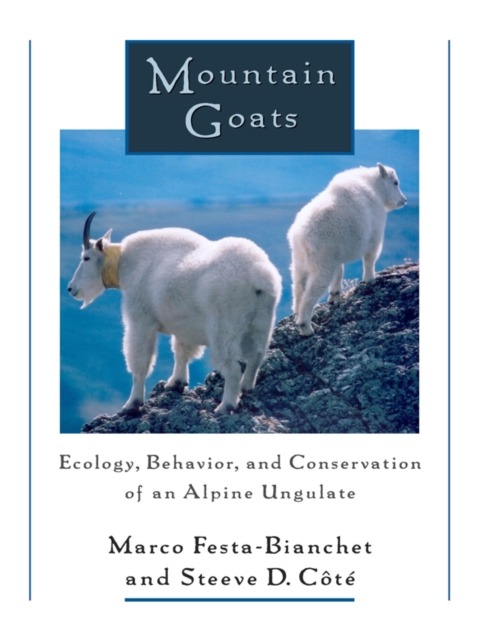
Mountain goats : ecology, behavior, and conservation of an alpine ungulate
Mountain goats have been among the least studied of North American ungulates, leaving wildlife managers with little information on which to base harvest strategies or conservation plans.
This book offers the first comprehensive assessment of the ecology and behavior of mountain goats, setting forth the results of a remarkable 16-year longitudinal study of more than 300 marked individuals in a population in Alberta, Canada. The authors' thorough, long-term study allowed them to draw important conclusions about mountain goat ecology—including individual reproductive strategies, population dynamics, and sensitivity to human disturbance—and to use those conclusions in offering guidance for developing effective conservation strategies.
Chapters examine:
-habitat use, vegetation quality, and seasonal movements
-sexual segregation and social organization
-individual variability in yearly and lifetime reproductive success of females
-age- and sex-specific survival and dispersal
-reproductive strategies and population dynamics
-management and conservation of mountain goats
The book also draws on the rich literature on long-term monitoring of marked ungulates to explore similarities and differences between mountain goats and other species, particularly bighorn sheep and ibex.
By monitoring a marked population over a long period of time, researchers were able to document changes in sex-age structure and identify factors driving population dynamics. Because it explores the links between individual life-history strategy and population dynamics in a natural setting, Mountain Goats will be an invaluable resource for wildlife managers, researchers in ecology and animal behavior, conservationists, population biologists, and anyone concerned with the ecology and management of natural populations, especially in alpine environments.
eBook
Long-term data reveal effects of climate, road access, and latitude on mountain goat horn size
Potential negative artificial selection on horn size is a concern for many harvested ungulates. The mountain goat (Oreamnos americanus) has distinct black horns, but targeting animals based on horn size in the field can be challenging. We analyzed over 23,000 horn records that included base circumference and total length, from which we also derived horn volume, from mountain goats harvested in Alaska, British Columbia, and the Northwest Territories from 1980 to 2016. We tested 3 potential drivers of horn size variation: geographical location, environmental conditions, and artificial selection. We found no support for a latitudinal effect with surprisingly little variation across the sampling distribution. The Pacific Decadal Oscillation had the largest effect outside age in the model, suggesting a role of climate in shaping variation. Mountain goats harvested closer to roads had larger horns, indicating that ease of access might allow hunters to be more selective, though the effect size was small. Our findings reinforce the value of accurate and complete record keeping on horn size, age, and sex of harvested animals, and highlight the importance of explicitly considering climate and accessibility when devising management strategies for the mountain goat.
Journal Article
Integrating Genetic Data and Demographic Modeling to Facilitate Conservation of Small, Isolated Mountain Goat Populations
Acquisition of field data and analytical methods needed for conservation and management of wildlife populations represent significant challenges, particularly for species that inhabit landscapes that are difficult to access or species that persist in small, isolated populations. In such instances, integrating diverse and complementary data streams, such as genetic and non-genetic data, can advance our understanding of population dynamics and associated management implications. We examined how genetic and morphologic data can be used to articulate population structure of a low-density, peninsular population of mountain goats (Oreamnos americanus) on the Cleveland Peninsula, Alaska, USA, and surrounding areas, 2005–2018. We then use a population demographic modeling approach to examine how the use of population structure information influences sustainable harvest quotas, as compared to a panmictic, null model. Specifically, we conducted extensive field sampling of genetic (n=446) and morphologic (i.e., horn length, n=371) data to characterize population structure. We conducted demographic analyses and examined harvest modeling scenarios using a sex- and age-specific matrix population modeling approach. Genetic and morphologic data analyses suggested peninsular subpopulations were demographically isolated, relative to surrounding mainland populations. Specifically, genetic structuring was evident and followed an isolation-by-distance, stepping-stone pattern indicating limited interchange, low effective population sizes, and reduced genetic diversity along a peninsular extremity to mainland gradient. Harvest modeling indicated that overharvest would likely occur if the panmictic, null model was used to guide harvest because the smallest genetically defined population at the peninsular extremity was too small to permit any level of sustainable harvest. Our analyses illustrate the importance of using genetic and morphologic data, in combination with demographic modeling, to quantitatively delineate population boundaries and dynamics for ensuring viability of small, isolated populations.
Journal Article

Neurotropic Tick-Borne Flavivirus in Alpine Chamois (Rupicapra rupicapra rupicapra), Austria, 2017, Italy, 2023
The European subtype of tick-borne encephalitis virus (TBEV-Eur; species Orthoflavivirus encephalitidis, family Flaviviridae) was the only tick-borne flavivirus present in central Europe known to cause neurologic disease in humans and several animal species. Here, we report a tick-borne flavivirus isolated from Alpine chamois (Rupicapra rupicapra rupicapra) with encephalitis and attached ticks, present over a wide area in the Alps. Cases were detected in 2017 in Salzburg, Austria, and 2023 in Lombardy and Piedmont, Italy. The virus strains exhibit 94.8–97.3% nucleotide identities to each other and are more closely related to Louping ill viruses (LIV; Orthoflavivirus loupingi; 90–92% identities) than to TBEV-Eur (less than 88%). The chamois-derived virus strains, tentatively termed “Alpine chamois encephalitis virus”, form a well-supported independent genetic clade with Spanish goat encephalitis virus, clearly separated from other LIV. This supports its designation as a new virus subtype with the proposed shared taxonomic name “Spanish goat and Alpine chamois encephalitis virus subtype” within the species Orthoflavivirus loupingi. The zoonotic potential of this newly identified virus subtype as well as its host range in other animal species including farm animals needs to be further investigated.
Journal Article