
Catalogue Search | MBRL


Are you sure you want to remove the book from the shelf?

{{itemTitle}}
67
result(s) for
"Multi-sided platform businesses."
Sort by:

Own this! : how platform cooperatives help workers build a democratic internet
\"An introduction to platform cooperativism: cooperatively owned, democratically governed businesses\"-- Provided by publisher.
Book
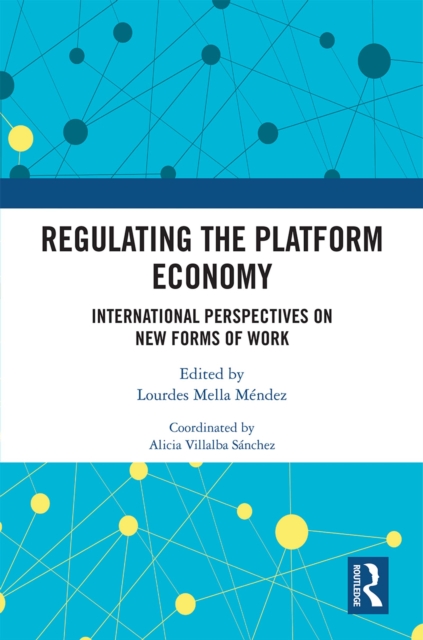
Regulating the Platform Economy
This book analyses novel and important issues relating to the emergence of new forms of work resulting from the introduction of disruptive technologies in the enterprises and the labour market, especially platform work. The first part of the book examines the platform economy and labour market, to address the more general challenges that the recent labour platforms pose for employment and the labour market, while the second part of the book considers the implications of the rise of different ways of work in the enterprises due to the incorporation of technology in a global context. Providing a rich analysis and evaluation of the numerous theoretical and practical regulatory problems arising from constantly developing technology, this book makes important and informed suggestions on how to solve the numerous problems which have arisen. The collection of chapters in this volume are varied and are dealt with from different disciplinary angles, and from a diverse range of countries and legal systems to create an interesting and unique global picture on the topics studied therein.
With an international perspective, the book will be of interest to students and scholars of economy and technology law.
Part one. The platform economy and the Labour Market: Some key issues
1. The Platform Economy: The Main Challenges for Labour Law
2. Uber: Regulatory and Institutional Experimentation in the Taxi Industry in Quebec
3. Comparative Study on Japanese Employment-like Working Style: Whether we are Discussing the Same Phenomenon or Not?
4. Identifying Labour Relationship in the Sharing Economy: Judicial Practice in China
5. Informality, Neoliberalism and the Gig Economy in Chile
6. Regulating Technology at Work
Part two. Other new forms of work, new workforce and new skills
7. New Forms of Work and Contractual Execution: Towards the “Smart Labour Contract”
8. Spanish Telework and Italian “Agile” Work: A Comparison
9. Robotics and Work: Labour and Tax Regulatory Framework
10. Technology and Jobs: Has What Was Old Become New?
11. Technologies and Powers: Marginal Notes on the Amazon Wristband
12. New Forms of Work and Trade Unions in the Digital Age
13. Emerging Skills and Occupations in the Fourth Industrial Revolution: How to Respond to Changing Work Demands?
14. The Resilience: The Main Skill for Industry 4.0
Lourdes Mella Méndez is Professor of Labour Law and Social Security at the University of Santiago de Compostela, Spain. Alicia Villalba Sánchez is Assistant Professor of Labour Law and Social Security at the University of Santiago de Compostela, Spain.
eBook


Multisided Platforms and Antitrust Enforcement
Multisided platforms are ubiquitous in today's economy. Although newspapers demonstrate that the platform business model is scarcely new, recent economic analysis has explored more deeply the manner of its operation. Drawing upon these insights, we conclude that enforcers and courts should use a multiple-markets approach in which different groups of users on different sides of a platform belong in different product markets. This approach appropriately accounts for cross-market network effects without collapsing all of a platform's users into a single product market. Furthermore, we advocate the use of a separate-effects analysis, which rejects the view that anticompetitive conduct harming users on one side of a platform can be justified so long as that harm funds benefits for users on another side. Courts should consider the price structure of a platform, and not simply the net price, in assessing competitive effects. This approach in turn supports our final conclusion: that antitrust plaintiffs should not be required to prove as part of their prima facie case more than occurrence of competitive harm in a properly-defined market; thereafter, the burden to produce procompetitive justifications should shift to defendants.
Journal Article

Landlords with no lands: a systematic literature review on hybrid multi-sided platforms and platform thinking
PurposeThis article is based on a systematic and comprehensive review of the literature on two-sided platforms, the business structure based on the concept of matchmaking groups of customers (e.g. Uber or Airbnb). The research aims to identify gaps in the existing literature while providing a structured summary of the existing knowledge in the field. Finally, we propose a conceptual framework enabling platform thinking, the ability to see hybrid multi-sided platforms as a useful resource-orchestration structure to unveil innovation opportunities.Design/methodology/approachThis study adopts a bibliometric approach, combing co-citation and text mining analyses of 196 papers, also implementing a longitudinal analysis that highlights the evolution of the field since its inception till today.FindingsThe novel aspect of the paper consists in taking a purely managerial stance of a very peculiar kind of platform, merging existing knowledge in comprehensive frameworks while providing potential avenues for research.Research limitations/implicationsFrom an academic perspective, this research highlights the double nature of two-sided platforms: as an operational choice or as a way to exploit (digital) assets and reach the economic sustainability. A research agenda is proposed, based on three pillars: a side-based standpoint, a business model perspective and an evolutionary stance to see how these businesses may evolve.Practical implicationsThe research identifies different literature streams that may help practitioners in identifying how two-sided platforms may help them in fostering innovation.Originality/valueThe identification of two-sided platforms as a different way to create value (transaction platforms) or to capture value (non-transaction platform), enhancing the debate on this innovative business model. A research agenda to bring the field forward is proposed.
Journal Article

The Digital Entrepreneurial Ecosystem—a critique and reconfiguration
Sussan and Acs (Small Business Economics, 49(1), 55–73, 2017) proposed the “Digital Entrepreneurial Ecosystem” (DEE), a novel framework to guide our understanding of entrepreneurship in the digital age. By integrating literatures on digital ecosystem and entrepreneurial ecosystem, they brought to attention the importance of examining entrepreneurship as an outcome of interactions between biotic and abiotic entities represented by four concepts: Digital User Citizenship, Digital Entrepreneurship, Digital Infrastructure Governance, and Digital Marketplace. This paper revisits, critiques, and refines the framework through the following reconfigurations: (1) Digital User Citizenship is reintroduced as a heterogeneous group of users differentiated by their primary activity, as either consumers or producers. (2) Digital Technology Entrepreneurship encompasses all agents that build complementary products and services connecting to platforms. (3) Digital Multisided Platform is the intermediary for transaction of goods and services, and also a medium of knowledge exchanges that enables and facilitates experimentation, entrepreneurial innovation, and value creation. The main contribution of the paper is in the reconfigurations that clearly lay the ground for a more sustainable DEE—one in which user privacy is protected, platform efficiency enhanced, market competition encouraged, and digital infrastructure secured.
Journal Article

The emergence of native multi-sided platforms and their influence on incumbents
Multi-sided platforms (MSPs) are one of the dominant designs of the digital age. However, prior research focuses mainly on established MSPs, leaving little insight into their emergence. We use the literature on technological trajectories and technology diffusion to derive four propositions that increase our understanding on the emergence of MSPs. The propositions include the emergence of native MSPs based on the assimilation of technologies in technological trajectories; how uncertainty influences incumbents to not follow those trajectories; how native MSPs create new demand; and how this demand eventually triggers the transformation process of incumbents to transform toward an MSP provider. We conduct a multiple-case study in the context of mobility services with three native MSP companies along with an incumbent that is transforming toward an MSP provider. The resulting process model shows that MSPs follow a process of sense-making and bricolage to assemble a service-oriented architecture, contrary to the incumbent who adopts technologies according to its institutional logic to improve existing products and processes.
Journal Article

The Role of IS Capabilities in the Development of Multi-Sided Platforms: The Digital Ecosystem Strategy of Alibaba.com
Multi-sided platforms (MSP) are revolutionizing the global competitive landscape in the new networked economy. Yet, although these MSPs are underpinned by information systems (IS), there is currently little research on how the IS capabilities of the platform sponsor can influence, and co-evolve with, the development of the platform over time. The lack of knowledge in this area may account for the difficulties faced by a significant number of platform sponsors in developing their MSPs effectively. Using a case study of Alibaba.com, one of the world's largest and most commercially successful online MSP, we inductively derive a process theory of MSP development from an IS capability perspective to address this knowledge gap. The process model reveals that the role of IS capabilities in MSP development is evolutionary in nature, and the antecedent IS capabilities, nature, and outcomes of MSP development can be dramatically different in the various stages of development.
Journal Article

Sustainable supply chain finance through digital platforms: a pathway to green entrepreneurship
This paper studies the green new product development (GNPD) problem of a risk-averse capital constrained supply chain (SC). The SC is managed by an SME entrepreneur, seeking financial support from a multi-sided FinTech platform (MSP) to develop a portfolio of green and non-green products. The MSP offers the SC a combination of equity financing (EF) and debt financing (DF) facilities and must decide on the interest rate of its DF facility. Using a benchmark model, we first characterize the SC’s production and the MSP’s financing decisions under a deregulated scenario. Focusing on an alternative case with government intervention (i.e., hybrid environmental-green entrepreneurship policy), we next develop a three-level game theoretical model and sequentially characterize the decision-making behavior of government, MSP, and SC. The model outcomes are analyzed by considering the policy approach (i.e., economic influence vs. social welfare) and the platform’s risk attitude. The results reveal that, when coupled with an appropriate government intervention policy, a regulated scenario leads to a better outcome, particularly when the MSP is risk-neutral and strikes a right balance between the EF and DF. The win–win situation may not be realized when the MSP is risk-averse and the host government is merely focused on its economic influence. To successfully promote sustainable supply chain finance (SSCF) through digital platforms, policy makers are urged to leverage their legislative power and prioritize green entrepreneurship and social welfare over their financial maximization agenda.
Journal Article

Digitalization in retailing: multi-sided platforms as drivers of industry transformation
PurposeDigitalization has transformed several industries during the past two decades. In this paper the authors focus on the retail sector, where new business models help retailers and suppliers meet the ever changing and demanding needs of retail shoppers. One example of this business model innovation is multi-sided digital platforms, which have become popular as they connect consumers with suppliers from around the world with a large ecosystem to support the retail platform. The purpose of this paper is to provide an overview of how multi-sided digital platforms are transforming the retail exchange logic and assess the implications and impact of these platform-based businesses on the retail sector, especially for business managers and consumers.Design/methodology/approachIn this paper, the authors employ literature review, conceptual analysis and qualitative case study methodology. The authors provide an overview of how the platform economy is affecting the retail sector through the illustration of four digital multi-sided platforms: Alibaba Group, Amazon.com, eBay and Rakuten Group, and what differentiates them from incumbent business models in retailing.FindingsThe findings suggest that platforms transform the transaction logic of retailing as they simply intermediate transactions between buyers and suppliers rather than handling the entire supply and logistics chain themselves. The authors highlight the role of consumer understanding and Big Data as one example of how multi-sided digital platforms differentiate from their non-platform competitors.Practical implicationsThe paper highlights how incumbent retailers can compete against new forms of business, such as digital platforms, and the authors demonstrate some of the managerial capabilities needed to remain relevant amidst this new digital competition.Originality/valueVery little empirical studies in marketing and retail literature have focused on multi-sided digital platforms and their business models. The present study fills this gap with an overview of how multi-sided digital platforms transform the retail sector.
Journal Article