
Catalogue Search | MBRL


Are you sure you want to remove the book from the shelf?

{{itemTitle}}
1,422
result(s) for
"Multicultural education Case studies."
Sort by:

Education in indigenous, nomadic and travelling communities
\"Education in Indigenous, Nomadic and Travelling Communities provides a thorough examination of up-to-date case studies of educational provision to travelling communities and indigenous people in their homeland or in host countries. Education is usually under-utilised during phases of transition. In many instances, indigenous groups and travelling people, including nomads, do not have educational opportunities equal to that of their settled counterpart-citizens of their country resulting in early school leaving, high school drop-out rates, low school attendance and low success rates resulting in such groups beginning their working life at an early age and finding difficulty penetrating the formal employment arena. In this volume international researchers analyse the internal and external factors affecting educational provision to travelling, nomadic and indigenous groups. Global case studies including the Roma people in Europe; indigenous groups in Malaysia; the nomadic tribes of Afghanistan as well as the Amazonian Indians of Latin America enable a comparative examination of the issues\"-- Provided by publisher.
Book

The Routledge International Companion to Multicultural Education
This volume is the first authoritative reference work to provide a truly comprehensive international description and analysis of multicultural education around the world. It is organized around key concepts and uses case studies from various nations in different parts of the world to exemplify and illustrate the concepts. Case studies are from many nations, including the United States, the United Kingdom, Canada, Australia, France, Germany, Spain, Norway, Bulgaria, Russia, South Africa, Japan, China, India, New Zealand, Malaysia, Singapore, Indonesia, Brazil, and Mexico. Two chapters focus on regions - Latin America and the French-speaking nations in Africa. The book is divided into ten sections, covering theory and research pertaining to curriculum reform, immigration and citizenship, language, religion, and the education of ethnic and cultural minority groups among other topics.
With fortynewly commissioned pieces written by a prestigious group of internationally renowned scholars, The Routledge International Companion to Multicultural Education provides the definitive statement on the state of multicultural education and on its possibilities for the future.
eBook


Promoting social cohesion through education
This book is part of the World Bank's effort to understand the positive role education can play in fostering respect for diversity and to redress the potentially negative role education can play in sustaining the social divisions and prejudices that help perpetuate generations of inequity and protracted conflict. ... This volume contains 11 chapters. Most originated as papers presented at a World Bank workshop on \"Curricula, Textbooks, and Pedagogical Practices and the Promotion of Peace and Respect for Diversity\", held in Washington in March 2003. The purpose of the workshop was to explore how textbooks and learning materials, teacher training, and processes of curriculum development can contribute to peace and respect for diversity. The volume pulls together these contributions, together with other materials prepared for the CEERD [Civic Engagement, Empowerment, and Respect for Diversity] program on Education and Respect for Diversity, as tools for practitioners in education to use when considering how they might change their education systems to improve social cohesion. ... This volume has three foci: the rationale for considering how aspects of education can affect social cohesion, case studies that review particular country experiences with curricula and textbooks, practical guidelines and applications to help countries improve areas of education. The three chapters that make up Part I of the book establish the importance of the topic of educating for social cohesion, describing not only the social and economic stakes but also the power of the mechanisms at play. Together they provide a loose framework to help countries analyze education and social cohesion issues. ... Part II of the volume consists of four case studies of countries or technical issues. ... Part III presents some applications learned from situations such as those described in Part II, as well as some tools for diagnosis and improvement. (DIPF/Orig.).
Book

Education, poverty, malnutrition and famine
\"Education, Poverty, Malnutrition and Famine provides an overview of education response - what it is and how it can be improved in relation to one of the more persistent issues globally. Poverty, famine and/or malnutrition exist in variant degrees among developing and developed nations and the issue figures prominently in international development. This book provides a global overview of education and such issues through case study samples of countries within various regions and offers insights and proposes solutions on how educational response can help alleviate this challenge. Each chapter contains contemporary questions to encourage active engagement with the material and an annotated list of suggested reading to support further exploration\"-- Provided by publisher.
Book

Negotiating Bilingual and Bicultural Identities
This book examines the changing linguistic and cultural identities of bilingual students through the narratives of four Japanese returnees (kikokushijo) as they spent their adolescent years in North America and then returned to Japan to attend university. As adolescents, these students were polarized toward one language and culture over the other, but through a period of difficult readjustment in Japan they became increasingly more sophisticated in negotiating their identities and more appreciative of their hybrid selves. Kanno analyzes how educational institutions both in their host and home countries, societal recognition or devaluation of bilingualism, and the students' own maturation contributed to shaping and transforming their identities over time. Using narrative inquiry and communities of practice as a theoretical framework, she argues that it is possible for bilingual individuals to learn to strike a balance between two languages and cultures. Negotiating Bilingual and Bicultural Identities: Japanese Returnees Betwixt Two Worlds: *is a longitudinal study of bilingual and bicultural identities--unlike most studies of bilingual learners, this book follows the same bilingual youths from adolescence to young adulthood; *documents student perspectives--redressing the neglect of student voice in much educational research, and offering educators an understanding of what the experience of learning English and becoming bilingual and bicultural looks like from the students' point of view; and *contributes to the study of language, culture, and identity by demonstrating that for bilingual individuals, identity is not a simple choice of one language and culture but an ongoing balancing act of multiple languages and cultures. This book will interest researchers, educators, and graduate students who are concerned with the education and personal growth of bilingual learners, and will
eBook

Education and NGOs / edited by Lorraine Pe Symaco
\"Education and NGOs discusses the role of sectors outside the mainstream in relation to improving access to education, with particular focus on the underprivileged. International case study examples offer insights into the work of non-governmental organizations, which play a crucial role in UNESCO's global Education for Sustainable Development (ESD) effort, by providing alternative forms of education and improving educational access.Including a discussion of the work of organizations such as Africa Educational Trust, Kids Company, FIDAL Foundation and many others, the volume explores the role of NGOs in the UK, the USA, India, Nepal, the Gaza Strip, Ecuador, Philippines and South Africa. Each chapter contains contemporary questions to encourage active engagement with the material and an annotated list of suggested reading to support further exploration\"-- Provided by publisher.
Book

Black Male Teachers
Recently, U.S. Secretary of Education Arne Duncan suggested that placing Black men in the classroom as teachers is a critical need in the American educational system. Many education policymakers and researchers falsely believe that Black male teachers have a primary responsibility to foster the social development of Black male students. However, increasing the presence of Black male teachers improves the diversity of the profession and should be viewed as a benefit to the system, as they provide quality services to all students regardless of race and/or gender. This edited volume offers sound suggestions for advancing diversity in the teaching profession. It provides teacher education programs with needed training materials to accommodate Black male students, and school district administrators and leaders with information to help recruit and retain Black male teachers. Each chapter will feature policy and practice recommendations and a case example to spur action and increase opportunities for discussion.
eBook

Education in South Asia and the Indian Ocean Islands
\"Education in South Asia and the Indian Ocean Islands is a critical reference guide to development of education in Bangladesh, Bhutan, India, Nepal, Sri Lanka, Comoros Islands, Maldives, Mauritius, Seychelles and Zanzibar. The chapters provide an overview of the education system in each country, focusing particularly on contemporary education policies and some of the problems countries in this region face during the processes of development. Key themes include the practice of implementation of educational policy and the impact of global and local educational decisions on societies. Due to the demographic scale and the cultural diversity of India, the volume contains a particularly extensive coverage of the distinctive educational issues in this country. Including a comparative introduction to the issues facing education in the region as a whole, this book is an essential reference for researchers, scholars, international agencies and policy-makers.\"-- Provided by publisher.
Book
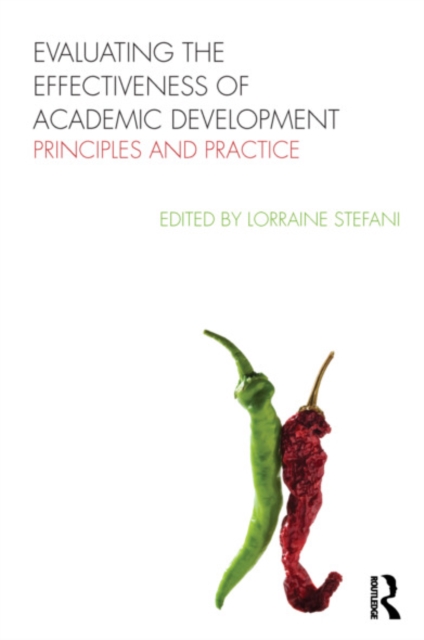
Evaluating the Effectiveness of Academic Development
How can Academic Developers provide evidence of the effectiveness and ‘added value’ of their work to the key stakeholders within their institutions?
Written for Academic Developers, academic administrators and others responsible for promoting organizational change, Evaluating the Effectiveness of Academic Development is a professional guide that shares best practice advice and provides developers with useful frameworks for effective evaluation and monitoring of their work.
Through case studies and up-to-date examples from experts in the field, this collection explores the nuances of evaluative practice and the tensions inherent in claiming a causal link between academic development and organizational transformation. As higher education institutions continue to seek effective ways to determine the impact of academic development on organizational transformation in general and student learning in particular, Evaluating the Effectiveness of Academic Development is sure to be an invaluable resource.
1. Evaluating the effectiveness of academic development: an overview , Lorraine Stefani
2. Locating Academic Development: the first step in evaluation , Shelda Debowski
3. The Quality Agenda: where does academic development sit? George Gordon
4. Demonstrating Fitness for Purpose: phronesis and authenticity as overarching purposes , Carolin Kreber
5. Using Student Survey Data to Shape Priorities and Approaches , Kerri-Lee Krause
6. Innovation and Change: responding to a digital environment , Cathy Gunn
Case Study 1. Whaia te pae tawhiti: Māori Academic Development at the University of Auckland , Matiu Ratima
Case Study 2. Academic Partnership: peer mentoring with early-career academics , Barbara Kensington-Miller
Case Study 3. Tending the Secret Garden: evaluating a doctoral skills program , Frances Kelly, Ian Brailsford and Susan Carter
Case Study 4. Evaluation as Bricolage: cobbling together a strategy for appraising supervision development , Barbara Grant
Case Study 5. Archiving for the Future: a longitudinal approach to evaluating a postgraduate certificate program , Helen Sword
Case Study 6. Tracking the Invisible: an elearning group’s approach to evaluation , Cathy Gunn and Claire Donald
Case Study 7. Continuous Improvement Projects: whose evaluation matters? Lorraine Stefani
Case Study 8. Leadership Programs: evaluation as a way forward , Linda McLain
7. Accrediation, Accountability and Assessment: addressing multiple agendas , Claudia Stanny and Jane Halonen
8. An Institutional Program: a national model for evaluation? Roni Bamber
9. Evaluation matters in a national, funded academic development project , Kogi Nadoo and Alison Holmes
10. Impact Evaluation and its Implications , Kathleen Gray and Alex Radloff
Endnote , Lorraine Stefani
Lorraine Stefani is Director and Professor of the Centre for Academic Development (CAD) at the University of Auckland.
eBook