
Catalogue Search | MBRL


Are you sure you want to remove the book from the shelf?

{{itemTitle}}
640
result(s) for
"Multiculturalism -- France"
Sort by:


Africa and France
Africa and France reveals how increased control over immigration has changed cultural and social production, especially in theatre, literature, film, and even museum construction. A hated of foreigners, accompanied by new forms of intolerance and racism, has crept from policy into popular expressions of ideas about the postcolony and ethnic minorities. Dominic Thomas's stimulating and insightful analyses unravel the complex cultural and political realities of longstanding mobility between Africa and Europe and question the attempt at placing strict limits on what it means to be French or European. Thomas offers a sense of what must happen to bring about a renewed sense of integration and global Frenchness.
eBook


Black France : colonialism, immigration, and transnationalism
[W]ithout a doubt one of the most important studies so far
completed on literature in French grounded in the experiences of migrants of
sub-Saharan African origin. -- Alec Hargreaves, Florida State
University France has always hosted a rich and vibrant black
presence within its borders. But recent violent events have raised questions about
France's treatment of ethnic minorities. Challenging the identity politics that have
set immigrants against the mainstream, Black France explores how black expressive
culture has been reformulated as global culture in the multicultural and
multinational spaces of France. Thomas brings forward questions such as -- Why is
France a privileged site of civilization? Who is French? Who is an immigrant? Who
controls the networks of production? Black France poses an urgently needed
reassessment of the French colonial legacy.
eBook

Identity Papers
What does citizenship mean? The essays in this volume range in subject from fiction and essay to architecture and film. Among the topics discussed are the 1937 Exposition Universelle; films dealing with Vichy France; François Truffaut's Histoire d'Adèle H.; the war of Algerian independence; and nation building under François Mitterrand. Contributors: Anne Donadey, U of Iowa; Elizabeth Ezra, U of Stirling, Scotland; Richard J. Golsan, Texas A Lynn A. Higgins, Dartmouth College; T. Jefferson Kline, Boston U; Panivong Norindr, U of Wisconsin, Milwaukee; Shanny Peer, New York U; Rosemarie Scullion, U of Iowa; David H. Slavin; Philip H. Solomon; Florianne Wild, U of Alabama.
eBook
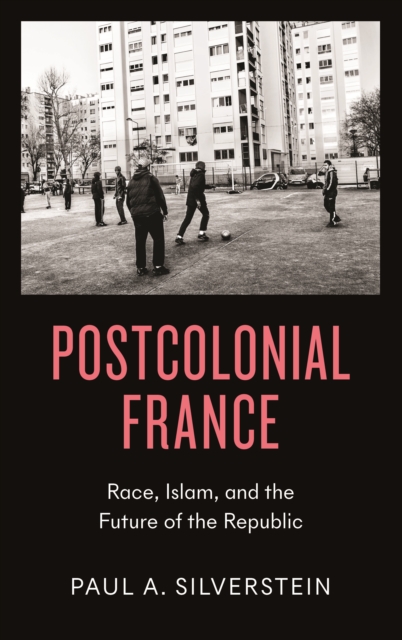
Postcolonial france : the question of race and the future of the republic
France is a bellwether for the postcolonial anxieties and populist politics emerging across the world today. This book explores the dynamics and dilemmas of the present moment of crisis and hope in France, through an exploration of recent moral panics. Taking stock of the tensions as they have emerged over the last quarter of a century, Paul Silverstein looks at urban racial violence, female Islamic dress and male public prayer, anti-system gangster rap, and sporting performances in and around which debates over France's multicultural future have arisen. It traces these conflicts to the unresolved tensions of an imperial project, the present-day effects of which are still felt by many. Despite the barriers, which include neo-nationalist racism and Islamophobia, French citizens of various backgrounds have found ways to build flourishing lives. Silverstein shows how they have responded to urban marginalisation, police violence and institutional discrimination in remarkably creative ways.
eBook

Race in Translation
While the term \"culture wars\" often designates the heated
arguments in the English-speaking world spiraling around race, the
canon, and affirmative action, in fact these discussions have raged
in diverse sites and languages. Race in Translation charts the
transatlantic traffic of the debates within and between three
zones-the U.S., France, and Brazil. Stam and Shohat trace the
literal and figurative translation of these multidirectional
intellectual debates, seen most recently in the emergence of
postcolonial studies in France, and whiteness studies in Brazil.
The authors also interrogate an ironic convergence whereby rightist
politicians like Sarkozy and Cameron join hands with some leftist
intellectuals like Benn Michaels, Žižek, and Bourdieu in condemning
\"multiculturalism\" and \"identity politics.\" At once a report from
various \"fronts\" in the culture wars, a mapping of the germane
literatures, and an argument about methods of reading the
cross-border movement of ideas, the book constitutes a major
contribution to our understanding of the Diasporic and the
Transnational.
eBook

Board Diversity and Corporate Social Responsibility: Empirical Evidence from France
This study analyzes how the board's characteristics could be associated with globally corporate social responsibility CSR and specific areas of CSR. It is drawn on all listed firms, in 2016, on the SBF120 between 2003 and 2016. Our results provide strong evidence that diversity in boards and diversity of boards globally are positively associated with corporate social performance. However, they influence differently specific dimensions of CSR performance. First, we show that large boards are positively associated with all areas of CSR performance, while specific and overall CSR scores are negatively associated with CEO-chair structures. Second, board gender diversity is positively associated with human rights and corporate governance dimensions. Third, age diversity is positively associated with corporate governance, human resources, human rights, and environmental activities. Also, our results provide evidence that outside directors care about CSR performance. Specifically, the presence of foreign directors is positively associated with environmental performance and community involvement, whereas CSR-Governance dimension is positively associated with the presence of independent directors. Regarding the director's educational level, post-graduated directors are positively and significantly associated with overall CSR score and all CSR sub-scores, except the corporate governance one. When directors have multiple directorships, they are more concerned about human resources, environmental performance, and business ethics. Finally, our findings are robust only in non-family firms. In fact, family boards are less diverse than non-family ones; specifically, they have a lower number of independent, foreign, and high-educated directors.
Journal Article

Foreign Modernism
At the beginning of the twentieth century, Paris was the cosmopolitan hub of Europe and home to a vast number of foreigners – including the writers, painters, sculptors, and musicians who were creating works now synonymous with modernism itself, such as Les Desmoiselles d’Avignon , The Rite of Spring , and Ulysses . The situation at the end of the period, however, could not have been more different: even before the violence of the Second World War, the cosmopolitan avant-garde had largely abandoned Paris, driven out by nationalism, xenophobia, and intolerance.
Foreign Modernism investigates this tense and transitional moment for both modernism and European multiculturalism by looking at the role of foreigners in Paris’s artistic scene. Examining works of literature, sculpture, ballet and performing arts, music, and architecture, Ihor Junyk combines cultural history with contemporary work in transnationalism and diaspora studies. Junyk emphasizes how émigré artists used radical new forms of art to resist the culture of virulent nationalism taking root in France, and to articulate new forms of cosmopolitan identity.
eBook

How migrants’ transcultural perceptions shape their children’s bilingual language development: Insights from a cross-sectional multicultural study
Little is known about the factors affecting children's language acquisition in transcultural situations and how clinicians can take these children's specific needs into account.
To better understand the acquisition of bilingualism by migrant parents' children, our aim was to study the relations between parental transcultural perceptions and their children's language skills in both the heritage language and the host country's majority language.
This cross-sectional study included 114 kindergarten children, born in France to migrant parents speaking Arabic, Tamil, or Soninke. Children's expressive language and comprehension skills were assessed with the ELAL and the N-EEL scales. In semistructured interviews, parents answered questions about perceptions of migration-related changes, extended-family relationships, and transgenerational transmission. Quantitizing methods and regression models were used to assess these factors' potential associations with children's language skills after adjustment for background characteristics and languages used at home.
Children of parents with a strongly positive perception of transgenerational transmission had better expressive skills in their heritage language. However, strongly positive parental perceptions of extended-family relationships and of migration-related changes were independently associated with some poorer skills in the heritage language. None of these transcultural/familial factors was significantly associated with any of the majority language skills assessed.
This research suggests that parental perceptions of migration, extended-family relationships, and transgenerational transmission are closely related to their children's heritage language skills regardless of the choice of languages spoken at home. Further research on transcultural factors is necessary to illuminate the mechanisms underlying bilingual learning and inform evidence-based practices for clinicians.
Journal Article