
Catalogue Search | MBRL


Are you sure you want to remove the book from the shelf?

{{itemTitle}}
498
result(s) for
"Multiculturalism Germany."
Sort by:

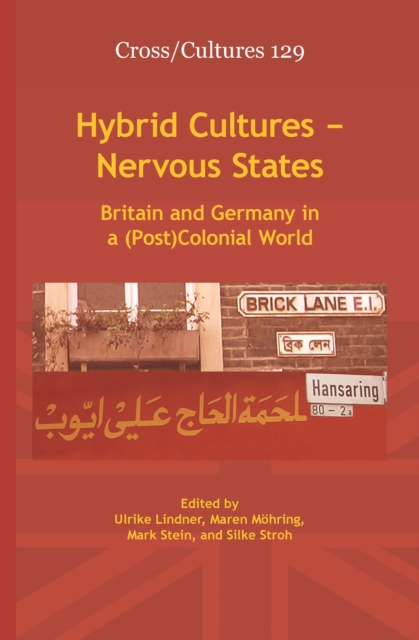
Hybrid cultures - nervous states : Britain and Germany in a (post)colonial world
While cultural diversity and hybridity have often been celebrated, they also challenge traditional concepts of national and cultural identity - challenges which have caused considerable anxiety. Various disciplines have often investigated the impact of cultural hybridity, multiculture, and (post)colonialism in relative isolation and with a tendency towards over-theorization and loss of specificity. Greater interdisciplinary cooperation can counter this tendency and encourage sustained comparisons between different former empires and across language boundaries. This volume contributes to such developments by combining contributions from history, English and German studies, cultural geography, theatre studies, and film studies; by covering both the colonial and the postcolonial period; and by looking comparatively at two different (post)colonial contexts: the United Kingdom and Germany. The result is productive dialogue across the distinct colonial and migration histories of the UK and Germany, which brings out divergent concepts of cultural difference - but, importantly, without neglecting similarities and transnational developments. The interdisciplinary outlook extends beyond political definitions of identity and difference to include consumer culture, literature, film, and journalism - cultural and social practices that construct, represent, and reflect personal and collective identities. Section I discusses the historical and contemporary role of colonial experience and its remembrance in the construction of national identities. Section II follows on by tracing the reflections of (post)coloniality and twentieth-century migration in the specific fields of economic history and consumer culture. Section III centres on recent debates about multiculture and national/cultural identity in politics, literature, and film.
eBook

Native bias : overcoming discrimination against immigrants
\"As migration to Europe has increased, so too has discrimination again immigrant populations. Countries across the EU have supported and instituted policies to force assimilation as part of a larger regional fear that immigration from Muslim majority cultures, especially, will threaten Europeans' national identities and increase the risk of radicalization. The common wisdom has been that immigrants must change their appearance, their religion, or their language in an attempt to \"pass\" as members of the majority. Through a series of innovative field experiments, the authors show that assimilationist strategies are not the only or even the best way to reduce biases: rather, discrimination is reduced when immigrants and natives share social norms that define a common identity as citizens. The core of the empirical work was done in a series of extensive, multi-year experiments in Germany--an ideal site for this work given its large immigrant population and its clearly defined cultural norms. The work showed both what animated discriminatory attitudes (cultural differences, and religious differences in particular), how this animus played out in everyday interactions (a disinclination to offer assistance to immigrant minorities, and religious Muslim immigrants in particular), and what behaviors reduce discrimination. They find--going against much conventional and even scholarly wisdom--that immigrants speaking German face as much discrimination as those using a foreign language. On the other hand, immigrants that uphold social norms (anti-littering or a progressive attitude towards women, for instance) see decreased discrimination. Ultimately, the authors offer a meticulously researched picture of what modern discrimination looks like, how it can be reduced, and the continued burden that immigrants face\"-- Provided by publisher.
BOOK

Becoming multicultural : immigration and the politics of membership in Canada and Germany
This book demonstrates how global human rights norms intersected with domestic political identities and institutions to transform Canada and Germany into diverse multicultural societies in the second half of the twentieth century.
eBook

Migration, memory, and diversity : Germany from 1945 to the present
\"Within Germany, policies and cultural attitudes toward migrants have been profoundly shaped by the difficult legacies of the Second World War and its aftermath. This wide-ranging volume explores the complex history of migration and diversity in Germany from 1945 to today, showing how conceptions of 'otherness' developed while memories of the Nazi era were still fresh, and identifying the continuities and transformations they exhibited through the Cold War and reunification. It provides invaluable context for understanding contemporary Germany's unique role within regional politics at a time when an unprecedented influx of immigrants and refugees present the European community with a significant challenge\"--Publisher description.
Book

Polyculturalism and discourse
This volume gathers together research by ten scholars engaging with multicultural discourse in Australia and Germany. The term 'polyculturalism' rather than 'multiculturalism' is employed deliberately to re-open a space in which the workings of discourse on culturally diverse societies, both as archive or practice, and as intervention, can be considered in greater depth. The inter-cultural perspective and wide range of disciplinary affiliations exhibited by the essays in this volume contribute to this goal: whereas the majority of discourse analytical work addresses the diversity of speaking positions, as well as the arbitrariness of ascribed meanings, within a historical framework delimited by national boundaries and disciplinary boundaries, the texts collected here transgress this perspective in working comparatively between Australia and Germany.
eBook


New Germans, New Dutch
In the globalised world of today, traditional definitions of national Self and national Other no longer hold. The unmistakable transformation of German and Dutch societies demands a thorough rethinking of national boundaries on several levels. This book examines how literature of migration intervenes in public discourses on multiculturality in Germany and the Netherlands, epitomised in the strikingly parallel debates on the 'German Leitkultur' and the Dutch 'multicultural drama' in the year 2000. By juxtaposing detailed analyses of literary work by the Turkish-German writers Emine Sevgi özdamar and Feridun Zaimoglu and the Moroccan-Dutch writers Abdelkader Benali and Hafid Bouazza, New Germans, New Dutch offers crucial insights into the specific ways in which this literature negotiates its national context of writing. This book demonstrates how German literature of migration seeks alternative forms of community outside the national parameters, whereas the Dutch literature negotiates difference and re-imagines Dutchness within the national framework.
De etnische transformatie van de Duitse en Nederlandse samenleving vraagt om diepgaande reflectie op het omstreden concept van nationale identiteit. Literatuur levert een belangrijke bijdrage aan dit proces van reflectie. New Germans, New Dutch onderzoekt migratieliteratuur in de Nederlandse en Duitse context. Literaire werken van de Turks Duitse schrijvers Emine Sevgi özdamar en Feridun Zaimoglu en de Marokkaans-Nederlandse schrijvers Abdelkader Benali en Hafid Bouazza worden beschouwd als kritische buiteninterventies in polariserende debatten over het 'multiculturele drama' en de 'deutsche Leitkultur'. De Duits-Nederlandse vergelijking biedt een verrassend inzicht in de nationale specificiteit van zowel deze interventies als van de verbeeldingen van nationale identiteit in deze literatuur. Dit is de eerste uitgave in de reeks Palimpsest: Disorientations.
eBook

Fragmented fatherland
1945 to 1980 marks an extensive period of mass migration of students, refugees, ex-soldiers, and workers from an extraordinarily wide range of countries to West Germany. Turkish, Kurdish, and Italian groups have been studied extensively, and while this book uses these groups as points of comparison, it focuses on ethnic communities of varying social structures—from Spain, Iran, Ukraine, Greece, Croatia, and Algeria—and examines the interaction between immigrant networks and West German state institutions as well as the ways in which patterns of cooperation and conflict differ. This study demonstrates how the social consequences of mass immigration became intertwined with the ideological battles of Cold War Germany and how the political life and popular movements within these immigrant communities played a crucial role in shaping West German society.
eBook

Fortifying Citizenship: Policy Strategies for Civic Integration in Western Europe
Why have European states introduced mandatory integration requirements for citizenship and permanent residence? There are many studies comparing integration policy and examining the significance of what has been interpreted as a convergent and restrictive “civic turn,” a “retreat from multiculturalism,” and an “inevitable lightening of citizenship.” None of these studies, however, has puzzled over the empirical diversity of integration policy design or presented systematic, comparative explanations for policy variation. This article is the first to develop an argument for what, in fact, amounts to a wealth of variation in civic integration policy (including scope, sequencing, and difficulty). Using a historical institutionalist approach, the author argues that states use mandatory integration to address different membership problems, which are shaped by both existing citizenship policy (whether it is inclusive or exclusive) and political pressure to change it (in other words, the politics of citizenship). She illustrates this argument by focusing on three case studies, applying the argument to a case of unchallenged restrictive retrenchment and continuity (Denmark), to a case of negotiated and thus moderated restriction (Germany), and to a case that recently exhibited both liberal continuity (the United Kingdom, 2001–6) and failed attempts at new restriction (the United Kingdom, 2006–10). These cases show that although states may converge around similar mandatory integration instruments, they may apply them for distinctly different reasons. As a result, new requirements augment rather than alter the major contours of national citizenship policy and the membership association it maintains.
Journal Article