
Catalogue Search | MBRL


Are you sure you want to remove the book from the shelf?

{{itemTitle}}
1,447
result(s) for
"Multilingual education."
Sort by:


Tension-Filled English at the Multilingual University
This book begins with the idea that English in the multilingual
university is filled with and surrounded by tensions, from the
renegotiation and bending of language norms to the emotional strain
of the increasing use of English. It explores how these tensions
are experienced by those who find themselves in multilingual
university settings outside the anglophone world and use English in
their research or education. The author examines the use of English
in multiple domains in Swedish universities, progressing from macro
perspectives on language policies to in-depth qualitative studies
of individuals. The book presents both a synthesis of recent
scholarship on the use of language in multilingual universities and
the author's own empirical findings, which are situated in a
theoretical framework based on the work of Mikhail Bakhtin. The
book offers the reader a novel way of tracing the links between
language perceptions and practices on the ground, and the forces
and processes which govern these practices.
eBook


Motivation to learn multiple languages in Japan : a longitudinal perspective
This book provides rare insights into motivation among extremely successful learners of English and languages other than English (LOTEs) through the analysis of a longitudinal study and the examination of the factors involved in becoming multilingual in a non-multilingual environment. Based on sixteen interview sessions, conducted over the course of nine years while the learners progressed from high school to the world of work, this book offers the story of how two learners persist in English/LOTE learning. The study illuminates the long-term processes through which the interviewees develop ideal English/LOTE selves in an environment where multilingualism is not emphasized and where both English and LOTEs can still be described as foreign languages. Educators and researchers will learn from this study, which stretches our understanding of motivation beyond the recent theorizing of L2 motivation and contributes to the limited research in long-term motivational trajectories and LOTE learning motivation, which is particularly scarce in non-European contexts. The book will be of interest not only to readers in Japan but also to those in other contexts as it offers an example of successful learners who go beyond the pragmatic and instrumentalist view of language learning to hold a more holistic view, thus revealing the factors which can sustain multiple language learning, even in foreign language contexts.
eBook

Content-based language learning in multilingual educational environments
The spread of English as an international language along with the desire to maintain local languages lead us to consider multilingualism as the norm rather than the exception. Consequently, bi/multilingual education has bloomed over the last decades. This volume deals with one such type of education currently in the spotlight as an essentially European strategy to multilingualism, CLIL (Content and Language Integrated Learning), in which curricular content is taught through a foreign language. The book contributes new empirical evidence on its effects on linguistic and attitudinal outcomes focusing on bi/multilingual learners who acquire English as an additional language. Moreover, it presents critical analyses of factors influencing multilingual education, the effects of CLIL on both language and content learning, and the contrast between CLIL and other models of instruction. The research presented suggests that CLIL can greatly enhance language acquisition in multilingual settings.
Book

International students' multilingual literacy practices : an asset-based approach to understanding academic discourse socialization
This book presents the results of research that focused on international students receiving writing instruction on a US university campus. It explores how the students developed their foreign-student identities and their own ways of grappling with the unique issues they encountered as they worked to improve their academic literacy skills.
eBook


Translanguaging, Coloniality and Decolonial Cracks
In this linguistic ethnography of bilingual science learning in a South African high school, the author connects microanalyses of classroom discourse to broader themes of de/coloniality in education. The book challenges the deficit narrative often used to characterise the capabilities of linguistically-minoritised youth, and explores the challenges and opportunities associated with leveraging students' full semiotic repertoires in learning specific concepts. The author examines the linguistic landscape of the school and the beliefs and attitudes of staff and students which produce both coloniality and cracks in the edifice of coloniality. A critical translanguaging lens is applied to analyse multilingual and multimodal aspects of students' science meaning-making in a traditional classroom and a study group intervention. Finally, the book suggests implications for decolonial pedagogical translanguaging in Southern multilingual classrooms.
eBook

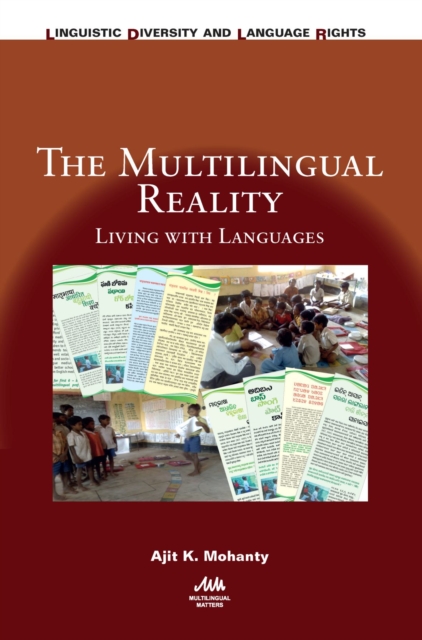
The Multilingual Reality
This book is a multidisciplinary analysis of the meaning and
dynamics of multilingualism from the perspectives of multilingual
societies and language communities in the margins, who are trapped
in a vicious circle of disadvantage. It analyses the social,
psychological and sociolinguistic processes of linguistic dominance
and hierarchical relationships among languages, discrimination,
marginalisation and assertive maintenance in multilingualism
characterised by a Double Divide, and shows the relationship
between educational neglect of languages, capability deprivation
and poverty, and loss of linguistic diversity. Its comparative
analysis of language-in-education policies and practices and
applications of multilingual education (MLE) in diverse contexts
shows some promises and challenges in the education of
indigenous/tribal/minority children. This book will be of interest
to students, researchers, educators and practitioners in
sociolinguistics, educational linguistics, psycholinguistics,
multilingualism and bilingual/multilingual education.
eBook