
Catalogue Search | MBRL


Are you sure you want to remove the book from the shelf?

{{itemTitle}}
2,111
result(s) for
"Multiple personality."
Sort by:


Rewriting the Soul
Twenty-five years ago one could list by name the tiny number of multiple personalities recorded in the history of Western medicine, but today hundreds of people receive treatment for dissociative disorders in every sizable town in North America. Clinicians, backed by a grassroots movement of patients and therapists, find child sexual abuse to be the primary cause of the illness, while critics accuse the \"MPD\" community of fostering false memories of childhood trauma. Here the distinguished philosopher Ian Hacking uses the MPD epidemic and its links with the contemporary concept of child abuse to scrutinize today's moral and political climate, especially our power struggles about memory and our efforts to cope with psychological injuries.
What is it like to suffer from multiple personality? Most diagnosed patients are women: why does gender matter? How does defining an illness affect the behavior of those who suffer from it? And, more generally, how do systems of knowledge about kinds of people interact with the people who are known about? Answering these and similar questions, Hacking explores the development of the modern multiple personality movement. He then turns to a fascinating series of historical vignettes about an earlier wave of multiples, people who were diagnosed as new ways of thinking about memory emerged, particularly in France, toward the end of the nineteenth century. Fervently occupied with the study of hypnotism, hysteria, sleepwalking, and fugue, scientists of this period aimed to take the soul away from the religious sphere. What better way to do this than to make memory a surrogate for the soul and then subject it to empirical investigation?
Made possible by these nineteenth-century developments, the current outbreak of dissociative disorders is embedded in new political settings.Rewriting the Soulconcludes with a powerful analysis linking historical and contemporary material in a fresh contribution to the archaeology of knowledge. As Foucault once identified a politics that centers on the body and another that classifies and organizes the human population, Hacking has now provided a masterful description of the politics of memory : the scientizing of the soul and the wounds it can receive.
eBook

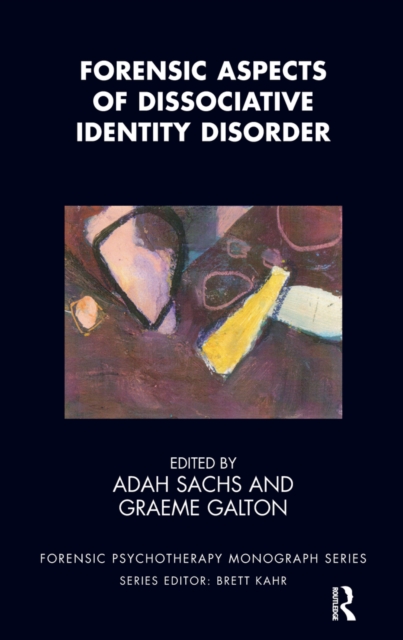
Forensic Aspects of Dissociative Identity Disorder
Forensic Aspects of Dissociative Identity Disorder examines the complex role of crime in the traumatic history of people with DID: crimes that they have endured, crimes that they have witnessed, and crimes that they have committed themselves. The book brings together the thoughts of professionals from a wide range of related fields: psychotherapy, psychiatry, medicine, law and law enforcement.These professionals, as well as two people with DID, address the complex clinical, moral, legal and ethical problems that this field presents.
eBook


Living with the Reality of Dissociative Identity Disorder
This book is the product of a Campaign Day organised by the Paracelsus Trust to raise awareness of Dissociative Identity Disorder (DID). The Campaign Day brought people together, enabling individuals to tell their story, and allowed all of those involved to recognise the progress that has been made in recognition of the condition, which has long been either ignored or misunderstood, and the possibilities for the future. As this was a profoundly moving experience, it was decided to put the presentations into a book, which recounts some painful personal experiences and some ideas for ways forward, always recognising the pain of the condition and the abuse that precedes it. The Paracelsus Trust is a Charity which exists to support people with DID who are in receipt of services from the Clinic for Dissociative Studies.
eBook

Freshwater
A debut novel exploring the metaphysics of identity and mental health, centering on a young Nigerian woman as she struggles to reconcile the proliferation of multiple selves within her.
BOOK

m-polar neutrosophic soft mapping with application to multiple personality disorder and its associated mental disorders
Multiple personality disorder (MPD) or dissociative identity disorder is the mental disease in which one can observe the existence of two or more than two personalities in a single person. We define the controversies nearby the diagnosis of MPD with its associated mental disorders. We discuss the various symptoms of MPD, dissociative amnesia, depersonalization or derealization disorder, and major depression disorder. After this exploration, we perceive that these disorders enclose parallel symptoms and it is difficult to identify the accurate type of disorder with its severeness. Since in experimental diagnosis the indeterminacy and falsity parts are often neglected. Due to this problem, we cannot see the accuracy in the patient’s improvement record and cannot predict the duration of treatment. To eradicate these boundaries, we present the m-polar neutrosophic soft set (MPNSS) and m-polar neutrosophic soft mapping (MPNS-mapping) with its inverse mapping. These notions are proficient and valuable to diagnose the disorder appropriately by connecting it with the mathematical modeling. The connection of m-polar neutrosophic set (MPNS) with the soft set characterizes a relation among patients, symptoms, and treatments which decreases the complexity of the case study. We build a chart based on a fuzzy interval [0, 1] to range the types of disorders. We establish an algorithm based on MPNS-mapping to identify the disease appropriately and to select the finest treatment for the corresponding disease of every patient. At last, we introduce the generalized MPNS-mapping which will helps a doctor to save the patient’s improvement record and to predict the period of treatment until the disease is cured.
Journal Article

Both of me
\"When her carry-on bag is accidentally switched with Elias's identical pack, Clara uses the luggage tag to track down her things. At that address she discovers there is not one Elias Phinn, but two\"-- Provided by publisher.
Book

Inter-Identity Autobiographical Amnesia in Patients with Dissociative Identity Disorder
A major symptom of Dissociative Identity Disorder (DID; formerly Multiple Personality Disorder) is dissociative amnesia, the inability to recall important personal information. Only two case studies have directly addressed autobiographical memory in DID. Both provided evidence suggestive of dissociative amnesia. The aim of the current study was to objectively assess transfer of autobiographical information between identities in a larger sample of DID patients.
Using a concealed information task, we assessed recognition of autobiographical details in an amnesic identity. Eleven DID patients, 27 normal controls, and 23 controls simulating DID participated. Controls and simulators were matched to patients on age, education level, and type of autobiographical memory tested.
Although patients subjectively reported amnesia for the autobiographical details included in the task, the results indicated transfer of information between identities.
The results call for a revision of the DID definition. The amnesia criterion should be modified to emphasize its subjective nature.
Journal Article