
Catalogue Search | MBRL


Are you sure you want to remove the book from the shelf?

{{itemTitle}}
136
result(s) for
"Mummies and mummification."
Sort by:

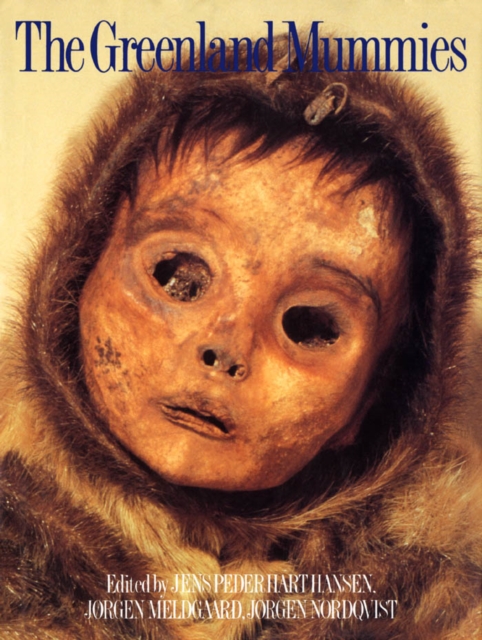
Greenland Mummies
In 1972, two brothers on a hunting expedition in Greenland, 450 kilometres north of the Arctic Circle, discovered the graves of six women and two children who had died more than 500 years ago. They had been buried in the traditional Inuit way, dressed in warm clothing and provided with the goods needed for their journey to the Land of the Dead. A combination of low ground temperature and dry air preserved their bodies and their clothing in excellent condition, making the Greenland mummies the oldest and most significant archaeological discovery in the Arctic.
eBook

IDEAS & TRENDS; Body Language: The Lure of The Dead
Approaching a dead body is like standing at the edge of a cliff. \"The closer you get to it, the more alluring it is,\" says Sherwin Nuland, the author of \"How We Die.\" Echoing Freud, Dr. Nuland says, \"we are most attracted to the things we fear most. We cover our eyes, but spread our fingers so we can see.\" Why? \"We identify with that body,\" he says. \"It is us.\" And the more horrible the death, the more alluring the body, because a violent death combines two things we fear most -- our own death and our aggression. Not everyone feels this intense a bond, but almost everyone has some visceral reaction to corpses, and not just at Halloween. Dr. Guillen says, \"My father doesn't want to shake my hands when he knows I've been working with dead people.\" The author Joyce Carol Oates likens looking at ancient corpses to \"looking at baby pictures.\" Sarah Carthew, who heads the British Museum Society, says that when she looks at Pete (the pet name for Lindow Man, who was dug from a peat bog), she thinks, \"That's my uncle.\" There's a price for digging up the dead. The very presence of corpses among the living endangers their survival. As Freud once said of buried memories and buried antiquities: \"Their burial had been their preservation.\" And so, their excavation is the beginning of their demise. \"This one has not let me sleep for the past two months,\" Dr. Guillen said of the ice woman. \"I'm worried about her.\"
Newspaper Article
IDEAS & TRENDS; Body Language: The Lure of The Dead
Approaching a dead body is like standing at the edge of a cliff. \"The closer you get to it, the more alluring it is,\" says Sherwin Nuland, the author of \"How We Die.\" Echoing Freud, Dr. Nuland says, \"we are most attracted to the things we fear most. We cover our eyes, but spread our fingers so we can see.\" Why? \"We identify with that body,\" he says. \"It is us.\" And the more horrible the death, the more alluring the body, because a violent death combines two things we fear most -- our own death and our aggression. Not everyone feels this intense a bond, but almost everyone has some visceral reaction to corpses, and not just at Halloween. Dr. Guillen says, \"My father doesn't want to shake my hands when he knows I've been working with dead people.\" The author Joyce Carol Oates likens looking at ancient corpses to \"looking at baby pictures.\" Sarah Carthew, who heads the British Museum Society, says that when she looks at Pete (the pet name for Lindow Man, who was dug from a peat bog), she thinks, \"That's my uncle.\" There's a price for digging up the dead. The very presence of corpses among the living endangers their survival. As Freud once said of buried memories and buried antiquities: \"Their burial had been their preservation.\" And so, their excavation is the beginning of their demise. \"This one has not let me sleep for the past two months,\" Dr. Guillen said of the ice woman. \"I'm worried about her.\"
Newspaper Article
World News Briefs; Lenin's Preservers Work On an Ancient Siberian
The man was found recently on the Ukok plateau, high in the Altai mountains near Russia's borders with China and Mongolia, Interfax said. He had long red hair, worn in braids, and he wore embroidered trousers, a fur coat and high boots. A horse was buried next to him.
Newspaper Article
CAT Scan for 3,000-Year-Old Mummy
\"Historically, this is a very important mummy,\" Dr. Brier, who has done research for the Egyptian Government and is a member of the Egyptian Exploration Society, said on Monday. \"For me it's special.\" Most likely, Dr. Brier added, the mummy was from Deir al-Bahri, a burial place for religious leaders and the wealthy on the west bank of the Nile. \"There aren't many Deir al-Bahri mummies around,\" he said. \"And I don't know of any that have been CAT-scanned.\" As for the early results, Dr. Streiter was moved to wave his arms in the air as he read the X-rays. \"This is cool,\" he said, \"really cool.\"
Newspaper Article
Mummies Found by Police
The Egyptian police have recovered 18 Pharaonic coffins and 10 mummies in raids on two houses near the Nile town of Minya, 160 miles south of Cairo, the...
Newspaper Article
THE MUMMY'S SECRET
Her coffin, decorated with colorful designs and hieroglyphics, showed Tabes as she probably wanted to look, said Mimi Leveque, a conservator at the museum. ''It's a very stylized, traditional Egyptian image with a small, very petite nose and regular features,'' she said. ''That probably was what the average person wanted to look like.'' ''He had severe hardening of the arteries,'' said Ms. Leveque. A doctor suggested that [Nesptah]'s calcified arteries might have been caused by diabetes, which produces similar conditions today.
Newspaper Article
2,500-YEAR-OLD EGYPTIAN RETURNS TO BOSTON HOME
''He's probably in better condition today than he was when he was interred,'' said Charles Hayward, an art history professor at Bay Path Junior Coillege, who arranged for the restoration work. Donated to Boston in 1823 ''He was just a little bit old,'' said Emil Schnorr, chief curator of the museum, who led the team of three workers who restored [Padihershef]. Mr. Schnorr said he spent six months working on the mummy ''until I couldn't stand it anymore.'' He said the smell of natron, a salt compound used by Egyptians for embalming, ''gets to you after awhile.''
Newspaper Article
WORKS IN PROGRESS; Under Wraps
At the instigation of the museum's curator of anthropology, Robert B. Pickering, and radiologist, Dr. Ethan M. Braunstein, Wenu-hotep's CT scan was performed at Indiana University Medical Center (above), generating images, such as the one shown at right, that collectively yield a 3-D visage. ''It's her mummy face, not what she looked like in real life,'' Pickering says. ''But using it, we can have a forensic facial reconstructionist do an artist's rendering of what she would have looked like.'' A new exhibit, including the artist's rendering and a video of the 3-D CT images (as well as the lady herself), is to open at the Children's Museum by year's end.
Newspaper Article