
Catalogue Search | MBRL


Are you sure you want to remove the book from the shelf?

{{itemTitle}}
63
result(s) for
"Municipal indigent policies"
Sort by:

A Review and Reformation of Municipal Indigent Policies Towards Sustainable Service Delivery in Selected Rural Municipalities in South Africa
The South African government has been focused on repealing unconstitutional laws, passing transformative policies, and building democratic and transparent policies responsive to the demands of the current generation and the public. This erected a need to have policy systems that largely resonate and address the problems upstretched in societies, intending to improve the quality of lives and advance communities. The National Framework for Municipal Indigent Policies issued a guiding document as a source of reference for the formulation and implementation of municipal indigent policies, with the intent of reducing poverty and eliminating service delivery backlogs in municipalities. The study seeks to examine and explore how indigent policies are implemented in rural municipalities to propose strategies to enhance the framework for sustainable service delivery. The objective of the study is to determine whether municipal indigent policies fulfil their dual purpose, which is to improve the lives of indigents and improve access to basic services. The study has established that indigent policies are deemed not sufficient to address the needs of indigents living in poverty and are reinforcing poverty rather than alleviating it. This has resulted in the dysfunction of municipal administration in terms of their indigent policies' implementation, failing the policies to yield their intended objectives, and as a result, most rural municipalities ended up being characterised as poor in their service delivery. The study argues that indigent policies can be consistent and serve as appropriate tools to fulfil the needs of indigent households, given that they are effectively formulated and their implementation yields desired outcomes. The study employed a qualitative research methodology supplemented by scholarly review of existing literature and document analysis. The study significantly contributes to theory and practice, concludes by proposing possible ways in which the challenges confronting municipal indigent policies can be effectively dealt with, and recommends that further empirical research be conducted to draw conclusions from both primary and secondary data.
Journal Article

Caring for the indigent urban population in South Africa: A case study of the eThekwini municipality
BackgroundIndigent policy within the eThekwini Metropolitan municipality like every well-meaning government policy seeks to address three major challenges of poverty, lack of employment and gross disparities that pose a major threat to growth in the city. Overcoming these threefold challenges forms a core objective of consolidating and advancing developmental local governance, which aims to support poor households with the intention of uplifting their everyday living conditions. There is no desire to change the current status quo of the eThekwini municipality indigent policy, and the gap still exists in the lack of internal control systems, a consolidated approach to execution and a dedicated office to deal with the roll-out of the support.AimThis research investigated factors undermining the effective implementation of this indigent policy and proposed a strategic policy framework that ensures a long-term solution to the ineffective implementation of indigent policy.SettingThe study was conducted in eThekwini Metropolitan Municipality, and respondents were employees in the following units: Electricity, Customer Services and Revenue Protection, Water Services, Finance Services, and Strategy Office.MethodsThe study adopted a qualitative data approach where a semi-structured interview was used to collect data from 11 purposively selected employees from five departments of eThekwini municipality.ResultsThe findings reveal that the indigent policy in eThekwini municipality is ineffective because of poor implementation, poor maintenance of the indigent register, budget deficit and corruption.ConclusionThe study concludes that some measures such as maintenance of indigent registers and adequate budget allocation to improve the inefficiency in the implementation of the indigent policy.
Journal Article

How much water is enough? Domestic metered water consumption and free basic water volumes : the case of Eastwood, Pietermaritzburg
In this study, a water resource management model that facilitates indicator-based decisions, with respect to environmental, social and economic dimensions in a multiple criteria perspective, is developed for the Gediz River Basin in Turkey. The basic input of the proposed model is the quantity of surface water that is mainly allocated to irrigation purposes. The model has been applied under 3 different hydro-meteorological scenarios that reflect baseline as well as better and worse conditions of water supply and demand, not only to reach a comprehensive assessment of the water budget in the Gediz Basin, but also to evaluate the impacts of proposed management alternatives under different conditions. The Water Evaluation and Planning (WEAP) software is used as a simulation and evaluation tool to assess the performance of possible management alternatives; performance is measured by 9 indicators representing economic, social and environmental sustainability. The study has delineated the best management alternative on the basis of 3 different multi-criteria decision making (MCDM) methods, including simple additive weighting (SAW), compromise programming (CP) and technique for order preference by similarity to ideal solution (TOPSIS). Each method is also applied with 7 different sets of criteria weights that represent objective judgements as well as subjective preferences of decision makers. The results of the study indicate that the decision on the best alternative is basically independent of the MCDM method used, but slightly sensitive to the weights assigned to the criteria as well as the data used in the analyses.
Journal Article
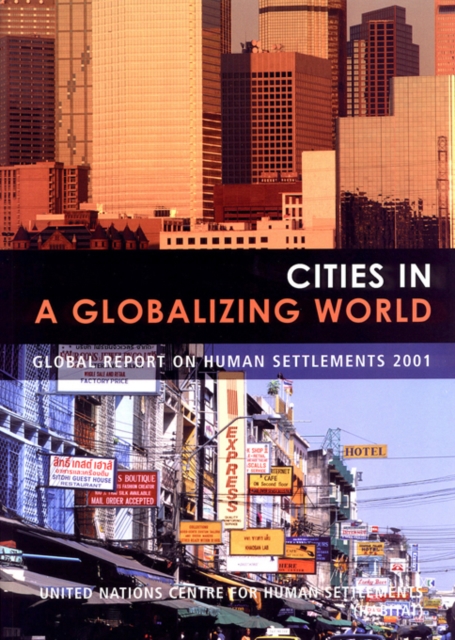
Cities in a Globalizing World
'The world has entered the urban millennium. Nearly half the world's people are now city dwellers, and the rapid increase in urban population is expected to continue, mainly in developing countries. This historic transition is being further propelled by the powerful forces of globalization. The central challenge for the international community is clear: to make both urbanization and globalization work for all people, instead of leaving billions behind or on the margins. Cities in a Globalizing World: Global Report on Human Settlements is a comprehensive review of conditions in the world's cities and the prospects for making them better, safer places to live in an age of globalization. I hope that it will provide all stakeholders - foremost among them the urban poor themselves - with reliable and timely information with which to set our policies right and get the machinery of urban life moving in a constructive direction.' From the Foreword by Kofi Annan, Secretary-General, United Nations.
Cities in a Globalizing World presents a comprehensive review of the world's cities and analyses the positive and negative impacts on human settlements of the global trends towards social and economic integration and the rapid changes in information and communication technologies. In this Global Report, the United Nations Centre for Human Settlements (Habitat) draws on specially commissioned and contributed background papers from more than 80 leading international specialists. The report focuses on recent trends in human settlements and their implications for poverty, inequity and social polarization. It develops advance knowledge for urban planning and management policies in support and promotion of inclusive cities and good urban governance. This major and influential report is the most authoritative and up-to-date assessment of human settlements conditions and trends. Written in clear, non-technical language and supported by informative graphics, ca
eBook

Ambulatory Health Care Use by Patients in a Public Hospital Emergency Department
OBJECTIVE: To describe primary care clinic use and emergency department (ED) use for a cohort of public hospital patients seen in the ED, identify predictors of frequent ED use, and ascertain the clinical diagnoses of those with high rates of ED use. DESIGN: Cohort observational study. SETTING: A public hospital in Atlanta, Georgia. PATIENTS: Random sample of 351 adults initially surveyed in the ED in May 1992 and followed for 2 years. MEASUREMENTS AND MAIN RESULTS: Of the 351 patients from the initial survey, 319 (91%) had at least one ambulatory visit in the public hospital system during the following 2 years and one third of the cohort was hospitalized. The median number of subsequent ED visits was 2 (mean 6.4), while the median number of visits to a primary care appointment clinic was 0 (mean 1.1) with only 90 (26%) of the patients having any primary care clinic visits. The 58 patients (16.6%) who had more than 10 subsequent ED visits accounted for 65.6% of all subsequent ED visits. Overall, patients received 55% of their subsequent ambulatory care in the ED, with only 7.5% in a primary care clinic. In multivariate regression, only access to a telephone (odds ratio [OR] 0.48; 95% confidence interval [CI] 0.39, 0.60), hospital admission (OR 5.90; 95% CI 4.01, 8.76), and primary care visits (OR 1.68; 95% CI 1.34, 2.12) were associated with higher ED visit rates. Regular source of care, insurance coverage, and health status were not associated with ED use. From clinical record review, 74.1% of those with high rates of use had multiple chronic medical conditions, or a chronic medical condition complicated by a psychiatric diagnosis, or substance abuse. CONCLUSIONS: All subgroups of patients in this study relied heavily on the ED for ambulatory care, and high ED use was positively correlated with appointment clinic visits and inpatient hospitalization rates, suggesting that high resource utilization was related to a higher burden of illness among those patients. The prevalence of chronic medical conditions and substance abuse among these most frequent emergency department users points to a need for comprehensive primary care. Multidisciplinary case management strategies to identify frequent ED users and facilitate their use of alternative care sites will be particularly important as managed care strategies are applied to indigent populations who have traditionally received care in public hospital EDs.
Journal Article

The effects of medical factors on transfer deficits in Public Assistance in Japan: a quantile regression analysis
In countries where local governments are heavily involved in financing health care for the indigent, regional disparities in local revenues may adversely affect the access of the poor to medical care. It is thus important to examine how central governments provide funds for such local medical needs. In Japan, local governments finance all medical costs for the poor through their Public Assistance (PA) programs. Using the unique mechanism of the Japanese system of central grants, I construct a measure of \"transfer deficit\" which shows the portion of the PA expenditures that fails to be secured by the central grants. The distribution of such a measure provides important information to assess the regional equity in financing local programs. The results suggest a compromise on the regional equity in financing medical care for the indigent. Then, I explore the determinants of the deficit measure by performing a quantile regression analysis. Since no effects of potential determinants imply that the central grants well accommodate changes in local needs, finding such effects helps evaluate the performance of the transfer system. The results shows that, among others, the number of PA households and the factors related to mental illness of PA recipients have positive impacts that attenuate toward the top of the conditional quantile of the transfer deficit. I elaborate on plausible causes of such attenuating responses.
Journal Article

