
Catalogue Search | MBRL


Are you sure you want to remove the book from the shelf?

{{itemTitle}}
4,011
result(s) for
"Murat"
Sort by:

Hadji Murat
\"Inspired by a historical figure Tolstoy heard about while serving in the Caucasus, this story brings to life the famed warrior Hadji Murat, a Chechen rebel who has fought fiercely and courageously against the Russian empire. After a feud with his commander he defects to the Russians, only to find that he is now trusted by neither side. He is first welcomed but then imprisoned by the Russians under suspicion of being a spy, and when he hears news of his wife and son held captive by the Chechens, Murat risks all to try to save his family\"--Back cover.
Book


Revisiting History in Yeşilçam Cinema: An Analysis on Yeşilçam Heroes; Karaoğlan, Malkoçoğlu, Kara Murat and Battal Gazi
History presented in films has always been problematic. This debate is generally categorized into two categories, if the historical movies are loyal to the historical fact or if they should be aesthetically considered an art form. Costume adventure films in Turkish Cinema, present mythological characters with fantasy elements raising nationalist sentiments. This authentic genre in Turkish Cinema takes history as a background motif presenting Karaoğlan, Malkoçoğlu, Kara Murat and Battal Gazi, yet combines real facts and people in history with fantasy world heroes and incidents. Hence, these films raise a query regarding the accuracy of their portrayal in relation to historical fact. This paper aims to uncover the fact beyond the fantasy, the conflict between the real people and their representations in the movies in a different perspective.
Journal Article

Analyzing the Connectivity of Fracture Networks Using Natural Fracture Characteristics in the Khairi Murat Range, Potwar Region, Northern Pakistan
Rock fracture connectivity is a developing concept that demonstrates the effectiveness of fracture networks in facilitating the preferential flow of fluid through the medium. This study demonstrates the significance and impact of fracture parameters in determining the connectivity of fracture networks. An attempt is made to define fracture parameters, such as fracture density, length, and the quotient of dispersion in their orientation, in addition to understanding the characteristics of fracture and the connectivity of the fracture network in a specified domain. The results based on field observations and measurements at outcrops of the Khairi Murat Range, including the study of field photographs and images, indicate that the fractional connected area (FCA) significantly determines the connectivity of fracture networks and, conversely, depends upon the fracture parameters. Eight fracture sets identified in the study area represent the intensity of dispersion of the strike angles of the fractures. The angular dispersion, i.e., the Fisher coefficient of strike angle of the fracture sets, ranges from 0.26 to 1, indicating that the fracture sets are systematic and concentrated in one direction. Although fracture density and length establish a linear relationship, fracture network connectivity is surprisingly independent of length. Scale-dependent fracture length plays a significant role in serving as the “backbone” of the network in the connectivity of the fracture system. Instead of the length and size of the cluster, fracture network connectivity is affected by fracture orientation and density. Characterization of the fracture properties-based approach successfully explores the connectivity of fracture networks on an outcrop scale.
Journal Article

Diagenetic evolution of Early Eocene Chorgali Formation in the Upper Indus Basin of Pakistan: outcrop, petrographic and geochemical signatures
The study investigates the Early Eocene Chorgali Formation in the Khair-e-Murat Range of the Upper Indus Basin of Pakistan. The Chorgali Formation has previously been vastly studied for depositional settings and biostratigraphy but have not been evaluated for detailed diagenetic evaluation. Therefore, the present study is carried out to understand the detailed paragenetic sequence of the Chorgali Formation at its type locality in the Khair-e-Murat Range. Outcrop investigations were performed, and samples were collected for laboratory analyses. The collected samples were further studied for detailed petrography and stable isotope geochemistry (δ
13
C and δ
18
O). Field, petrographic and geochemical observations were integrated and a paragenetic sequence of diagenesis was developed. The paragenetic sequence of the Chorgali Formation shows the multiple stages i.e., cementation, micritization, compaction, dissolution, dolomitization, pyritization and dedolomitization. The dolomitization in the study section is from mimetic (preserved original depositional fabrics) to non-mimetic fabric (replaced the original depositional fabrics). The stable δ
13
C and δ
18
O isotope values of the dolomite matrix vary from δ
13
C (–38.87 to 0.04 V-PDB‰) and δ
18
O (–10.12 to –3.95 V-PDB‰) respectively. The isotope values of different calcite types of cement range δ
13
C (–35.88 to –4.76 V-PDB‰) and δ
18
O (–13.66 to –3.42 V-PDB‰), respectively. The isotopic values of studied samples of δ
13
C and δ
18
O range from (δ
13
C –9.98 to δ
18
O-7.84 V-PDB‰). The values are highly depleted, suggesting the meteoric origin of dolomitization. The diagenetic events range from shallow burial eogenetic to deep burial telogenetic diagenesis. The paragenetic sequence of these diagenetic events with help of filed, petrographic and isotopic signature offers insights into the pre- and post-depositional history of the studied sequence and the regional basin evaluation. Additionally, it enhances the understanding of how various diagenetic processes have altered porosity and permeability.
Journal Article
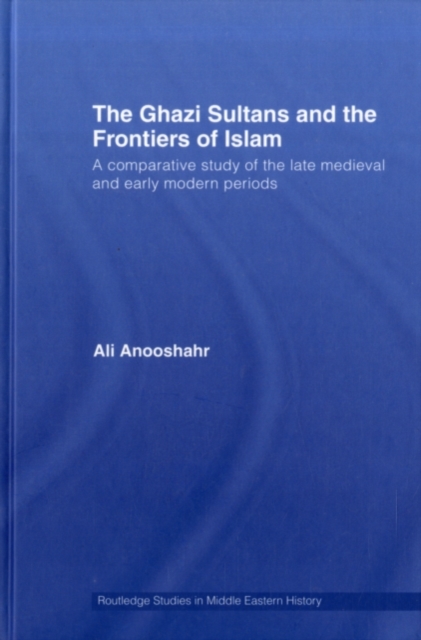
The Ghazi Sultans and the Frontiers of Islam
The Ghazi Sultans were frontier holy-warrior kings of late medieval and early modern Islamic history. This book is a comparative study of three particular Ghazis in the Muslim world at that time, demonstrating the extent to which these men were influenced by the actions and writings of their predecessors in shaping strategy and the way in which they saw themselves.
Using a broad range of Persian, Arabic and Turkish texts, the author offers new findings in the history of memory and self-fashioning, demonstrating thereby the value of intertextual approaches to historical and literary studies. The three main themes explored include the formation of the ideal of the Ghazi king in the eleventh century, the imitation thereof in fifteenth and early sixteenth century Anatolia and India, and the process of transmission of the relevant texts. By focusing on the philosophical questions of ‘becoming’ and ‘modelling’, Anooshahr has sought alternatives to historiographic approaches that only find facts, ideology, and legitimization in these texts.
This book will be of interest to scholars specialising in Medieval and early modern Islamic history, Islamic literature, and the history of religion.
Ali Anooshahr teaches Comparative Pre-modern Islamic History at the University of California, Davis.
'Anooshahr’s hypotheses are plausible and derive from meticulous research. They offer a promising new perspective on the significance of an ideology vital to Islamic historiography in the Middle Period.' - CARL F. PETRY, Northwestern University, American Historical Review, October 2009
'This is a provocative and intelligent book, and promises to engage specialists in various disciplines of Near Eastern, Central Asian and Islamic studies.' - Insight Turkey Vol.12/ No.1/ 2010
Introduction 1. How Babur became a Ghazi 2. Disclaiming Timur’s Inheritance and the Rise of the Mughal Empire 3. The Origins of the Ghazi King 4. Inventing the Image of the ‘Founder King’ 5. The Triad of kings 6. Tatars and Ottomans 7. The Ghazas of Sultan Murad II. Conclusion
eBook

Unveiling Vernacular Features: Interdisciplinary Knowledge for the Conservation of Villa Murat in the Sorrento Peninsula
The Sorrento Peninsula is characterized by a significant occurrence of examples of vernacular architecture, which exhibit distinctive morphological and constructive features. These have been the subject of numerous studies. However, some buildings have undergone a process of transformation over time, the details of which have yet to be investigated. Architectures that initially held a rural character were enlarged and ennobled, thereby becoming what could be termed as “villas of delights”. However, these clearly manifest their origin based on the permanence of some vernacular features. This paper focuses on the analysis of a case study, Villa Murat, which is exemplary in illustrating this process. This thorough interdisciplinary research combines historical investigation, based mainly on archival documents, with a direct examination of the Villa. This has enabled the retracing of the building’s evolution and of the events that occurred in it. An integrated survey, which employed photogrammetry and laser scanning, enabled the assessment of the current state of conservation. The ultimate objective of this research is to propose conservative interventions which, in conjunction with the suggested new intended use, could ensure the preservation of the Villa.
Journal Article

Paradoxical Philogyny: The Comtesse de Murat’s Defense of Women and Female Friendship in Dialogue with François Poullain de la Barre and Gabrielle Suchon
In her memoirs, the Comtesse de Murat replies to the long list of misogynist accusations made in Abbé de Villiers’s Mémoires de la vie du comte D*** avant sa retraite (1696) by criticizing gender inequalities and by emphasizing female virtue. This article focuses on Murat’s positive representation of female friendship, whereby she denounces Villiers’s allegation that women’s affection is guided by greed. While Murat’s protagonist proves the contrary through her devoted comradeship with Mademoiselle Laval, not all female relationships in Murat’s memoirs are portrayed in a favourable light. The protagonist’s femme de chambre, for example, confirms Villiers’s critique of female covetousness and disloyalty. Even the relationship between the protagonist and Mademoiselle Laval is tarnished by sapphic allusions that are, however, outwardly denied. This article analyzes Murat’s paradoxical representation of women that builds on pro-feminist arguments by François Poullain de la Barre and Gabrielle Suchon. Yet, this paradox is lessened in Murat through the attribution of immoral acts to both sexes. Furthermore, the intimate connection between Mademoiselle Laval and the protagonist lends itself to a double entendre that advocates for homoeroticism and a preference for female-centred communities over heterosexual relationships.
Journal Article

Russian-Muslim Confrontation in the Caucasus
This book presents two extraordinary texts - The Shining of Swords by Al-Qarakhi and a new translation for a contemporary readership of Leo Tolstoy's Hadji Murat - illuminating the mountain war between the Muslim peoples of the Caucasus and the imperial Russian army from 1830 to 1859. The authors offer a complete commentary on the various intellectual and religious contexts that shaped the two texts and explain the historical significance of the Russian-Muslim confrontation. It is shown that the mountain war was a clash of two cultures, two religious outlooks and two different worlds. The book provides an important background for the ongoing contest between Russia and indigenous people for control of the Caucasus.
eBook