
Catalogue Search | MBRL


Are you sure you want to remove the book from the shelf?

{{itemTitle}}
494
result(s) for
"Museum techniques History."
Sort by:

Museums : a history
\"This comprehensive history of museums begins with the origins of collecting in prehistory and traces the evolution of museums from grave goods to treasure troves, from the Alexandrian Temple of the Muses to the Renaissance cabinets of curiosities, and onto the diverse array of modern institutions worldwide. The development of museums as public institutions is explored in the context of world history with a special emphasis on the significance of objects and collecting. The book examines how the successful exportation of the European museum model and its international adaptations have created public institutions that are critical tools in diverse societies for understanding the world. Rather than focusing on a specialized aspect of museum history, this volume provides a comprehensive synthesis of museums worldwide from their earliest origins to the present. Museums: A History tells the fascinating story of how museums respond to the needs of the cultures that create them.\"--Provided by publisher.
Book

Museums
This comprehensive history of museums begins with the origins of collecting in prehistory and traces the evolution of museums from grave goods to treasure troves, from the Alexandrian Temple of the Muses to the Renaissance cabinets of curiosities, and onto the diverse array of modern institutions worldwide. The development of museums as public institutions is explored in the context of world history with a special emphasis on the significance of objects and collecting. The book examines how the successful exportation of the European museum model and its international adaptations have created public institutions that are critical tools in diverse societies for understanding the world. Rather than focusing on a specialized aspect of museum history, this volume provides a comprehensive synthesis of museums worldwide from their earliest origins to the present. Museums: A History tells the fascinating story of how museums respond to the needs of the cultures that create them. Readers will come away with an understanding of: the comprehensive history of museums from prehistoric collections to the present the evolution of museums presented in the context of world history the development of museums considered in diverse cultural contexts global perspective on museums the object-centered history of museums museums as memory institutions A constant theme throughout the book is that ,useums have evolved to become institutions in which objects and learning are associated to help human beings understand the world around them. Illustrations amplify the discussions.
eBook

Inside the lost museum : curating, past and present
For more than two centuries museums have preserved art, artifacts, and natural specimens, engaged and educated the public, and provided resources for research in areas from art history to zoology. Inside the Lost Museum explains the work of museums--collecting, preserving, displaying, and using collections--by considering their remarkable history. Museums make choices about what's worth saving. Inside the Lost Museum explores those choices, and the processes--from donation to purchase to expedition--that shape collections. Once collected, museum objects are numbered, cataloged, and conserved, and sometimes deaccessioned--processes that have their own hows and whys. Museums display art and artifact in many ways, from dioramas and period rooms to paintings on white walls and visual storage. Inside the Lost Museums reveals the meanings of those choices, and the ways that they have changed and continue to change, shaped by new technologies and ideologies. It also argues for the the value of museum collections for research, teaching, and community-building. Woven through Inside the Lost Museum is the story of the Jenks Museum of Brown University, a nineteenth-century museum of natural history, anthropology and \"curiosities\" that disappeared a century ago. The Jenks Museum's history, and a recent effort to re-imagine that museum as art, science and history, serves as a framework for understanding museums' long record of usefulness and service. Inside the Lost Museum considers the lessons museum history holds for museums today and tomorrow.-- Provided by publisher
Book

The Public Art Museum in Nineteenth Century Britain
During the mid-nineteenth century a debate arose over the form and functions of the public art museum in Britain. Various occurrences caused new debates in Parliament and in the press about the purposes of the public museum which checked the relative complacency with which London's national collections had hitherto been run. This book examines these debates and their influence on the development of professionalism within the museum, trends in collecting and tendencies in museum architecture and decoration. In so doing it accounts for the general development of the London museums between 1850 and 1880, with particular reference to the National Gallery. This involves analysis of art display and its relations with art historiography, alongside institutional and architectural developments at the British Museum, the South Kensington Museum and the National Gallery. It is argued that the underpinning factor in all of these developments was a reformulation of the public museum's mission, which was in turn related to the electoral reform movement. In a potential situation of mass enfranchisement, the 'masses' should be well educated; the museum was openly identified as a useful institution in this sense. This consideration also influenced approaches to collecting and arranging artworks and to configuring their architectural setting within the museum, allowing for displays to be instructive in specific ways. Dissatisfaction with the British Museum and National Gallery buildings and their locations led to proposals to move the national collections, possibly merging and redefining them. Again the socio-political usefulness of the museum was key in determining where the national collections should be housed and in what form of building. This rich debate is analysed with full references to the various forums in and out of Parliament. Part one covers these issues in a thematic structure, examining all of the national collections, their interrelationships and their gradual development of discrete (yet sometimes arbitrary) museological territories. Part two focuses on the individual case of the National Gallery, observing how museological debate was brought to bear on the development of a specific institution. Every architectural development and redisplay is closely analysed in order to gauge the extent to which the products of debate were carried through into practice, and to comprehend the reasons why no museological grand project emerged in London.
This book would not have been possible were it not for the help and support of Malcolm Baker, Anthony Burton, David Carter, Jonathan Conlin, the late Francis Haskell, Hero Lotti, Donata Levi, Rhiannon Mason, Susan Pearce, Barbara Pezzini, Charles Saumarez Smith, Isobel Siddons, Paul Tucker, Matti Watton, Giles Waterfield and the late Clive Wainwright. Special thanks are due to Paola Barocchi, under whose enlightened tutelage this book began life as a doctoral thesis, to my editors Tom Gray and Sarah Charters, to my friends Martin Barnes and Imke Valentien, to the various branches of my family in the UK and Italy and, last but by no means least, to my wife Erica Bemporad.
eBook

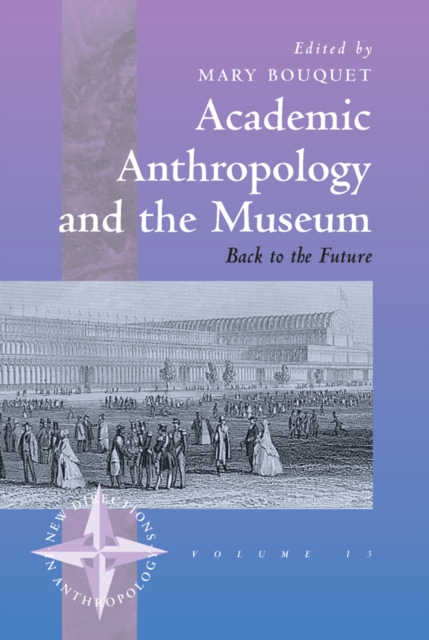
Academic anthropology and the museum
The museum boom, with its accompanying objectification and politicization of culture, finds its counterpart in the growing interest by social scientists in material culture, much of which is to be found in museums. Not surprisingly, anthropologists in particular are turning their attention again to museums, after decades of neglect, during which fieldwork became the hallmark of modern anthropology - so much so that the \"social\" and the \"material\" parted company so radically as to produce a kind of knowledge gap between historical collections and the intellectuals who might have benefitted from working on these material representations of culture. Moreover it was forgotten that museums do not only present the \"pastness\" of things. A great deal of what goes on in contemporary museums is literally about planning the shape of the future: making culture materialize involves mixing things from the past, taking into account current visions, and knowing that the scenes constructed will shape the perspectives of future generations. However, the (re-)invention of museum anthropology presents a series of challenges for academic teaching and research, as well as for the work of cultural production in contemporary museums - issues that are explored in this volume.
eBook

Mediating memory in the museum : trauma, empathy, nostalgia
\"Mediating Memory in the Museum is a contribution to an emerging field of research which is situated at the interface between memory studies and museum studies. It highlights the role of museums in the proliferation of the so-called memory boom as well as the influence of memory discourses on international trends in museum cultures. By looking at a range of museums in Germany, Britain, France and Belgium, which address a diverse spectrum of topics such as migration, difficult and dark heritage, war, slavery and the GDR, Arnold-de Simine outlines the paradigm shifts in exhibiting practices associated with the transformation of traditional history museums and heritage sites into 'spaces of memory' over the past thirty years. She probes the political and ethical claims of new museums and maps the relevance of key concepts such as 'vicarious trauma', 'secondary witnessing', 'empathic unsettlement', 'prosthetic memory' and 'reflective nostalgia' in the museum landscape\"-- Provided by publisher.
Book
Making Histories in Museums
This exciting new series recognizes the tremendous potential of museum-based histories and the ways in which they can engage people with ideas about the past.People encounter and use museums on many different levels - personal, social and intellectual - and access meanings that best fit their agendas.
eBook


Exhibiting Europe in museums
Museums of history and contemporary culture face many challenges in the modern age. One is how to react to processes of Europeanization and globalization, which require more cross-border cooperation and different ways of telling stories for visitors. This book investigates how museums exhibit Europe. Based on research in nearly 100 museums across the Continent and interviews with cultural policy makers and museum curators, it studies the growing transnational activities of state institutions, societal organizations, and people in the museum field such as attempts to Europeanize collection policy and collections as well as different strategies for making narratives more transnational like telling stories of European integration as shared history and discussing both inward and outward migration as a common experience and challenge. The book thus provides fascinating insights into a fast-changing museum landscape in Europe with wider implications for cultural policy and museums in other world regions.
eBook