
Catalogue Search | MBRL


Are you sure you want to remove the book from the shelf?

{{itemTitle}}
4,317
result(s) for
"Museums Evaluation."
Sort by:


The Engaging Museum
This very practical book guides museums on how to create the highest quality experience possible for their visitors. Creating an environment that supports visitor engagement with collections means examining every stage of the visit, from the initial impetus to go to a particular institution, to front-of-house management, interpretive approach and qualitative analysis afterwards.
This holistic approach will be immensely helpful to museums in meeting the needs and expectations of visitors and building their audience.
This book features:
includes chapter introductions and discussion sections
supporting case studies to show how ideas are put into practice
a lavish selection of tables, figures and plates to support and illustrate the discussion
boxes showing ideas, models and planning suggestions to guide development
an up-to-date bibliography of landmark research.
The Engaging Museum offers a set of principles that can be adapted to any museum in any location and will be a valuable resource for institutions of every shape and size, as well as a vital addition to the reading lists of museum studies students.
eBook

Purposeful museum programming using visitor response pedagogies
\"Purposeful Museum Programming Using Visitor Response Pedagogies offers museums of all sizes and genres practical, accessible, and inclusive programming ideas\"-- Provided by publisher.
Book
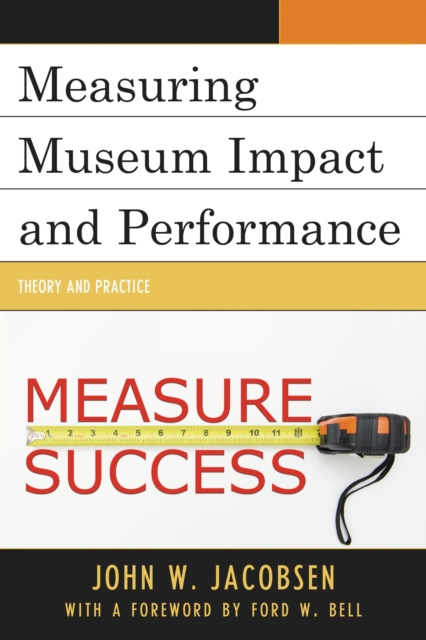
Measuring museum impact and performance
Based on extensive research and decades of experience, museum analyst and planner John W. Jacobsen provides both the theoretical underpinnings and the operational pragmatics of measuring any museum's intentional impact and performance by using 1,025 indicators drawn from 51 expert sources. Measuring Museum Impact and Performance: Theory and Practice provides museum professionals internationally with a clear, very open process that will improve their museum's value and performance by selecting indicators that monitor whether they are realizing their desired public, private, personal and institutional values. The book is not prescriptive, but liberating, as the framework recognizes that each museum needs to decide on its own purposes and priorities. The book is organized in two parts: \"Part 1: Theory\" is scholarly and builds on the museum field’s rich literature; and \"Part 2: Practice\" provides step-by-step methods for any museum to set up its own dashboard of prioritized impact and performance indicators. Substantive attachments include: the list of the 51 source documents for the MIIP indicators; definitions of terms and data fields; a long list of precedented museum impacts; measurement formulas and worksheet templates, filled in for a sample museum; and the MIIP 1.0 database available online. Readers will get the following benefits: - A literature review of prior work on measuring museum value - An analysis of eleven well-established evaluation frameworks that synthesize into a revolutionary, yet practical, Museum Theory of Action - A robust and searchable menu of 1,025 existing and aspirational indicators (the MIIP 1.0 database) that you can use to start your own selection - An analysis of the MIIP database using the Theory of Action that reveals 14 areas of potential museum impacts and benefits - A process to select and prioritize your museum’s intentional purposes and desired impacts - A process to determine, measure and compare your museum’s key performance indicators (KPIs) - A process to set-up and conduct peer museum comparisons - Procedures and examples of how to capture and report data used in your selected indicators - Principles for using indicator data to inform museum management decisions
eBook


Practical evaluation guide : tools for museums and other informal educational settings
Administrators of museums and other informal-learning centers often need to demonstrate, in some tangible way, the effectiveness of their institutions as teaching tools. Practical Evaluation Guide discusses specific methods for analyzing audience learning and behavior in museums, zoos, botanic gardens, nature centers, camps, and youth programs.
Evaluation is essential because it allows you to answer critical questions like:
How can one measure the impacts of educational experiences in a museum, zoo, or aquarium?Are digital technologies more effective than traditional exhibits for enhancing visitor interest and understanding? How does one measure learning in these informal environments where visitors themselves decide what they will experience? Since we know many visitors come to informal institutions for social interaction and play, how does one access these social impacts?
The Practical Evaluation Guide is an all-in-one resource to guide professionals working in museums and other informal educational institutions. This new edition includes updates throughout and features a brand-new chapter on evaluating digital interactive exhibits. The section on observational tools includes a new section on using video recordings and the section on interviews includes recent studies from countries outside the U.S.
Practical Evaluation Guide serves as a basic, easy-to-follow guide for museum professionals and students who want to understand the effects of such public institutions on the people who visit them.
eBook

Evaluating accessibility in museums : a practical guide
\"This book bridges accessibility and evaluation through case studies of museums that highlight the role of evaluation in accessibility work\"-- Provided by publisher.
Book

Gleaning museum visitors’ behaviors by analyzing questions asked in a mobile app
This study explores the feasibility of forming detailed inferences about museum visitor behavior based on analysis of data collected via Dr. Discovery—a mobile question-and-answer app. We analyzed 5656 questions asked by 795 visitor groups recorded by Dr. Discovery across two museums in the American Southwest. Analysis of this data supported the act of intuiting visitor movement through museum exhibit halls without the use of costly tracking or location technology by leveraging question keyword content, knowledge of exhibit hall layout, and question timestamp information. Additionally, data on question topic frequency enabled us to infer visitor engagement levels with specific exhibit hall content. We conclude that analysis of seemingly limited app-based data carries implications for the practice of museum evaluation since evaluators can gain evidence-based insight into visitor behaviors as well as illustrate helpful and promising technology-supported alternatives for conducting affordable, dependable, and scalable evaluations.
Journal Article

The museum of the senses : experiencing art and collections
\"Traditionally sight has been the only sense with a ticket to enter the museum. The same is true of histories of art, in which artworks are often presented as purely visual objects. The Museum of the Senses offers a sensory history of art and collections, revealing how people used to handle, smell and even taste artworks and artefacts. Topics range from the tactile power of relics to the sensuous allure of cabinets of curiosities, and from the feel of a Rembrandt to the scent of Monet's garden. The book concludes with a discussion of how contemporary museums are stimulating the senses through interactive and multimedia displays. Constance Classen, a leading authority on the cultural history of the senses, has produced a fascinating study of sensual and emotional responses to artefacts from the middle ages to the present. The Museum of the Senses is an important read for anyone interested in the history of art as well as for students and researchers in cultural studies and museum studies\"-- Provided by publisher.
Book
Ask Dr. Discovery: the impact of a casual mobile game on visitor engagement with science museum content
This study examines the impact of a mobile game app on science museum visitors’ level of engagement with exhibit content, compared to a non game-based version of the same app. Ask Dr. Discovery (Dr. D) is a question-asking app containing two versions: a Game Mode employing casual game mechanics and an Ask Mode providing a baseline version. We implemented both versions of Dr. D at two science museums located in the Southwestern United States with 1539 participants. In both conditions, participants could type or speak questions to receive vetted answers about museum content, but only Game Mode embedded question-asking within a simple game. Participants’ level of engagement was represented by the number of questions asked about exhibit content in Dr. D. Additionally, we explored the relationship between app engagement and participants’ self-reported level of interest in science. All participants completed pre- and post-questionnaires with questions related to science interest, impressions of the Dr. D app, and demographic information. Results in both museums indicated that users of Game Mode asked nearly twice as many questions on average as participants using Ask Mode. Science interest predicted engagement at one of two sites. Demographic variables, including gender, age, and race/ethnicity were not found to influence the rate of question asking in either mode. These results indicate that employing simple game mechanics in apps for museum visitors may lead to strong positive impacts on visitor engagement with museum content.
Journal Article