
Catalogue Search | MBRL


Are you sure you want to remove the book from the shelf?

{{itemTitle}}
106
result(s) for
"Music 21st century History and criticism."
Sort by:


Towards a Twenty-First-Century Feminist Politics of Music
Towards a Twenty-First-Century Feminist Politics of Music opens up a new way of thinking about the absence of women's music. It does not aim to find 'a solution' in a liberal feminist sense, but to discover new potentialities, new possibilities for thought and action. Sally Macarthur encourages us, with the assistance of Deleuze, and feminist-Deleuzian work, to begin the important work of imagining what else might be possible, not in order to provide answers but to open up the as yet unknown. The power of thought - or what Deleuze calls the 'virtual' - opens up new possibilities. Macarthur suggests that the future for women's 'new' music is not tied to the predictable and known but to futures beyond the already-known. Previous research concludes that women's music is virtually absent from the concert hall, and yet fails to find a way of changing this situation. Macarthur finds that the flaw in the recommendations flowing from past research is that it envisages the future from the standpoint of the present, and it relies on a set of pre-determined goals. It thus replicates the present reality, so reinforcing rather than changing the status quo. Macarthur challenges this thinking, and argues that this repetitive way of thinking is stuck in the present, unable to move forward. Macarthur situates her argument in the context of current dominant neoliberal thought and practice. She argues that women have generally not thrived in the neoliberal model of the composer, which envisages the composer as an individual, autonomous creator and entrepreneur. Successful female composers must work with this dominant, modernist aesthetic and exploit the image of the neo-romantic, entrepreneurial creator. This book sets out in contrast to develop a new conception of subjectivity that sows the seeds of a twenty-first-century feminist politics of music.
eBook

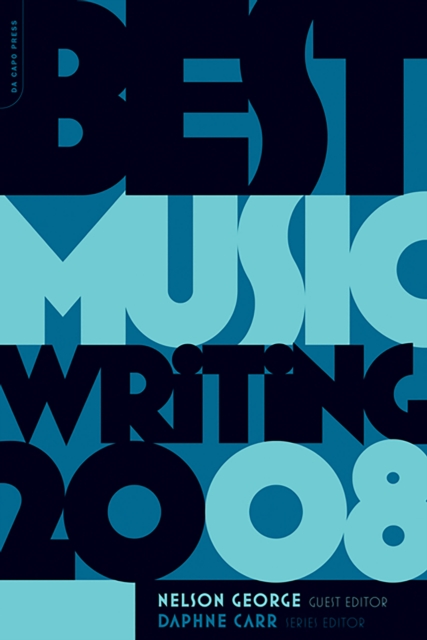
Best Music Writing 2008
The ninth entry in the acclaimed series celebrating the best writing on every style of music, from rock to hip-hop, RB to jazz, pop to blues, and more.Best music writing is the definitive guide to the year in music writing, an annual feast of essays, missives, and musings on every musical style by critics, novelists, and musicians themselves. Culled from publications ranging from blogs to the New Yorker, the 2008 edition captures a year in music writing as diverse and riveting as the music it illuminates.Writers who have appeared in Best Music Writing include: Greil Marcus, Sarah Vowell, Nick Tosches, Jonathan Lethem, Dave Eggers, David Rakoff, David Hadju, Lenny Kaye, The Onion, Gary Giddins, Jessica Hopper, Luc Sante, Kelefa Sanneh, David Byrne, Daphne A. Brooks, Jody Rosen, Anne Midgette, Sasha Frere-Jones, Elizabeth Méndez Berry, Alex Ross, Touré, Lynn Hirschberg, Chuck Klosterman, Elizabeth Gilbert, Jay McInerney, Elvis Costello, Susan Orlean, Mike Doughty, Lorraine Ali, and many more.
eBook


The Ashgate Research Companion to Minimalist and Postminimalist Music
In recent years the music of minimalist composers such as La Monte Young, Terry Riley, Steve Reich and Philip Glass has, increasingly, become the subject of important musicological reflection, research and debate. Scholars have also been turning their attention to the work of lesser-known contemporaries such as Phill Niblock and Eliane Radigue, or to second and third generation minimalists such as John Adams, Louis Andriessen, Michael Nyman and William Duckworth, whose range of styles may undermine any sense of shared aesthetic approach but whose output is still to a large extent informed by the innovative work of their minimalist predecessors. Attempts have also been made by a number of academics to contextualise the work of composers who have moved in parallel with these developments while remaining resolutely outside its immediate environment, including such diverse figures as Karel Goeyvaerts, Robert Ashley, Arvo Pärt and Brian Eno.
Theory has reflected practice in many respects, with the multimedia works of Reich and Glass encouraging interdisciplinary approaches, associations and interconnections. Minimalism's role in culture and society has also become the subject of recent interest and debate, complementing existing scholarship, which addressed the subject from the perspective of historiography, analysis, aesthetics and philosophy. The Ashgate Research Companion to Minimalist and Postminimalist Music provides an authoritative overview of established research in this area, while also offering new and innovative approaches to the subject.
eBook

Music after the fall : modern composition and culture since 1989
This is the first book to survey contemporary Western art music within the transformed political, cultural, and technological environment of the post-Cold War era. In this book, Tim Rutherford-Johnson considers musical composition against this changed backdrop, placing it in the context of globalization, digitization, and new media. Drawing connections with the other arts, in particular visual art and architecture, he expands the definition of Western art music to include forms of composition, experimental music, sound art, and crossover work from across the spectrum, inside and beyond the concert hall. Each chapter is a critical consideration of a wide range of composers, performers, works, and institutions, and develops a broad and rich picture of the new music ecosystem, from North American string quartets to Lebanese improvisers, from electroacoustic music studios in South America to ruined pianos in the Australian outback. Rutherford-Johnson puts forth a new approach to the study of contemporary music that relies less on taxonomies of style and technique than on the comparison of different responses to common themes of permission, fluidity, excess, and loss.
Book

Vocal Music and Contemporary Identities
Looking at musical globalization and vocal music, this collection of essays studies the complex relationship between the human voice and cultural identity in 20th- and 21st-century music in both East Asian and Western music. The authors approach musical meaning in specific case studies against the background of general trends of cultural globalization and the construction/deconstruction of identity produced by human (and artificial) voices. The essays proceed from different angles, notably sociocultural and historical contexts, philosophical and literary aesthetics, vocal technique, analysis of vocal microstructures, text/phonetics-music-relationships, historical vocal sources or models for contemporary art and pop music, and areas of conflict between vocalization, \"ethnicity,\" and cultural identity. They pinpoint crucial topical features that have shaped identity-discourses in art and popular musical situations since the1950s, with a special focus on the past two decades. The volume thus offers a unique compilation of texts on the human voice in a period of heightened cultural globalization by utilizing systematic methodological research and firsthand accounts on compositional practice by current Asian and Western authors.
eBook


Kaija Saariaho
This book is the first comprehensive study of the music and career of contemporary composer Kaija Saariaho. Born in Finland in 1952, Saariaho received her early musical training at the Sibelius Academy, where her close circle included composer and conductor Esa-Pekka Salonen. She has since become internationally known and recognized for her operas L'amour de loin and Adriana Mater and other works that involve electronic music. Her influences include the spectral analysis of timbre, especially string sounds, micropolyphonic techniques, the visual and literary arts, and sounds in the natural world._x000B__x000B_Pirkko Moisala approaches the unique characteristics of Saariaho's music through composition sketches, scores, critical reviews, and interviews with the composer and her trusted musicians. Drawing extensively from this material, Moisala describes the development of Saariaho's career and international reception, the characteristics of her musical expression, and the progression of her compositional process.
eBook