
Catalogue Search | MBRL


Are you sure you want to remove the book from the shelf?

{{itemTitle}}
141
result(s) for
"Music Political aspects United States History."
Sort by:


Pulse of the People
Hip-Hop music encompasses an extraordinarily diverse range of approaches to politics. Some rap and Hip-Hop artists engage directly with elections and social justice organizations; others may use their platform to call out discrimination, poverty, sexism, racism, police brutality, and other social ills. InPulse of the People, Lakeyta M. Bonnette illustrates the ways rap music serves as a vehicle for the expression and advancement of the political thoughts of urban Blacks, a population frequently marginalized in American society and alienated from electoral politics.
Pulse of the Peoplelays a foundation for the study of political rap music and public opinion research and demonstrates ways in which political attitudes asserted in the music have been transformed into direct action and behavior of constituents. Bonnette examines the history of rap music and its relationship to and extension from other cultural and political vehicles in Black America, presenting criteria for identifying the specific subgenre of music that is political rap. She complements the statistics of rap music exposure with lyrical analysis of rap songs that espouse Black Nationalist and Black Feminist attitudes. Touching on a number of critical moments in American racial politicsincluding the 2008 and 2012 elections and the cases of the Jena 6, Troy Davis, and Trayvon MartinPulse of the Peoplemakes a compelling case for the influence of rap music in the political arena and greatly expands our understanding of the ways political ideologies and public opinion are formed.
eBook

Songs of America : patriotism, protest, and the music that made a nation
From \"The Star-Spangled Banner\" to \"Born in the U.S.A.,\" Jon Meacham and Tim McGraw take readers on a journey through eras in American history and the songs and performers that inspired us. Meacham chronicles our history, exploring the stories behind the songs, and Tim McGraw reflects on them as an artist and performer. Their perspectives combine to create a unique view of the role music has played in uniting and shaping a nation. Beginning with the battle hymns of the revolution, and taking us through songs from the defining events of the Civil War, the fight for women's suffrage, the two world wars, the Great Depression, the civil rights movement, the Vietnam War, and into the twenty-first century, Meacham and McGraw explore the songs that defined generations, and the cultural and political climates that produced them. Readers will discover the power of music in the lives of figures such as Harriet Tubman, Franklin Roosevelt, Eleanor Roosevelt, and Martin Luther King, Jr., and will learn more about some of our most beloved musicians and performers, including Marian Anderson, Elvis Presley, Sam Cooke, Aretha Franklin, Bob Dylan, Duke Ellington, Carole King, Bruce Springsteen, and more.
Book

Freedom Song
Melding memorable music and inspiring history, Freedom Song presents a fresh perspective on the civil rights movement by showing how songs of hope, faith, and freedom strengthened the movement and served as its voice. In this eye-opening account, you'll discover how churches and other groups--from the SNCC Freedom Singers to the Chicago Children's Choir--transformed music both religious and secular into electrifying anthems that furthered the struggle for civil rights. From rallies to marches to mass meetings, music was ever-present in the movement. People sang songs to give themselves courage and determination, to spread their message to others, to console each other as they sat in jail. The music they shared took many different forms, including traditional spirituals once sung by slaves, jazz and blues music, and gospel, folk, and pop songs. Freedom Song explores in detail the galvanizing roles of numerous songs, including \"Lift Every Voice and Sing,\" \"The Battle of Jericho,\" \"Wade in the Water,\" and \"We Shall Overcome.\" As Rosa Parks, Martin Luther King Jr., and many others took a stand against prejudice and segregation, a Chicago minister named Chris Moore started a children's choir that embraced the spirit of the civil rights movement and brought young people of different races together, young people who lent their voices to support African Americans struggling for racial equality. More than 50 years later, the Chicago Children's Choir continues its commitment to freedom and justice. An accompanying CD, Songs on the Road to Freedom, features the CCC performing the songs discussed throughout the book.
eBook

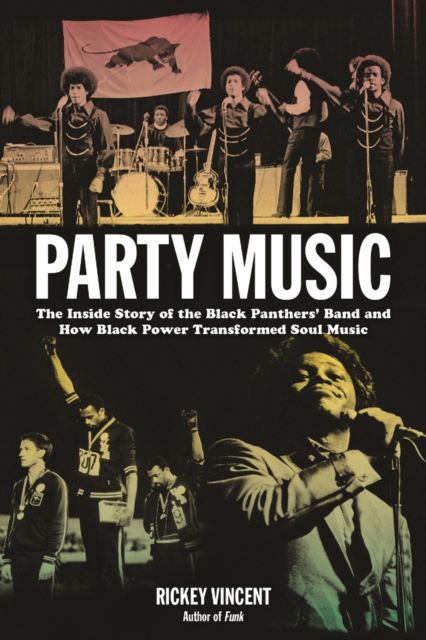
Party Music
Connecting the black music tradition with the black activist tradition, Party Music brings both into greater focus than ever before and reveals just how strongly the black power movement was felt on the streets of black America. Interviews reveal the never-before-heard story of the Black Panthers' R&B band the Lumpen and how five rank-and-file members performed popular music for revolutionaries. Beyond the mainstream civil rights movement that is typically discussed are the stories of the Black Panthers, the Black Arts Movement, the antiwar activism, and other radical movements that were central to the impulse that transformed black popular music—and created soul music.
eBook

Rocking in the free world : popular music and the politics of freedom in postwar America
\"Progressive and libertarian, anti-Communist and revolutionary, Democratic and Republican, quintessentially American but simultaneously universal. By the late 1980s, rock music had acquired a dizzying array of political labels. These claims about its political significance shared one common thread: that the music could set you free. Rocking in the Free World explains how Americans came to believe they had learned the truth about rock 'n' roll, a truth shaped by the Cold War anxieties of the Fifties, the countercultural revolutions (and counter-revolutions) of the Sixties and Seventies, and the end-of-history triumphalism of the Eighties. How did rock 'n' roll become enmeshed with so many different competing ideas about freedom? And what does that story reveal about the promise-and the limits-of rock music as a political force in postwar America?\"-- Provided by publisher.
BOOK

Harnessing Harmony
Following the creation of the United States, profound disagreements remained over how to secure the survival of the republic and unite its diverse population. In this pathbreaking account, Billy Coleman uses the history of American music to illuminate the relationship between elite power and the people from the early national period to the Civil War. Based on deep archival research in sources such as music periodicals, songbooks, and manuals for musical instruction, Coleman argues that a particular ideal of musical power provided conservative elites with an attractive road map for producing the harmonious union they desired. He reassesses the logic behind the decision to compose popular patriotic anthems like \"The Star-Spangled Banner,\" reconsiders the purpose of early American campaign songs, and brings to life a host of often forgotten but fascinating musical organizations and individuals. The result is not only a striking interpretation of music in American political life but also a fresh understanding of conflicts that continue to animate American democracy.
eBook


Destructive Desires
Despite rhythm and blues culture’s undeniable role in molding, reflecting, and reshaping black cultural production, consciousness, and politics, it has yet to receive the serious scholarly examination it deserves. Destructive Desires corrects this omission by analyzing how post-Civil Rights era rhythm and blues culture articulates competing and conflicting political, social, familial, and economic desires within and for African American communities. As an important form of black cultural production, rhythm and blues music helps us to understand black political and cultural desires and longings in light of neo-liberalism’s increased codification in America’s racial politics and policies since the 1970s. Robert J. Patterson provides a thorough analysis of four artists—Kenneth “Babyface” Edmonds, Adina Howard, Whitney Houston, and Toni Braxton—to examine black cultural longings by demonstrating how our reading of specific moments in their lives, careers, and performances serve as metacommentaries for broader issues in black culture and politics.
eBook