
Catalogue Search | MBRL


Are you sure you want to remove the book from the shelf?

{{itemTitle}}
2,524
result(s) for
"Music Psychological aspects."
Sort by:


Musical Forces
Steve Larson drew on his 20 years of research in music theory, cognitive linguistics, experimental psychology, and artificial intelligence-as well as his skill as a jazz pianist-to show how the experience of physical motion can shape one's musical experience. Clarifying the roles of analogy, metaphor, grouping, pattern, hierarchy, and emergence in the explanation of musical meaning, Larson explained how listeners hear tonal music through the analogues of physical gravity, magnetism, and inertia. His theory of melodic expectation goes beyond prior theories in predicting complete melodic patterns. Larson elegantly demonstrated how rhythm and meter arise from, and are given meaning by, these same musical forces.
eBook

Applying music in exercise and sport
This book combines contemporary research, evidence-based practice, and specific recommendations to enhance motivation and performance through music-related intervention. Readers will examine the psychological and physiological effects of music and learn how to apply scientific principles to personal workouts, group exercise classes, and a variety of sports.
Book

Bad Vibrations
Music has been used as a cure for disease since as far back as King David's lyre, but the notion that it might be a serious cause of mental and physical illness was rare until the late eighteenth century. At that time, physicians started to argue that excessive music, or the wrong kind of music, could over-stimulate a vulnerable nervous system, leading to illness, immorality and even death. Since then there have been successive waves of moral panics about supposed epidemics of musical nervousness, caused by everything from Wagner to jazz and rock 'n' roll. It was this medical and critical debate that provided the psychiatric rhetoric of \"degenerate music\" that was the rationale for the persecution of musicians in Nazi Germany and the Soviet Union. By the 1950s, the focus of medical anxiety about music shifted to the idea that \"musical brainwashing\" and \"subliminal messages\" could strain the nerves and lead to mind control, mental illness and suicide. More recently, the prevalence of sonic weapons and the use of music in torture in the so-called War on Terror have both made the subject of music that is bad for the health worryingly topical. This book outlines and explains the development of this idea of pathological music from the Enlightenment until the present day, providing an original contribution to the history of medicine, music and the body.
eBook

Tarab : music, ecstasy, emotion, and performance
\"Often described as \"ecstasy\" or \"rapture\" brought on by listening to and producing music, tarab is a central concept within Arab music traditions. With A.J. Racy's Making Music in the Arab World: The Culture and Artistry of Tarab (Cambridge, 2004) came the first book-length examination of the phenomenon in English-language scholarship. Tarab: Music, Ecstasy, Emotion, and Performance in the Middle East is a follow-up to Racy's pivotal work, combining an assortment of geographic and disciplinary focuses to expand beyond the Arab world and into the present day. The volume asserts that the transnational character of tarab and its spread is critical to understanding the concept's historical, geographic, and sociological impact\"-- Provided by publisher.
BOOK
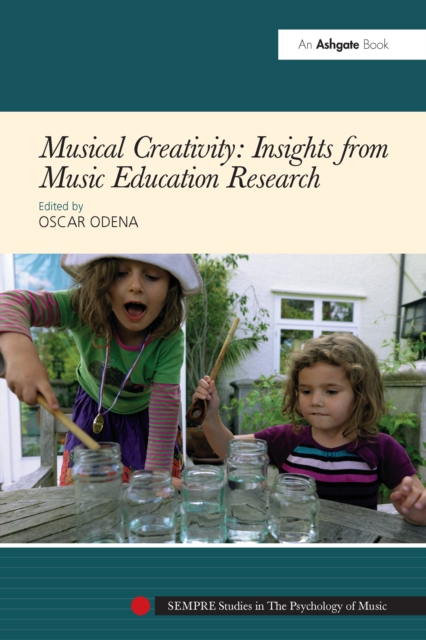
Musical Creativity: Insights from Music Education Research
How do we develop musical creativity? How is musical creativity nurtured in collaborative improvisation? How is it used as a communicative tool in music therapy? This comprehensive volume offers new research on these questions by an international team of experts from the fields of music education, music psychology and music therapy. The book celebrates the rich diversity of ways in which learners of all ages develop and use musical creativity. Contributions focus broadly on the composition/improvisation process, considering its conceptualization and practices in a number of contexts. The authors examine how musical creativity can be fostered in formal settings, drawing examples from primary and secondary schools, studio, conservatoire and university settings, as well as specialist music schools and music therapy sessions. These essays will inspire readers to think deeply about musical creativity and its development. The book will be of crucial interest to music educators, policy makers, researchers and students, as it draws on applied research from across the globe, promoting coherent and symbiotic links between education, music and psychology research.
Contents: Introduction, Oscar Odena; Part I Conceptualising Musical Creativity: Rethinking 'musical creativity' and the notion of multiple creativities in music, Pamela Burnard; Teachers' perceptions of creativity, Oscar Odena and Graham Welch. Part II Examples from Practice: Preparing the mind for musical creativity: early music learning and engagement, Margaret S. Barrett; Music composition as a way of learning: emotions and the situated self, Ana Luísa Veloso and Sara Carvalho; Towards pedagogies of revision: guiding a students' music composition, Peter R. Webster; The nature of the engagement of Brazilian adolescents in composing activities, José Soares; Empathetic creativity in music making, Frederick A. Seddon; Cognition and musical improvisation in individual and group contexts, Su-Ching Hsieh; Music therapy: a resource for creativity, health and well-being across the lifespan, Leslie Bunt. Part III Paths for Further Enquiry: Action-research on collaborative composition: an analysis of research questions and designs, Gabriel Rusinek; Perspectives on musical creativity: where next?, Oscar Odena; Index.
Oscar Odena is Reader in Education at the University of Glasgow, UK. He is past Co-Chair of the Research Commission of the International Society for Music Education (2012-14) and a member of the editorial boards of leading journals including the British Journal of Music Education, Journal of the Musical Arts in Africa and Research Studies in Music Education.
eBook


Music, Mind and Education
Keith Swanwick explores the psychological and sociological dimensions of musical experience and the implications of these for children's development and music education in schools and colleges. Music is seen, with the other arts, as contributing to the growth of mind, with deep psychological roots in play. Swanwick examines the ways in which children make their own music, and confirms that there is an observable sequence of development. His insights into musical experience help to draw together and interpret fragmented psychological work that has been done in the field and make it possible to plan music education in schools, colleges and studios in a more purposeful way. His analysis of the nature of musical experience and music education has consequences both for curriculum development and the assessment of students' work, with special reference given to the National Curriculum and GCSE.
eBook


Collaborative creative thought and practice in music
The notion of the individual creator, a product in part of the Western romantic ideal, is now troubled by accounts and explanations of creativity as a social construct. While in collectivist cultures the assimilation (but not the denial) of individual authorship into the complexities of group production and benefit has been a feature, the notion of the lone individual creator has been persistent. Systems theories acknowledge the role of others, yet at heart these are still individual views of creativity - focusing on the creative individual drawing upon the work of others rather than recognizing the mutually constitutive elements of social interactions across time and space. Focusing on the domain of music, the approach taken in this book falls into three sections: investigations of the people, processes, products, and places of collaborative creativity in compositional thought and practice; explorations of the ways in which creative collaboration provides a means of crossing boundaries between disciplines such as music performance and musicology; and studies of the emergence of creative thought and practice in educational contexts including that of the composer and the classroom. The volume concludes with an extended chapter that reflects on the ways in which the studies reported advance understandings of creative thought and practice. The book provides new perspectives to our understandings of the role of collaborative thought and processes in creative work across the domain of music including: composition, musicology, performance, music education and music psychology.
eBook