
Catalogue Search | MBRL


Are you sure you want to remove the book from the shelf?

{{itemTitle}}
169,419
result(s) for
"Music Theatre"
Sort by:

Performing Mexicanidad
An examination of the intersection of public discourses on sexualities with recent political, economic, and social shifts in the national context of Mexico and the Mexican diaspora in the United States.
eBook
Composed theatre
A unique contribution to an emerging field, this book explores musical strategies of organization as viable alternative means of organizing theatrical work. It includes insightful essays by a group of international contributors and interviews with important practitioners, shedding light on historical and theoretical aspects of composed theatre.
eBook

Music Hall and Modernity
The late-Victorian discovery of the music hall by English intellectuals marks a crucial moment in the history of popular culture.Music Hall and Modernitydemonstrates how such pioneering cultural critics as Arthur Symons and Elizabeth Robins Pennell used the music hall to secure and promote their professional identity as guardians of taste and national welfare. These social arbiters were, at the same time, devotees of the spontaneous culture of \"the people.\"In examining fiction from Walter Besant, Hall Caine, and Henry Nevinson, performance criticism from William Archer and Max Beerbohm, and late-Victorian controversies over philanthropy and moral reform, scholar Barry Faulk argues that discourse on music-hall entertainment helped consolidate the identity and tastes of an emergent professional class. Critics and writers legitimized and cleaned up the music hall, at the same time allowing issues of class, respect, and empowerment to be negotiated.Music Hall and Modernityoffers a complex view of the new middle-class, middlebrow mass culture of late-Victorian London and contributes to a body of scholarship on nineteenth-century urbanism. The book will also interest scholars concerned with the emergence of a professional managerial class and the genealogy of cultural studies.
eBook

The Great White Way
Broadway musicals are one of America's most beloved art forms and play to millions of people each year. But what do these shows, which are often thought to be just frothy entertainment, really have to say about our country and who we are as a nation?
The Great White Wayis the first book to reveal the racial politics, content, and subtexts that have haunted musicals for almost one hundred years fromShow Boat(1927) toThe Scottsboro Boys(2011). Musicals mirror their time periods and reflect the political and social issues of their day. Warren Hoffman investigates the thematic content of the Broadway musical and considers how musicals work on a structural level, allowing them to simultaneously present and hide their racial agendas in plain view of their audiences. While the musical is informed by the cultural contributions of African Americans and Jewish immigrants, Hoffman argues that ultimately the history of the American musical is the history of white identity in the United States.
Presented chronologically,The Great White Wayshows how perceptions of race altered over time and how musicals dealt with those changes. Hoffman focuses first on shows leading up to and comprising the Golden Age of Broadway (1927-1960s), then turns his attention to the revivals and nostalgic vehicles that defined the final quarter of the twentieth century. He offers entirely new and surprising takes on shows from the American musical canon-Show Boat(1927),Oklahoma!(1943),Annie Get Your
Gun(1946),The Music Man(1957),West Side Story(1957),A Chorus Line(1975), and42nd Street(1980), among others.New archival research on the creators who produced and wrote these shows, including Leonard Bernstein, Jerome Robbins, Stephen Sondheim, and Edward Kleban, will have theater fans and scholars rethinking forever how they view this popular American entertainment.
eBook

Chaplin’s Music Hall
“Charlie Chaplin grew up in and around the music hall. His parents, aunt and their friends all earned their precarious livings on the stage and Chaplin himself started out his career touring music halls with a dance troupe. His experiences of the culture of the music hall were a major influence, shaping his style of acting and the films he made, most famously Limelight, which tells the story of a failing variety performer and which evoked painful memories of his own past. Chaplin was horrified to see how performers’ lives were ruined when their audience turned against them and he was relieved to exchange the stresses of live performance for screen comedy. Barry Anthony here tells the story of the lives and careers of Chaplin’s family and their music–hall circle–from ‘dashing’ Eva Lester to the great Fred Karno and from Chaplin’s parents Hannah Hill and Charles Chaplin to ‘The Great Calvero’ himself. He reveals the difficult and often–tragic lives of London’s variety community in the late–Victorian and Edwardian years, a time of great change in the music hall and entertainment scene, and in doing so sheds important new light on the inspiration behind Chaplin’s genius, providing a fascinatingly fresh perspective on this popular cultural icon of the twentieth century.”
eBook

Weill's musical theater
In the first musicological study of Kurt Weill's complete stage works, Stephen Hinton charts the full range of theatrical achievements by one of twentieth-century musical theater's key figures. Hinton shows how Weill's experiments with a range of genres—from one-act operas and plays with music to Broadway musicals and film-opera—became an indispensable part of the reforms he promoted during his brief but intense career. Confronting the divisive notion of \"two Weills\"—one European, the other American—Hinton adopts a broad and inclusive perspective, establishing criteria that allow aspects of continuity to emerge, particularly in matters of dramaturgy. Tracing his extraordinary journey as a composer, the book shows how Weill's artistic ambitions led to his working with a remarkably heterogeneous collection of authors, such as Georg Kaiser, Bertolt Brecht, Moss Hart, Alan Jay Lerner, and Maxwell Anderson.
eBook
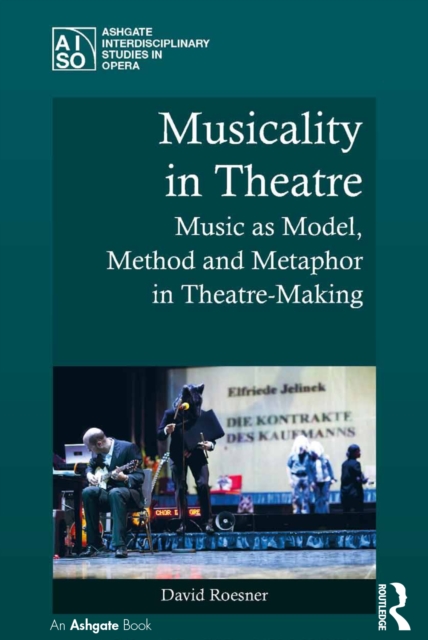
Musicality in theatre
Music continues to be immensely influential in key developments of theatrical practices. In this study of musicality in the theatre, David Roesner offers a revised view of the nature of the relationship between music and theatre. The theoretical scope of the book is developed from a wide range of case studies, some of which are re-readings of the classics of theatre history (Appia, Meyerhold, Artaud, Beckett), while others introduce or rediscover less-discussed practitioners such as Joe Chaikin, Thomas Bernhard, Elfriede Jelinek, Michael Thalheimer and Karin Beier.
eBook

Swing along : the musical life of Will Marion Cook
Renowned today as a prominent African-American in music theater and the arts community, composer, conductor, and violinist Will Marion Cook was a key figure in the development of American music from the 1890s to the 1920s. This book looks at his life’s story, drawing on his unfinished autobiography and his wife Abbie’s memoir. A violin virtuoso, Cook studied at Oberlin College (his parents’ alma mater), Berlin’s Hochschule für Musik with Joseph Joachim, and New York’s national Conservatory of Music with Antonín Dvořák. Cook wrote music for a now-lost production of Uncle Tom’s Cabin for the Chicago World’s Fair of 1893, and then devoted the majority of his career to black musical comedies due to limited opportunities available to him as a black composer. He was instrumental in showcasing his Southern Syncopated Orchestra in the prominent concert halls of the United States and Europe, even featuring New Orleans clarinetist Sidney Bechet, who later introduced European audiences to authentic blues. Once mentored by Frederick Douglas, Will Marion Cook went on to mentor Duke Ellington, paving the path for orchestral concert jazz. Through interpretive and musical analyses, the book traces Cook’s successful evolution from minstrelsy to musical theater. Written with his collaborator, the distinguished poet Paul Lawrence Dunbar, Cook’s musicals infused American musical theater with African-American music, consequently altering the direction of American popular music. Cook’s In Dahomeym was the first full-length Broadway musical to be written and performed by blacks. Alongside his accomplishments, Cook’s contentious side is revealed—a man known for his aggressiveness, pride, and constant quarrels, he became his own worst enemy in regards to his career. The book also sets Cook’s life against the backdrop of the changing cultural and social milieu: the black theatrical tradition, white audiences’ reaction to black performers, and the growing consciousness and sophistication of blacks in the arts, especially music.
eBook

Singing History—Politics of Idiom and Genre in Ted Hearne’s Music(al)-Theatre
In his productions, The Source (2014) and over and over vorbei nicht vorbei (2024), composer Ted Hearne deals with explicitly historio-political subjects and the memories of violent past(s). The pieces explore questions of documentation and representation, the authentic and the ‘fake’, the virtual and the real. This article examines how Hearne and his collaborators deconstruct political content, how they (re-)arrange, compose, and stage it using an eclectic mix of styles, employing various vocal characteristics, and staging words, video, and music in unconventional arrangements. Their productions thus foster empathetic acts of witnessing (see Kopf 2009), which I suggest to be a key characteristic of Hearne’s works.
Journal Article

British Rock Modernism, 1967–1977
British Rock Modernism, 1967-1977 explains how the definitive British rock performers of this epoch aimed, not at the youthful rebellion for which they are legendary, but at a highly self-conscious project of commenting on the business in which they were engaged. They did so by ironically appropriating the traditional forms of Victorian music hall. Faulk focuses on the mid to late 1960s, when British rock bands who had already achieved commercial prominence began to aspire to aesthetic distinction. The book discusses recordings such as the Beatles' Magical Mystery Tour album, the Kinks' The Village Green Preservation Society, and the Sex Pistols' Never Mind the Bollocks, Here's the Sex Pistols, and television films such as the Beatles' Magical Mystery Tour and the Rolling Stones' Rock and Roll Circus that defined rock's early high art moment. Faulk argues that these 'texts' disclose the primary strategies by which British rock groups, mostly comprised of young working and lower middle-class men, made their bid for aesthetic merit by sampling music hall sounds. The result was a symbolically charged form whose main purpose was to unsettle the hierarchy that set traditional popular culture above the new medium. Rock groups engaged with the music of the past in order both to demonstrate the comparative vitality of the new form and signify rock's new art status, compared to earlier British pop music. The book historicizes punk rock as a later development of earlier British rock, rather than a rupture. Unlike earlier groups, the Sex Pistols did not appropriate music hall form in an ironic way, but the band and their manager Malcolm McLaren were obsessed with the meaning of the past for the present in a distinctly modernist fashion.
eBook