
Catalogue Search | MBRL


Are you sure you want to remove the book from the shelf?

{{itemTitle}}
41,454
result(s) for
"Music Theory"
Sort by:


The Critical Nexus
This book confronts an enigma of early writings on music: why chant, which was understood to be divinely inspired, needed to be altered in order to work within the then-operative modal system. To unravel this mystery, the book creates a broad framework that moves from Greek harmonic theory to the various stages in the transmission of Roman chant, citing numerous music treatises from the 6th to the 12th century. Out of this examination emerges the central point behind the problem: the tone system advocated by writers coming from the Greek harmonic tradition was not suited to the notation of chant and this basic incompatibility led to the creation of new theoretical constructs. By tracing the path of subsequent adaptation at the nexus of tone system, mode, and notation, the book promises insights into what mode meant to the medieval musician and how the system responded to its inherent limitations. Through an examination of the major musical treatises from the 6th through the 12th centuries, this text establishes a central dichotomy between classical harmonic theory and the practices of the Christian church. The book builds the foundation for a broad and original reinterpretation of the modal system and how it relates to melody, grammar, and notation.
eBook

Music's Making
As a work of musical theory, or meta-theory, Music's
Making draws extensively on work done in philosophy and
literary criticism in addition to the scholarship of musicologists
and music theorists. Music's Making is divided into two
large parts. The first half develops global attitudes toward music:
emergence out of self and hearing through (drawing on Kabbalah and
other sources), middle-voice (as discussed in philosophical
phenomenology), liminal space (as discussed in literary theory), an
ethics of intersubjectivity (drawing on Levinas), and character,
canon, and metaleptic transformations (drawing chiefly on Harold
Bloom). The second half embodies a search for metaphors, figurative
language toward understanding music's endlessly variegated shaping
of time-space. The musicians and scholars who inform this part of
the book include Pierre Boulez, Gilles Deleuze, Anton Webern,
Morton Feldman, and James Dillon. The book closes with an extended
inquiry into the metaphors of horizontal and vertical experience
and the spiritual qualities of musical experience expressed through
those metaphors.
eBook

From scratch : writings in music theory
One of the twentieth century's most important musical thinkers, James Tenney did pioneering work in multiple fields, including computer music, tuning theory, and algorithmic and computer-assisted composition. From Scratch is a collection of Tenney's hard-to-find writings arranged, edited, and revised by the self-described \"composer/theorist.\" Selections focus on his fundamental concerns - \"what the ear hears\" - and include thoughts and ideas on perception and form, tuning systems and especially just intonation, information theory, theories of harmonic space, and stochastic (chance) procedures of composition.
Book
Modal Subjectivities
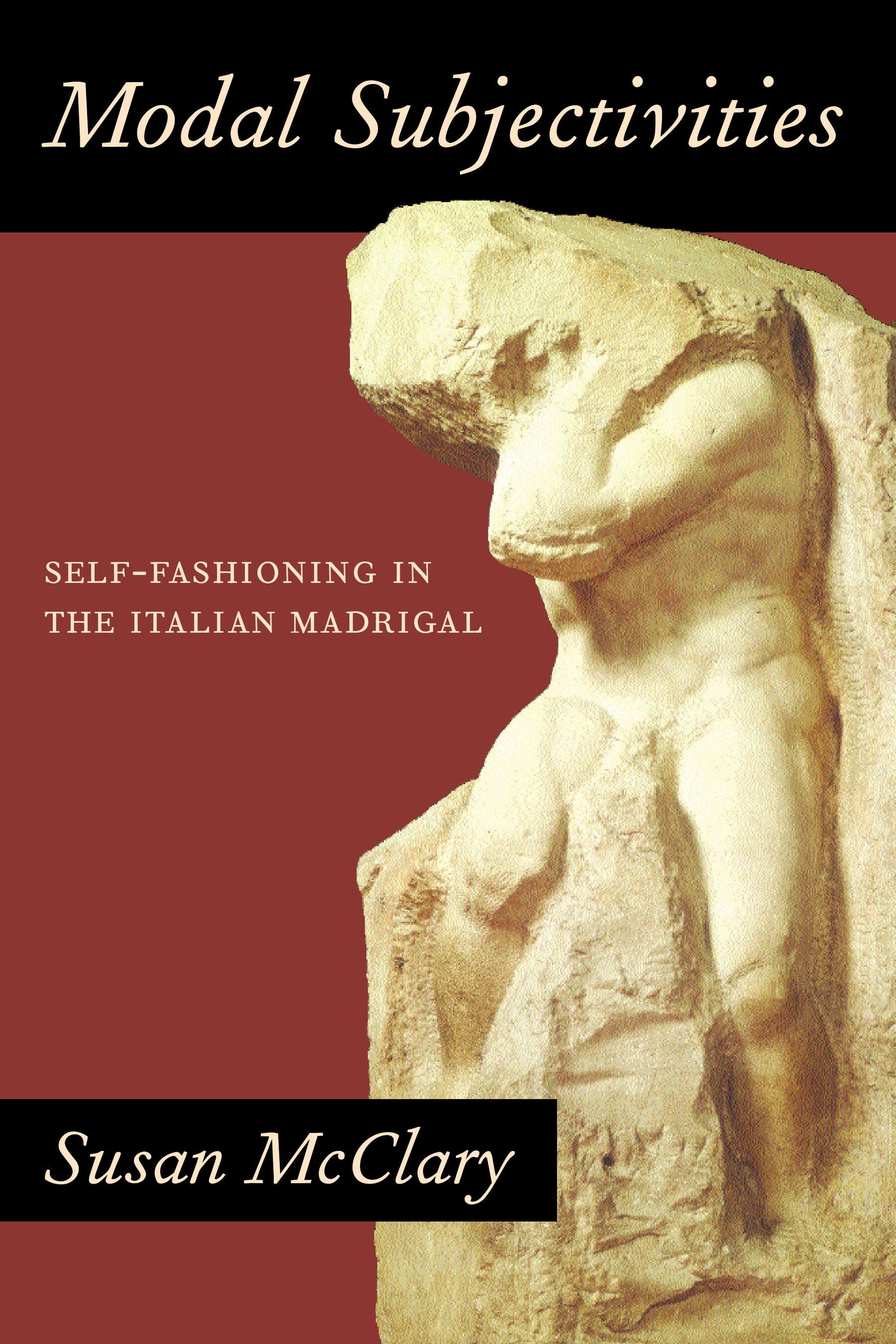
In this boldly innovative book, renowned musicologist Susan McClary presents an illuminating cultural interpretation of the Italian madrigal, one of the most influential repertories of the Renaissance. A genre that sought to produce simulations in sound of complex interiorities, the madrigal introduced into music a vast range of new signifying practices: musical representations of emotions, desire, gender stereotypes, reason, madness, tensions between mind and body, and much more. In doing so, it not only greatly expanded the expressive agendas of European music but also recorded certain assumptions of the time concerning selfhood, making it an invaluable resource for understanding the history of Western subjectivity.Modal Subjectivitiescovers the span of the sixteenth-century polyphonic madrigal, from its early manifestations in Philippe Verdelot's settings of Machiavelli in the 1520s through the tortured chromatic experiments of Carlo Gesualdo. Although McClary takes the lyrics into account in shaping her readings, she focuses particularly on the details of the music itself-the principal site of the genre's self-fashionings. In order to work effectively with musical meanings in this pretonal repertory, she also develops an analytical method that allows her to unravel the sophisticated allegorical structures characteristic of the madrigal. This pathbreaking book demonstrates how we might glean insights into a culture on the basis of its nonverbal artistic enterprises.
eBook

Help your kids with music : a unique step-by-step visual guide
Offers a simple, visual guide to helping children understand music with Carol Vorderman. Reduce the stress of studying music and help your child with their homework, Help Your Kids with Music is a unique visual guide to music theory which will demystify the subject for everyone. Including the latest updates to the UK National Curriculum, covering everything from semitones and note values, to harmony and music appreciation, Help Your Kids with Music helps you work through music step-by-step. Using clear, accessible pictures and diagrams you'll learn to approach even the most complex musical theory with confidence. Includes a glossary of key musical terms and symbols. Help Your Kids with Music is the perfect guide for every parent and child, who wants to understand music theory and put it into practice.
Book

Music Theory’s Therapeutic Imperative and the Tyranny of the Normal
Traditional music theory rationalizes abnormal musical elements (like dissonant or chromatic tones or formal anomalies) with respect to normal ones. It is thus allied with a medical model of disability, understood as a deficit or defect located within an individual body, and requiring remediation or cure. A newer sociocultural model of disability understands it as a culturally stigmatized deviance from normative standards for bodily appearance and functioning, analogous to (and intersectional with) race, gender, and sexuality as a source of affirmative political and cultural identity. The sociocultural model of disability suggests the possibility of a disablist music theory, one that subverts the traditional therapeutic imperative and resists the tyranny of the normal. Disablist music theory is music theory without norms, and without a commitment to wholeness, unity, coherence, and completeness—those fantasies of a normal, healthy body. Instead, disablist theory brings the seemingly anomalous event to the center of the discussion and revels in the commotion and discombobulation that result: it makes the normal strange. In the process, it opens up our sense of what music theory is and might be.
Journal Article

Music in theory and practice
\"This best-selling text gives music majors and minors a solid foundation in the theory of music. Music in Theory and Practice strengthens their musical intuition, builds technical skills, and helps them gain interpretive insights. The goal of this text is to instruct readers on the practical application of knowledge. The analytical techniques presented are carefully designed to be clear, uncomplicated, and readily applicable to any repertoire. The two-volume format ensures exhaustive coverage and maximum support for students and faculty alike. Volume I covers topics from basic elements through diatonic harmony, while Volume II covers chromatic harmony along with elements of styles and forms from Gregorian chants through the present day. The supplemental instructor's materials provide clear-cut solutions to assignment materials. Music in Theory and Practice is a well-rounded textbook that integrates the various components of musical structure and makes them accessible to students at the undergraduate level\"-- Provided by publisher.
Book
Music Theory’s White Racial Frame
For over twenty years, music theory has tried to diversify with respect to race, yet the field today remains remarkably white, not only in the people who practice music theory but also in the race of the composers and theorists whose work music theory privileges. In this article, I offer a few explanations for why this is so. I posit a music-theoretical “white racial frame” that is structural and institutionalized, and argue that only through a deframing and reframing of this white racial frame will we begin to see positive racial changes in music theory.
Journal Article