
Catalogue Search | MBRL


Are you sure you want to remove the book from the shelf?

{{itemTitle}}
301
result(s) for
"Musical instruments, Ancient."
Sort by:


RELIEF SCULPTURE OF MUSICAL INSTRUMENTS FROM ANCIENT GERASA: A COMPARATIVE STUDY
GERASA, in north Jordan, dating to the Roman period, has been found to contain impressive and well - Musicians and Musical instruments carving on architecture elements (pedestal or candelabrum base). The Gerasa carving expertly combined motifs with a long tradition, some going back to the Roman imperial age and earlier. This study is concerned with the musical instruments appear on architecture elements. The article provides a study of the musical instruments that can be classified into two main types: Aulos and Kithara. Purpose of this paper is to examine the details of those instruments and compare them with other musical instruments from the Roman period, where influences in design within and between regions can be seen. Wherever possible, comparative examples have been chosen from sites that are relatively nearby to establish an overview of musical instruments in the region, but also to distinguish the influences coming from Asia Minor and other areas.
Journal Article

The prehistory of music : human evolution, archaeology, and the origins of musicality
Music is possessed by all human cultures, and archaeological evidence for musical activities pre-dates even the earliest-known cave art. Music has been the subject of keen investigation across a great diversity of field, from neuroscience and psychology to ethnography, archaeology and its own dedicated field, musicology. Despite the great contributions that these studies have made towards understanding musical behaviours, much remains mysterious about this ubiquitous human phenomenon - not least, its origins. This study brings together evidence from these fields, and more, in investigating the evolutionary origins of our musical abilities, the nature of music, and the earliest archaeological evidence for musical activities amongst our ancestors.
Book

The Visual Heritage
Interest in ancient music, especially the Greek variety, dates back to a distant past. Since the Middle Ages, scholars have been translating and studying the written evidence regarding several aspects of music (theory, notation, acoustics) and its ethical and philosophical implications. Only later, starting from the seventeenth century, did their interest also extend to ancient musical instruments. The rediscovery of Pompeii was a significant starting point because it brought to light for the first time archaeological findings of Greek and Roman musical instruments.
Book Chapter

Un-discarded images: illustrations of antique musical instruments in 17th- and 18th-century books, their sources and transmission
Illustrations of ancient musical instruments appear in encyclopaedias, histories and general books on music from the 17th century onwards. This article examines the origins of some of these images, a number of which may be traced back to the early 17th century and to the so-called 'Paper Museum' of Cassiano dal Pozzo. The author also suggests that while later writers may deal critically with the text content of their sources, the illustrations have not been subject to the same level of scrutiny. Reproductions of images appear, often without acknowledgement, over a wide geographical area and considerable chronological span, disseminating visual information that becomes increasingly inaccurate. The lack of concern with illustrative detail sounds a warning about the use information gleaned from pictorial evidence, contained within often authoritative books, and the necessity to examine their sources.
Journal Article
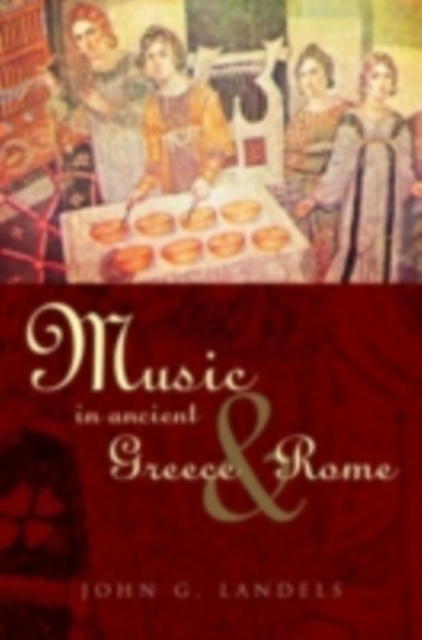
Music in Ancient Greece and Rome
Music in Ancient Greece and Rome provides a comprehensive introduction to the history of music from Homeric times to the Roman emperor Hadrian, presented in a concise and user-friendly way. Chapters include: * contexts in which music played a role * a detailed discussion of instruments * an analysis of scales, intervals and tuning * the principal types of rhythm used * and an exploration of Greek theories of harmony and acoustics. Music in Ancient Greece and Rome also contains numerous musical examples, with illustrations of ancient instruments and the methods of playing them.
'A well-illustrated and comprehensive introduction to ancient music from Homeric times to the emperor Hadrian ... we recommend it highly as a book that is both scholarly and approachable, and of value to everyone with an interest in the subject, scholars, students and the general reader.' - Classical Association News 'John Landels has produced a lively and illuminating survey of what we know ... his book can be recommended to any musical person wishing to imagine for himself the sound, the atmosphere and the meaning of ancient song and dance.' - Roger Scruton, The Times
eBook

Radiocarbon-Based Chronology for Dynastic Egypt
The historical chronologies for dynastic Egypt are based on reign lengths inferred from written and archaeological evidence. These floating chronologies are linked to the absolute calendar by a few ancient astronomical observations, which remain a source of debate. We used 211 radiocarbon measurements made on samples from short-lived plants, together with a Bayesian model incorporating historical information on reign lengths, to produce a chronology for dynastic Egypt. A small offset (19 radiocarbon years older) in radiocarbon levels in the Nile Valley is probably a growing-season effect. Our radiocarbon data indicate that the New Kingdom started between 1570 and 1544 B.C.E., and the reign of Djoser in the Old Kingdom started between 2691 and 2625 B.C.E.; both cases are earlier than some previous historical estimates.
Journal Article

In search of a musical past: evidence for early chordophones from Vietnam
Music likely played an important role within prehistoric societies but can be challenging to study in the absence of evidence for musical instruments. Here, the authors present two deer antlers recovered from the early Metal Age site of Go O Chua in southern Vietnam. A detailed examination of the artefacts, including evidence for use-wear, combined with insights from ethnographic analogies, leads the authors to conclude that the artefacts were single-stringed musical instruments. At least 2000 years old, the Go O Chua artefacts would be the earliest-known examples of chordophones from the region and indicate a long musical tradition. Their identification gives impetus to archaeo-musicological research in Southeast Asia and beyond.
Journal Article

Reconstructing flexible pathways of Aurignacian blade and bladelet production at Vogelherd
The beginning of the Upper Paleolithic represents a key period in human history. At this time, we can grasp the technological concepts that Homo sapiens used in the early Upper Paleolithic. The age of the Aurignacian in combination with the three-dimensional ivory artworks, musical instruments and personal ornaments in the Swabian Jura sites emphasize the importance of this region for understanding and defining the Upper Paleolithic. During that time blade and bladelet production became the central interest of lithic production. The study of these lithic reduction sequences is essential for understanding technological inventions and socio-economic behaviors of early anatomically modern humans in Central Europe. So far, however, the lithic technology from the Aurignacian of the Swabian Jura has only been studied in detail at the site of Geißenklösterle. In this paper, we provide an exhaustive study based on the rich lithic assemblage from Vogelherd Cave combining both the chaîne opératoire approach and attribute analysis. This work highlights the importance of carefully sorting minimal raw material units and engaging in systematic refitting. These observations allow us to reconstruct entire reduction sequences including the biographies of both cores and tools. The source and physical characteristics of lithic raw materials greatly influenced decision-making during the reduction process. As in many other Paleolithic contexts, Aurignacian knappers thoroughly exploited imported raw materials while exhausting low quality local material to a lesser degree. Comparisons with other assemblages from the region help to facilitate the characterization of the Swabian Aurignacian. This comparison allows us to separate regional adaptations from more site-specific behaviors.
Journal Article

Pompeii Performance Soundscapes in the Amphitheater, the Grand Theater, and the Odeon
Theaters in ancient Pompeii played a vital role in Roman entertainment, shaping the auditory experiences of spectators. This study examines the acoustic properties of the Amphitheater, the Grand Theater, and the Odeon using impulse response (IR) analysis to reconstruct their soundscapes. Next, the study considers the impact of typical musical instruments, vocal performances, and ambient sounds—such as gladiatorial combat—on these spaces’ acoustics. Findings reveal significant differences in reverberation times, sound clarity, and spatial characteristics, shaped by each theater’s design. These sites, preserved after the eruption of Mount Vesuvius, provide a unique opportunity to analyze how architecture influenced sound propagation. The Amphitheater, with its vast open structure, enhanced large-scale events, while the Grand Theater’s semi-enclosed design balanced musical and theatrical performances. The Odeon, the most intimate of the three, prioritized speech clarity. These insights highlight how Roman architects engineered performance spaces to accommodate diverse entertainment forms. By combining acoustic measurements with historical context, this research offers a deeper understanding of ancient Pompeii’s soundscapes and the auditory experiences of its inhabitants and offers insights for composition and soundscape creations that take inspiration from these prominent historical architectural and cultural icons whilst exploring its potential within contemporary immersive listening practices.
Journal Article