
Catalogue Search | MBRL


Are you sure you want to remove the book from the shelf?

{{itemTitle}}
49
result(s) for
"Musicals Stories, plots, etc."
Sort by:

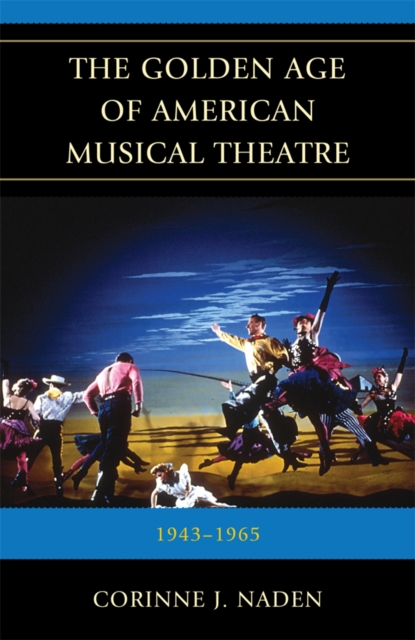
The golden age of American musical theatre
The Golden Age of American Musical Theatre: 1943-1965 provides synopses, cast and production credits, song titles, and other pertinent information for over 180 musicals from Oklahoma! to On A Clear Day You Can See Forever. Concentrating on a 22-year span, this book lists both commercial successes and flops of the Golden Age-when the musicals presented on Broadway showcased timeless, memorable tunes, sophisticated comedy, and the genius of creative artists like Richard Rodgers, Oscar Hammerstein, Jerome Robbins, Leonard Bernstein, George Abbott, Moss Hart, Angela Lansbury, Robert Preston, and many others. After an introduction and an overview of the history of Broadway, Naden offers a chronological timeline of the Golden Age musicals in America. She then presents details, in succeeding chapters, about the shows, the stars (on and off stage), the theatres, and the awards, beginning with an alphabetical listing of shows. Each show entry supplies the title, opening date, theatre, number of performances, primary cast and crew, and a plot synopsis, as well as other interesting data about the show, such as the awards won. Additional details about well-known actors, singers, composers, lyricists, directors, and choreographers of the period are provided, including birth and death dates, birth cities, born names, a brief biography, and award nominations and wins. Finishing with a bibliography and an index, this book is beneficial to anyone wanting to know more about one of the richest periods in Broadway history.
eBook

Rodgers and Hammerstein's \Chopsticks\ Musicals
\"Throughout the brilliant joint careers of Richard Rodgers and Oscar Hammerstein II, Rodgers the composer has been true to his childhood apprenticeship, with Oriental flavor liberally sprinkling his corpus...In terms of their corpus, one which manifests predominantly Western consciousness, it features a distinct Oriental period which includes The King and I, South Pacific (1958), and Flower Drum Song (1961). This...Oriental element can hardly be viewed as an awkward appendix to their stellar achievement. Indeed, in the comical maladroitness of their Orientalist songs lies the key to the overall success of Rodgers and Hammerstein...[T]he weaving of 'Chopsticks' motif into the 'real' music from the right hand is the extra stuff that enlivens otherwise mediocre compositions...The ostensibly negligible Oriental ambience helps catapult each 'Chopsticks' musical as well as the careers of Rodgers and Hammerstein into prominence.\" (Literature/Film Quarterly) The \"Chopsticks\" musicals of Rodgers and Hammerstein--The King and I, South Pacific and Flower Drum Song--are reviewed.
Journal Article

TINY DANCER
\"Not many musicals in the history of, well, musical theatre have gotten the kind of glowing notices Billy Elliot: The Musical received upon opening in March [2005] at the Victoria Palace Theatre [in London, England]...With music by Elton John and written by Lee Hall based on his original screenplay, Billy Elliot is directed by the film's original director Stephen Daldry who oversaw a creative team that included lighting designer Rick Fisher, scenic designer Ian MacNeil, costumer Nicky Gillibrand, and sound designer Paul Arditti. Also on hand is the movie's original choreographer, Peter Darling, who trained three different young actors in the titular and grueling title role. A bigger hit than the 2000 movie, the musical version has become the must-see show in London.\" (Entertainment Design) This overview of the production of Billy Elliot: The Musical details Fisher's, MacNeil's, Gillibrand's and Arditti's contributions to the show's \"exuberant\" reviews.
Journal Article

Trouble in River City?
Meredith Willson wrote the musicals THE MUSIC MAN and THE UNSINKABLE MOLLY BROWN and composed more than 300 hundred songs during his lifetime. The U.S. Postal service is printing a stamp with his face on it as part of \"the stamp series 'Legends of American Music'\" (GOLDFINCH). Learn more about this composer.
Magazine Article
Traveling Light
The design team behind the musical theater version of The Light in the Piazza discuss the evolution of the show's sets, lights, costumes and sound. The 2005 Broadway production, considered a \"stunning recreation\" (Entertainment Design), \"is neither altogether literal, nor completely abstract. It is instead the Florence [Italy] of your fondest hopes and deepest desires, a city steeped in longing and reverie--an ideal setting, in other words, for a musical romance.\"
Journal Article

From Mule Bones to Funny Bones: The Plays of Zora Neale Hurston
\"Zora Neale Hurston has recently been rescued from literary oblivion and installed as a major figure in the American literary canon. Her stature thus far, however, has stemmed from her success as a novelist, especially in her masterwork, THEIR EYES WERE WATCHING GOD (1937). Some Hurston aficionados were therefore surprised when the play she coauthored with Langston Hughes, `Mule Bone,' had its Broadway debut in 1991. Did Hurston write plays as well? Indeed she did. In fact, one of her first publications was a play, and she never gave up trying to mount a successful production.\" (SOUTHERN QUARTERLY) Hurston's published and unpublished plays are examined.
Journal Article

Legacy
Jonathan Larson's rock opera \"Rent\" continues the American musical legacy by being a \"teacher of our hearts, daring to tell us truths we have needed to know, or to know again or to know more deeply\" (AMERICA). \"Based on a concept by Billy Aronson, `Rent' translates the story of Puccini's `La Boheme,' from the Left Bank in 1860's Paris to the East Village in today's New York... `Rent' overflows with positive energy, with confident affirmation of the good that is to be found in life and in people.\" Larson's life and final work are analyzed.
Magazine Article

Bombay Dreams
Bose reviews a performance of Meera Syal and Thomas Meehan's Bombay Dreams directed by Stephen Pimlott, music by A. R. Rahman, and choreographed by Anthony Van Laast and Farah Khan at the Broadway Theater in New York City.
Book Review

What Is This Thing Called Love?
\"Cole Porter, the subject of [ the 2004 film, De-Lovely ], was one of America's wittiest and most innovative composers. But his unconventional marriage steals the show...Linda Lee, 8 to 14 years Porter's senior (accounts differ), was a wealthy divorcee...Porter was homosexual...What Porter saw in Linda was sophistication, security and someone to help him satisfy his voracious social appetite. She saw him as a ticket to a world equally remote to her...For more than 30 years, [the two were] each other's companion, inspiration, comfort, protector and guiding light.\" (Smithsonian) Cole's seminal musical career and \"remarkable, unorthodox marriage\" are explored. The 2004 film De-Lovely, a \"cinematic rendering of...Porter's life,\" is briefly discussed.
Magazine Article