
Catalogue Search | MBRL


Are you sure you want to remove the book from the shelf?

{{itemTitle}}
177
result(s) for
"Muslim converts"
Sort by:
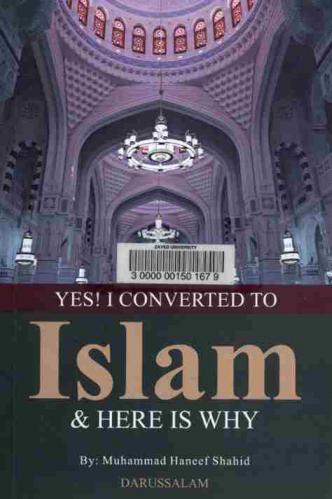
Yes ! I converted to Islam and here is why? = أسلمت ولماذا ؟
A compilation from numerous narratives of scientists, intellectuals, nobles, professionals, dignitaries, laureates and others about their lives, experiences and previous beliefs as well as Islamic impressions and reasons why they reverted to Islam.

Exploring the Liminal Characteristics of Muslim Converts
When considering questions of integration, assimilation, and adjustment in the formative centuries of Islam it is vital to think about the individuals who converted to Islam. The gradual nature of conversion and the enduring ties of Muslim converts to their former coreligionists kept them in a liminal position. My analysis will evolve around three spheres of inquiry: linguistic, social, and practical. Linguistically, I show how ecclesiastical Syriac and rabbinic Hebrew terms that refer to apostates speak of individuals who did not burn all bridges but retained some level of contact with their former coreligionists. With respect to society, I discuss the place of converts to Islam as treated by the law of their former religions, and, finally, I dwell upon the persistence of former religious practices among converts to Islam. By viewing converts as liminal figures and unpacking the concept of liminality in its historical context I hope to contribute to the theoretical discussion regarding the process of conversion to Islam in the early and late formative Islamic periods and to argue against its presentation in linear terms.
Journal Article

Conversion and Narrative
In 1322, a Jewish doctor named Abner entered a synagogue in the Castilian city of Burgos and began to weep in prayer. Falling asleep, he dreamed of a \"great man\" who urged him to awaken from his slumber. Shortly thereafter, he converted to Christianity and wrote a number of works attacking his old faith. Abner tells the story in fantastic detail in the opening to his Hebrew-language but anti-Jewish polemical treatise, Teacher of Righteousness.In the religiously plural context of the medieval Western Mediterranean, religious conversion played an important role as a marker of social boundaries and individual identity. The writers of medieval religious polemics such as Teacher of Righteousness often began by giving a brief, first-person account of the rejection of their old faith and their embrace of the new. In such accounts, Ryan Szpiech argues, the narrative form plays an important role in dramatizing the transition from infidelity to faith.Szpiech draws on a wide body of sources from Christian, Jewish, and Muslim polemics to investigate the place of narrative in the representation of conversion. Making a firm distinction between stories told about conversion and the experience of religious change, his book is not a history of conversion itself but a comparative study of how and why it was presented in narrative form within the context of religious disputation. He argues that between the twelfth and fifteenth centuries, conversion narratives were needed to represent communal notions of history and authority in allegorical, dramatic terms. After considering the late antique paradigms on which medieval Christian conversion narratives were based, Szpiech juxtaposes Christian stories with contemporary accounts of conversion to Islam and Judaism. He emphasizes that polemical conflict between Abrahamic religions in the medieval Mediterranean centered on competing visions of history and salvation. By seeing conversion not as an individual experience but as a public narrative, Conversion and Narrative provides a new, interdisciplinary perspective on medieval writing about religious disputes.
eBook
Becoming Muslim
While Islam has become a controversial topic in the West, a growing number of Westerners find powerful meaning in Islam. Becoming Muslim is an ethnographic study based on in-depth interviews with Swedish and American women who have converted to Islam.
eBook

Islamic Conversion and Christian Resistance on the Early Modern Stage
This book explores the threat of Christian conversion to Islam in twelve early modern English plays. In works by Shakespeare, Marlowe, Massinger, and others, conversion from Christianity to Islam is represented as both tragic and erotic, as a fate worse than death and as a sexual seduction.
eBook

Black Pilgrimage to Islam
Drawing on hundreds of interviews, Dannin provides an unprecedented look inside the fascinating and little understood world of black Muslims. He examines the tension between the Nation of Islam and Islamic orthodoxy, visits mosques and prisons, and ponders the effect of the assassination of Malcolm X.
eBook