
Catalogue Search | MBRL


Are you sure you want to remove the book from the shelf?

{{itemTitle}}
3,035
result(s) for
"Muslims Biography."
Sort by:
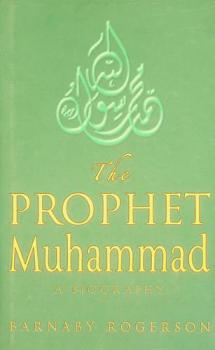
The prophet Muhammad
\"In this biography, Barnaby Rogerson explores the life and times of this deeply influential figure. Bringing to life the sixth-century Arabia where Muhammad was born, Rogerson charts his early years among the flocks, the caravans and the markets of his native Mecca, the night the Archangel Gabriel appeared before him and he became the messenger of God, the dangerous years of teaching in Mecca; his escape to Yathrib and the subsequent battles between the Meccans and the Prophet's Muslim forces, who would ultimately prove victorious.\"--Jacket.
BOOK

This Muslim American Life
Over the last few years, Moustafa Bayoumi has been an extra inSex and the City 2playing a generic Arab, a terrorist suspect (or at least his namesake \"Mustafa Bayoumi\" was) in a detective novel, the subject of a trumped-up controversy because a book he had written was seen by right-wing media as pushing an \"anti-American, pro-Islam\" agenda, and was asked by a U.S. citizenship officer to drop his middle name of Mohamed.
Others have endured far worse fates. Sweeping arrests following the terrorist attacks of September 11, 2001 led to the incarceration and deportation of thousands of Arabs and Muslims, based almost solely on their national origin and immigration status. The NYPD, with help from the CIA, has aggressively spied on Muslims in the New York area as they go about their ordinary lives, from noting where they get their hair cut to eavesdropping on conversations in cafés. InThis Muslim American Life, Moustafa Bayoumi reveals what the War on Terror looks like from the vantage point of Muslim Americans, highlighting the profound effect this surveillance has had on how they live their lives. To be a Muslim American today often means to exist in an absurd space between exotic and dangerous, victim and villain, simply because of the assumptions people carry about you. In gripping essays, Bayoumi exposes how contemporary politics, movies, novels, media experts and more have together produced a culture of fear and suspicion that not only willfully forgets the Muslim-American past, but also threatens all of our civil liberties in the present.
eBook
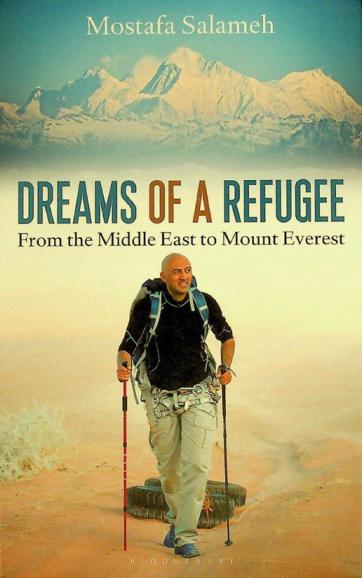
Dreams of a refugee
Dreams of a Refugee tells Mostafa's remarkable story, one of extraordinary faith and positivity. His message for our sceptical times is simple: that each of us has an Everest inside us, which we all can summit if only we dare to dream.
BOOK

Mawdudi and the making of Islamic revivalism
Nasr examines the life and thought of Mawlana Mawdudi, one of the first and most important Islamic ideological thinkers. Mawdudi was the first to develop a modern political Islamic ideology, and a plan for social action to realize his vision. The prolific writings and indefatigable efforts of Mawdudi's party, the Jamaat-i-Islami, first in India and later in Pakistan, have disseminated his ideas far and wide. His views have informed revivalism from Morocco to Malaysia. Nasr discerns the events that led Mawdudi to a revivalist perspective, and probes the structure of his thought, in order to gain fresh insights into the origins of Islamic revivalism. He argues that Islamic revivalism did not simply develop as a cultural rejection of the West, rather it was closely tied to questions of communal politics and its impact on identity formation, discourse of power in plural societies, and nationalism. Mawdudi's discourse, though aimed at the West, was motivated by Muslim-Hindu competition for power in British India. His aim, according to Nasr, was to put forth a view of Islam whose invigorated, pristine, and uncompromising outlook would galvanize Muslims into an ideologically uniform and hence politically indivisible community. In time, this view developed a life of its own and evolved into an all-encompassing perspective on society and politics, and has been a notable force in South Asia and Muslim life and thought across the Muslim world.
eBook

Malcolm Little : the boy who grew up to become Malcolm X
\"Malcolm X grew to be one of America's most influential figures. But first, he was a boy named Malcolm Little. Written by his daughter, this inspiring picture book biography celebrates a vision of freedom andBolstered by the love and wisdom of his large, warm family, young Malcolm Little was a natural born leader. But when confronted with intolerance and a series of tragedies, Malcolm's optimism and faith were threatened. He had to learn how to be strong and how to hold on to his individuality. He had to learn self-reliance. Together with acclaimed illustrator AG Ford, Ilyasah Shabazz gives us a unique glimpse into the childhood of her father, Malcolm X, with a lyrical story that carries a message that resonates still today--that we must all strive to live to our highest potential.\"--Provided by publisher.
BOOK
Elijah Muhammad
In the mid-1930s, Elijah Muhammad was just one of several competing leaders of the embryonic movement begun by the mysterious Wali Fard Muhammad, who claimed to be a prophet of Islam and who had recently disappeared. By the time of his death in 1975, Elijah Muhammad led a movement that may have numbered a few hundred thousand, making him the most powerful Muslim in the United States of America. Even before his death he was overshadowed by the growing legend of Malcolm X, and after his death by the activities of Louis Farrakhan and his own son Warith Deen Mohammed. Each of these men, however, was brought to Islam by Elijah Muhammad. And although Malcolm X and Elijah Muhammad's son came to reject his idiosyncratic and racial formulation of Islam, Elijah Muhammad was responsible for introducing hundreds of thousands, perhaps even millions of African Americans to Islam. Almost four decades after his death, he remains by far the most influential American Muslim.
eBook
Malcolm X
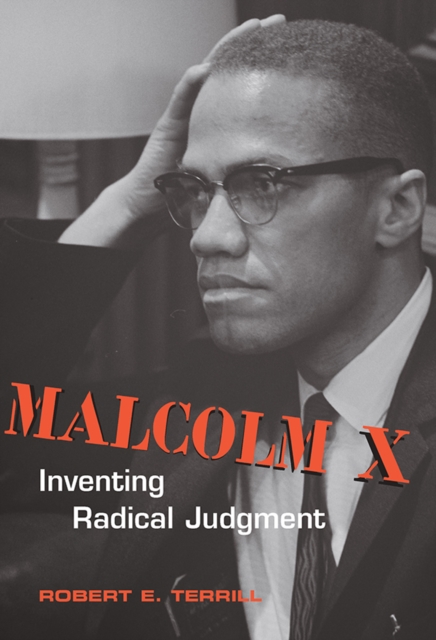
Few figures haunt the collective American psyche like Malcolm X. Hoodlum, convict, convert, prophet, nationalist, and martyr, Malcolm’s life spans the Civil Rights era like an index of America’s racial anxiety. Dozens of books and hundreds of articles have analyzed his life, his work, and the various ways that his image has been appropriated by American culture. Not much has been done, however, to analyze his speeches. This would be a glaring omission in the body of scholarship about almost any public figure, but is especially troubling with regard to Malcolm X. His legacy does not consist of marches preserved on newsreels, legislation passed by Congress, or holidays observed by the state; his legacy consists almost exclusively of his words.
Malcolm X, like any orator, did not fashion his discourse in a vacuum but worked within and modified modes fashioned by his predecessors. Malcolm X: Inventing Radical Judgment begins by exploring the interpretive strategies presented in key texts from the history of African American protest, establishing a spectrum against which Malcolm’s oratory can be assessed. The texts of speeches that Malcolm delivered while he was a minister for the Nation of Islam and the texts of speeches and statements he made after he left the Nation are analyzed carefully to discern the strategies of interpretation and judgment that he enacted and fostered in his audiences. Finally, this radical judgment, presented in and through Malcolm’s public discourse, is re-contextualized by using three disparate theoretical approaches. The purpose of this triangulation is not to contain the rhetoric of Malcolm X within the limitations of these vocabularies, but rather to show that the changing potential of Malcolm’s rhetoric lies, in part, in its iconoclastic refusal to be constrained by definitive boundaries.
eBook
An Islamic biographical dictionary of the Eastern Kazakh Steppe, 1770-1912
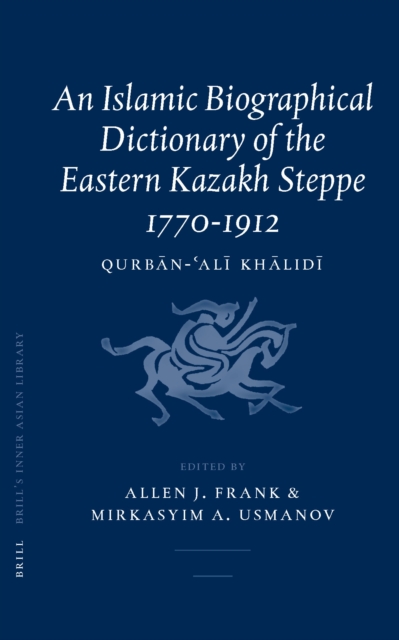
This biographical dictionary, based on a Turkic manuscript compiled in 1912, is essential for all those interested in the Islamic history of Central Asia under Russian and Chinese rule. Covering the period from 1770 - 1912, it brings to life the muslim communities of Sufis and scholars of the eastern Kazakh steppe. Its extensive biographical information provides fresh insights into the intellectual, political, and religious life of a region for which indigenous Islamic sources are virtually unknown.With a historical and textological introduction, full English translation, extensive notes, and an Arabic-script Turkic text.
eBook