
Catalogue Search | MBRL


Are you sure you want to remove the book from the shelf?

{{itemTitle}}
1,206
result(s) for
"Muslims France."
Sort by:

Muslims and Jews in France
This book traces the global, national, and local origins of the conflict between Muslims and Jews in France, challenging the belief that rising anti-Semitism in France is rooted solely in the unfolding crisis in Israel and Palestine. Maud Mandel shows how the conflict in fact emerged from processes internal to French society itself even as it was shaped by affairs elsewhere, particularly in North Africa during the era of decolonization.
Mandel examines moments in which conflicts between Muslims and Jews became a matter of concern to French police, the media, and an array of self-appointed spokesmen from both communities: Israel's War of Independence in 1948, France's decolonization of North Africa, the 1967 Arab-Israeli War, the 1968 student riots, and François Mitterrand's experiments with multiculturalism in the 1980s. She takes an in-depth, on-the-ground look at interethnic relations in Marseille, which is home to the country's largest Muslim and Jewish populations outside of Paris. She reveals how Muslims and Jews in France have related to each other in diverse ways throughout this history--as former residents of French North Africa, as immigrants competing for limited resources, as employers and employees, as victims of racist aggression, as religious minorities in a secularizing state, and as French citizens.
InMuslims and Jews in France, Mandel traces the way these multiple, complex interactions have been overshadowed and obscured by a reductionist narrative of Muslim-Jewish polarization.
eBook


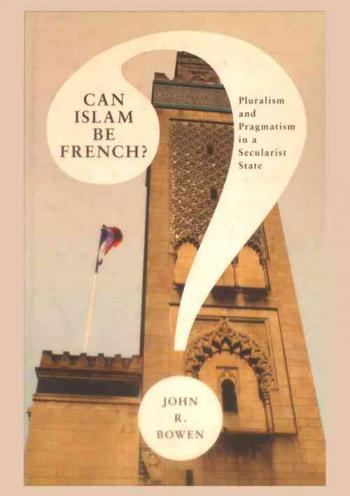
Can Islam Be French?
Can Islam Be French? is an anthropological examination of how Muslims are responding to the conditions of life in France. Following up on his book Why the French Don't Like Headscarves, John Bowen turns his attention away from the perspectives of French non-Muslims to focus on those of the country's Muslims themselves. Bowen asks not the usual question--how well are Muslims integrating in France?--but, rather, how do French Muslims think about Islam? In particular, Bowen examines how French Muslims are fashioning new Islamic institutions and developing new ways of reasoning and teaching. He looks at some of the quite distinct ways in which mosques have connected with broader social and political forces, how Islamic educational entrepreneurs have fashioned niches for new forms of schooling, and how major Islamic public actors have set out a specifically French approach to religious norms. All of these efforts have provoked sharp responses in France and from overseas centers of Islamic scholarship, so Bowen also looks closely at debates over how--and how far--Muslims should adapt their religious traditions to these new social conditions. He argues that the particular ways in which Muslims have settled in France, and in which France governs religions, have created incentives for Muslims to develop new, pragmatic ways of thinking about religious issues in French society.
eBook


Immigration, Islam, and the Politics of Belonging in France
Over the past three decades, neither France's treatment of Muslims nor changes in French, British, and German immigration laws have confirmed multiculturalist hopes or postnationalist expectations. Yet analyses positing unified national models also fall short in explaining contemporary issues of national and cultural identity.Immigration, Islam, and the Politics of Belonging in France: A Comparative Frameworkpresents a more productive, multifaceted view of citizenship and nationality. Political scientist Elaine R. Thomas casts new light on recent conflicts over citizenship and national identity in France, as well as such contentious policies as laws restricting Muslim headscarves. Drawing on key methods and insights of ordinary language philosophers from Austin to Wittgenstein, Thomas looks at parliamentary debates, print journalism, radio and television transcripts, official government reports, legislation, and other primary sources related to the rights and status of immigrants and their descendants. Her analysis of French discourse shows how political strategies and varied ideas of membership have intertwined in France since the late 1970s. Thomas tracks the crystallization of a restrictive but apparently consensual interpretation of French republicanism, arguing that its ideals are increasingly strained, even as they remain politically powerful. Thomas also examines issues of Islam, immigration, and culture in other settings, including Britain and Germany.Immigration, Islam, and the Politics of Belonging in Francegives scholarly researchers, political observers, and human rights advocates tools for better characterizing and comparing the theoretical stakes of immigration and integration and advances our understanding of an increasingly significant aspect of ethnic and religious politics in France, Europe, and beyond.
eBook

Respectable Muslims : morals and manners of minority citizens in France
\"Across Europe, many Muslims seek to gain respect through exemplary behavior. This book draws parallels with other minority citizens to examine this under-researched path of action. It unravels the politics of respectability of French Muslim leaders, shedding light on class and ethics in quiet minority politics\"-- Provided by publisher.
BOOK

Only Muslim
The French state has long had a troubled relationship with its diverse Muslim populations. InOnly Muslim, Naomi Davidson traces this turbulence to the 1920s and 1930s, when North Africans first immigrated to French cities in significant numbers. Drawing on police reports, architectural blueprints, posters, propaganda films, and documentation from metropolitan and colonial officials as well as anticolonial nationalists, she reveals the ways in which French politicians and social scientists created a distinctly French vision of Islam that would inform public policy and political attitudes toward Muslims for the rest of the century-Islam français. French Muslims were cast into a permanent \"otherness\" that functioned in the same way as racial difference. This notion that one was only and forever Muslim was attributed to all immigrants from North Africa, though in time \"Muslim\" came to function as a synonym for Algerian, despite the diversity of the North and West African population.
Davidson grounds her narrative in the history of the Mosquée de Paris, which was inaugurated in 1926 and epitomized the concept of Islam français. Built in official gratitude to the tens of thousands of Muslim subjects of France who fought and were killed in World War I, the site also provided the state with a means to regulate Muslim life throughout the metropole beginning during the interwar period. Later chapters turn to the consequences of the state's essentialized view of Muslims in the Vichy years and during the Algerian War. Davidson concludes with current debates over plans to build a Muslim cultural institute in the middle of a Parisian immigrant neighborhood, showing how Islam remains today a marker of an unassimilable difference.
eBook

Postcolonial counterpoint : orientalism, France, and the Maghreb
\"Postcolonial Counterpoint is a critical study of Orientalism and the state of Francophone and postcolonial studies, examined through the lens of the historical and cross-cultural relations between France and North Africa. Thoroughly questioning the inability of Western academia to shake free of universalism and essentialism and come to grips with the Orientalism within postcolonial discourse, Farid Laroussi offers a cultural tour d'horizon which considers André Gide's writing on Algeria, literature by French authors of Maghrebi descent, and the conversation surrounding secularism and the headscarf in France. A provocative investigation of the place of Muslims and Islam in Francophone culture, Postcolonial Counterpoint asks how we must proceed if postcolonial studies is to make a difference in reconciling history, identity, citizenship, and Islam in the West.\"-- Provided by publisher.
Book

Why the French Don't Like Headscarves
The French government's 2004 decision to ban Islamic headscarves and other religious signs from public schools puzzled many observers, both because it seemed to infringe needlessly on religious freedom, and because it was hailed by many in France as an answer to a surprisingly wide range of social ills, from violence against females in poor suburbs to anti-Semitism.Why the French Don't Like Headscarvesexplains why headscarves on schoolgirls caused such a furor, and why the furor yielded this law. Making sense of the dramatic debate from his perspective as an American anthropologist in France at the time, John Bowen writes about everyday life and public events while also presenting interviews with officials and intellectuals, and analyzing French television programs and other media.
Bowen argues that the focus on headscarves came from a century-old sensitivity to the public presence of religion in schools, feared links between public expressions of Islamic identity and radical Islam, and a media-driven frenzy that built support for a headscarf ban during 2003-2004. Although the defense oflaïcité(secularity) was cited as the law's major justification, politicians, intellectuals, and the media linked the scarves to more concrete social anxieties--about \"communalism,\" political Islam, and violence toward women.
Written in engaging, jargon-free prose,Why the French Don't Like Headscarvesis the first comprehensive and objective analysis of this subject, in any language, and it speaks to tensions between assimilation and diversity that extend well beyond France's borders.
eBook