
Catalogue Search | MBRL


Are you sure you want to remove the book from the shelf?

{{itemTitle}}
10
result(s) for
"Myoneural junction."
Sort by:

Nerve and muscle
\"Written with undergraduate students in mind, the new edition of this classic textbook provides a compact introduction to the physiology of nerve and muscle. It gives a straightforward account of the fundamentals accompanied by some of the experimental evidence upon which this understanding is based. It first explores the nature of nerve impulses, clarifying their mechanisms in terms of ion flow through molecular channels in cell membranes. There then follows an account of the synaptic transmission processes by which one excitable cell influences activity in another. Finally, the emphasis turns to the consequences of excitable activity in the activation of contraction in skeletal, cardiac and smooth muscle, highlighting the relationships between cellular structure and function. This fourth edition includes new material on the molecular nature of ion channels, the activation of skeletal muscle and the function of cardiac and smooth muscle, reflecting exciting new developments in these rapidly growing fields\"-- Provided by publisher.
Book

Myoneural Junctions of Extraocular Muscles: Distances from the Orbital Rim and Widths
Purpose: To examine both the distances from the orbital rim to the myoneural junctions (MNJs) and the widths of the MNJs of all extraocular muscles. Methods: Six orbits of 3 post-mortem cadavers were used. The cadavers (1 female and 2 males) were all Japanese with an average age of 76.3 years. The MNJs of the extraocular muscles and their motor nerves were exposed, and then the distance from the orbital rim to each MNJ and the width of each MNJ were examined. Results: The distance from the orbital rim to each MNJ in the 6 extraocular muscles ranged from 24.4 to 33.6 mm and the width of each MNJ ranged from 5.0 to 8.5 mm. Conclusions: It is essential for orbital surgeons to understand both the distance from the orbital rim to MNJs and the widths of MNJs. This information not only aids the understanding of MNJ damage, but also prevents iatrogenic nerve impairment during orbital surgery.
Journal Article

Combined involvement of muscle, nerve, and myoneural junction following Leptospira infection
Leptospirosis is a zoonosis prevalent worldwide and is endemic in many parts of India. In early leptospiremic as well as late immune phase of the disease kidney, liver, heart, and lungs are commonly involved. Neurological manifestations are rare but may occur during immune phase in the form of aseptic meningitis, meningoencephalitis, seizures, myelitis, polyradiculoneuritis, and myalgia. In this report, we describe a rare case of leptospirosis with combined involvement of nerve, muscle, and myoneural junction in generalized fashion along with pulmonary, renal, and hepatic dysfunction.
Journal Article

Role of Ryanodine Receptors in the Effects of Hydrogen Sulfide on Transmitter Release from the Frog Motor Nerve Ending
We studied the role of ryanodine receptors in the effects of hydrogen sulfide on transmitter release from frog motor nerve ending. Sodium hydrosulfide (300 μM), a donor of hydrogen sulfide, reversibly increased the frequency of miniature endplate current without changes in its amplitude–time parameters. These effects were associated with reversible increase in endplate current amplitude, which was abolished by activation of ryanodine receptors of intracellular Ca
2+
stores with caffeine (3 mM) and ryanodine (0.5 μM). Under conditions of ryanodine receptors blockade with ryanodine (10 μM), sodium hydrosulfide had no effect on induced transmitter release, but its effects remained unchanged during ryanodine receptors blockade with dantrolene (25 μM). We concluded that an enhanced acetylcholine release induced by hydrogen sulfide is related to an increase of intracellular Ca
2+
concentration due to activation of ryanodine receptors for intracellular Ca
2+
-pool.
Journal Article
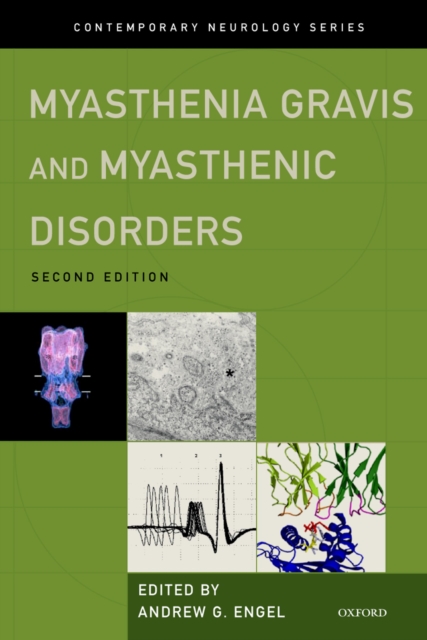
Myasthenia Gravis and Myasthenic Disorders
Myasthenia Gravis and Myasthenic Disorders, Second Edition is a thoroughly re-written and updated version of the highly successful first edition published in 1999. Comprehensively written by leaders at the forefront of research, not to mention thoroughly referenced throughout and gorgeously illustrated, this new edition of the classic 1999 text will cement its place as the text on Myasthenia Gravis and related disorders for years to come.
eBook

Familial Risks for Diseases of Myoneural Junction and Muscle in Siblings Based on Hospitalizations and Deaths in Sweden
Diseases of the myoneural junction and muscle are disabling and some are life-threatening. Recent successes in the identification of the underlying genetic mechanisms have had profound implication for their diagnostics, treatment and classification. We define familial risks for siblings who were hospitalized for or deceased from diseases of the myoneural junction and muscle. A nationwide database on diseases of the myoneural junction and muscle was constructed by linking the Multigeneration Register on 0- to 69-year-old siblings to the Hospital Discharge Register and the Causes of Death Register from years 1987 to 2001. Standardized risk ratios (SIRs) were calculated for affected sibling pairs by comparing to those whose siblings had no diseases of myoneural junction and muscle. Among a total of 2307 patients, myasthenia gravis, muscular dystrophy and myotonic disorders were commonest diagnoses. The sibling risks for these disease were 22, 190 and 198, respectively, when a sibling was diagnosed with any disease of the myoneural junction and muscle. The concordant SIRs, both siblings presenting the same disease, were 42 for myasthenia gravis, 737 for muscular dystrophy, 2000 for congenital myopathy, 1211 for myotonic disorder, 909 for periodic paralysis and 209 for unspecified myopathy. Only a few discordant sibling pairs were noted. The very high overall SIRs for the diseases of the myoneural junction and muscle imply that the sporadic forms of these diseases are relatively rare and these diseases are overwhelmingly heritable.
Journal Article
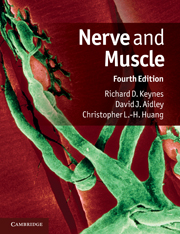
Nerve and Muscle
Written with undergraduate students in mind, the new edition of this classic textbook provides a compact introduction to the physiology of nerve and muscle. It gives a straightforward account of the fundamentals accompanied by some of the experimental evidence upon which this understanding is based. It first explores the nature of nerve impulses, clarifying their mechanisms in terms of ion flow through molecular channels in cell membranes. There then follows an account of the synaptic transmission processes by which one excitable cell influences activity in another. Finally, the emphasis turns to the consequences of excitable activity in the activation of contraction in skeletal, cardiac and smooth muscle, highlighting the relationships between cellular structure and function. This fourth edition includes new material on the molecular nature of ion channels, the activation of skeletal muscle and the function of cardiac and smooth muscle, reflecting exciting new developments in these rapidly growing fields.
eBook

Investigating the neural organisation of response selection and response conflict during language production using functional magnetic resonance imaging and repetitive transcranial magnetic stimulation
Motor response selection is the process by which an intention to act is transformed into an action; this multifaceted process occurs at the interface between cognitive and motor systems. Despite the importance of response selection, the nature and neural implementation of this process is still a subject of debate (Thompson-Schill et al, 1997; Botvinick et al., 2001; Rushworth et al., 2004; Nachev et al., 2007). While previous research has demonstrated that the selection of finger movements relies on a distributed network involving premotor and prefrontal areas, the specific contribution of these regions, however, remains unclear. It is also unclear if the selection of words engages similar processes as the selection of finger movements, that is, if response selection is a domain-general or a domain-specific process. In order to address these issues, a set of four complementary studies using functional magnetic resonance imaging (fMRI) and repetitive transcranial magnetic stimulation (rTMS) was developed in which different factors affecting response selection were examined: selection mode, response type (words vs. oral movements), attention and response competition (conflict). The results of these studies provide new insights into the neural architecture of response selection by uncovering the respective contribution of premotor areas (pre-SMA and PMA) and prefrontal areas (DLPFC and IFG). A preliminary two-stage model of response selection is proposed, in which the PMA is generating a set of response alternatives from which the pre-SMA performs selection using one of two different mechanisms (response facilitation and response inhibition). In general, these findings do not support the hypothesis of a medio-lateral gradient of control (Goldberg, 1985) but confirm the fundamental role of the lateral (PMA) and medial (pre-SMA) premotor areas in the process of selecting motor responses. Importantly, the results also demonstrate that selection is a domain-general (response-independent) process. Uncovering the general, multifaceted nature of brain mechanisms is essential to reveal the basic units of control in the central nervous system; this knowledge is fundamental to broaden current understanding of the basic brain operations that are used to produce language. Theoretical and clinical implications of these findings are discussed.
Dissertation

A comparison of acetylcholine and stable depolarizing agents
The method of brief ionophoretic application was used to compare the time course of action of acetylcholine and of stable depolarizing substances. The drugs were discharged from twin micropipettes, allowing a quick comparison of two substances, applied from virtually the same point source. With pulse application at close range, the time course of an acetylcholine potential is faster than those produced by other drugs. Comparing half-times of decay, if that of the acetylcholine potential is taken as unity, carbaminoylcholine is slower by a factor of about 2, nicotine and succinylcholine by 2 to 3, and decamethonium by approximately 10. After treating the muscle with prostigmine, the average difference in time course between acetylcholine and carbachol effects becomes insignificant. Different processes are discussed whose kinetics influence the shape of the observed drug potentials.
Journal Article
The identity of 'intrinsic’ and ‘extrinsic’ acetylcholine receptors in the motor end-plate
A possible distinction between ‘extrinsic’ drug receptors and ‘intrinsic’ neuro-receptors at the motor end-plate has been considered, and an experiment described to test the validity of such a differentiation. A dose of d-tubocurarine is applied ionophoretically to a motor end-plate, and its inhibitory effects are examined on (i) a ‘massive’ local discharge of miniature end-plate potentials (involving ‘intrinsic’ release of acetylcholine) and (ii) artificially produced acetylcholine potentials. Under suitable experimental conditions, curare is shown to suppress both types of depolarization with equal speed and efficacy. It is considered, therefore, that there is no basis for differentiating, in accessibility, location or pharmacological behaviour, between ‘drug- ’ and ‘neuro-receptors’ of the motor end-plate.
Journal Article