
Catalogue Search | MBRL


Are you sure you want to remove the book from the shelf?

{{itemTitle}}
121,140
result(s) for
"NATIONAL EDUCATION"
Sort by:

Between citizens and the state
This book tracks the dramatic outcomes of the federal government's growing involvement in higher education between World War I and the 1970s, and the conservative backlash against that involvement from the 1980s onward. Using cutting-edge analysis, Christopher Loss recovers higher education's central importance to the larger social and political history of the United States in the twentieth century, and chronicles its transformation into a key mediating institution between citizens and the state.
Framed around the three major federal higher education policies of the twentieth century--the 1944 GI Bill, the 1958 National Defense Education Act, and the 1965 Higher Education Act--the book charts the federal government's various efforts to deploy education to ready citizens for the national, bureaucratized, and increasingly global world in which they lived. Loss details the myriad ways in which academic leaders and students shaped, and were shaped by, the state's shifting political agenda as it moved from a preoccupation with economic security during the Great Depression, to national security during World War II and the Cold War, to securing the rights of African Americans, women, and other previously marginalized groups during the 1960s and '70s. Along the way, Loss reappraises the origins of higher education's current-day diversity regime, the growth of identity group politics, and the privatization of citizenship at the close of the twentieth century.
At a time when people's faith in government and higher education is being sorely tested, this book sheds new light on the close relations between American higher education and politics.
eBook


Education in Nazi Germany
This book examines how Nazism took shape in the classroom and offers a compelling new analysis of Nazi educational policy. The author convincingly argues that in order to understand National Socialism, we need to understand its policies on youth.
eBook

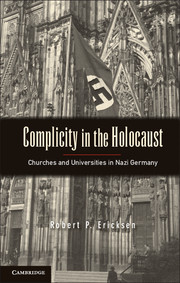
Complicity in the Holocaust
In one of the darker aspects of Nazi Germany, churches and universities - generally respected institutions - grew to accept and support Nazi ideology. Robert P. Ericksen explains how an advanced, highly educated, Christian nation could commit the crimes of the Holocaust. This book describes how Germany's intellectual and spiritual leaders enthusiastically partnered with Hitler's regime, thus becoming active participants in the persecution of Jews, and ultimately, in the Holocaust. Ericksen also examines Germany's deeply flawed yet successful postwar policy of denazification in these institutions. Complicity in the Holocaust argues that enthusiasm for Hitler within churches and universities effectively gave Germans permission to participate in the Nazi regime.
eBook

Indigenous vanguards : education, national liberation, and the limits of modernism
The interwar period witnessed an unprecedented emergence of anticolonial movements in Africa, Asia, and the Americas. Their vanguard intellectuals were preoccupied with the education of future postcolonial citizens, hoping to teach independent thought and enable participation in a nonimperial world. In order to undo the cultural destruction of colonialism, they sought to reimagine indigenous collective forms at the same time as drawing upon structures and technologies of modern public education. In Indigenous Vanguards, Ben Conisbee Baer provides a theoretical and historical account of the relationships between modern literature, representations of indigeneity by cultural vanguards, and practices of teaching and learning in colonial zones from the 1920s to the 1940s. He shows how modernizing educative projects existed in complex tension with impulses to indigenize liberation movements, and how this tension manifests as a central aspect of modernist aesthetics. Offering new readings of figures such as Alain Locke, Lâeopold Senghor, Aimâe C âesaire, D. H. Lawrence, Rabindranath Tagore, and Mahatma Gandhi, Baer draws unexpected connections among colonial intellectuals and artists that underscore the importance of class and educational continuities. The first study of modernism and colonialism that encompasses the central place of teaching and learning both in modernist aesthetics and on the part of writer-activists, Indigenous Vanguards forges new links between literary modernism and postcolonialism in a transnational, multilingual frame.
Book
Sustaining educational and economic momentum in Africa
The conference brought together 44 African ministers of finance and of education from 28 African countries for a structured dialogue on sustaining Africa's economic and educational progress in the current context of a global economic slowdown. African countries have achieved laudable progress during the last decade towards the Education for All (EFA) goals for 2015 that were agreed in Dakar in 2000, particularly with regard to Universal Primary Education (UPE). This progress reflects the combined impact of several factors, notably courageous education reforms, substantially increased public financing of education made possible largely by sustained economic growth and increased political priority for education-and greater inflows of external aid for education. The momentum may be jeopardized, however, by the current worldwide economic downturn. Tightening domestic budgets and external aid could increase the difficulty of sustaining policy reform and strategic investments, thereby putting at risk the hard won gains of the last ten years. They could also undermine Africa's efforts to develop post basic education and training and delay achievement of key goals of the African Union's Second Decade for Education in Africa. The result would be to frustrate the aspirations of the increasing numbers of African youth who seek to go beyond primary education and to deny their prospective employers the skilled workforce that could help boost business competitiveness and economic growth. The emerging global economic circumstances provided a key rationale for the Conference. Its purpose was to stimulate dialogue among senior policy makers on policy options to achieve a mutually reinforcing relation between education and the economy.
eBook

Educating \good\ citizens in a globalising world for the twenty-first century
What is needed to be a 'good' citizen for the twenty-first century? And how can schools and curricula address this question? This book addresses these questions and what it means to be a 'good citizen' in the twenty-first century by exploring this concept in two different, but linked, countries. China is a major international power whose citizens are in the midst of a major social and economic transformation. Australia is transforming itself into an Asian entity in multiple ways and is influenced by its major trading partner - China. Yet both rely on their education systems to facilitate and guide this transformation as both countries search for 'good' citizens. The book explores the issue of what it means to be a 'good citizen' for the 21st century at the intersection between citizenship education and moral education. The issue of what constitutes a 'good citizen' is problematic in many countries and how both countries address this issue is vitally important to understanding how societies can function effectively in an increasingly interconnected world. The book contends that citizenship education and moral education in both countries overlap on the task of how to educate for a 'good citizen'. Three key questions are the focus of this book: 1. What is a 'good citizen' in a globalizing world? 2. How can 'good citizenship' be nurtured in schools? 3. What are the implications of the concept of 'good citizen' in education, particularly the school curriculum? [Publisher website, ed].
Book

The role and impact of public-private partnerships in education
Enhancing the role of private sector partners in education can lead to significant improvements in education service delivery. However, the realization of such benefits depends in great part on the design of the partnership between the public and private sectors, on the overall regulatory framework of the country, and on the governmental capacity to oversee and enforce its contracts with the private sector. Under the right terms, private sector participation in education can increase efficiency, choice, and access to education services, particularly for students who tend to fail in traditional education settings. Private-for-profit schools across the world are already serving a vast range of usersâ€\"from elite families to children in poor communities. Through balanced public-private partnerships (PPPs) in education, governments can leverage the specialized skills offered by private organizations as well as overcome operating restrictions such as salary scales and work rules that limit public sector responses. 'The Role and Impact of Public-Private Partnerships in Education' presents a conceptualization of the issues related to PPPs in education, a detailed review of rigorous evaluations, and guidleines on how to create successful PPPs. The book shows how this approach can facilitate service delivery, lead to additional financing, expand equitable access, and improve learning outcomes. The book also discusses the best way to set up these arrangements in practice. This information will be of particular interest to policymakers, teachers, researchers, and development practitioners.
eBook