
Catalogue Search | MBRL


Are you sure you want to remove the book from the shelf?

{{itemTitle}}
64,312
result(s) for
"NATIONAL IDENTITY"
Sort by:

Understanding national identity
\"We live in a world in which being a 'citizen' of a state and being a 'national' are by no means the same. Amidst much scholarly debate about 'nations' and 'nationalism', comparatively little has been written explicitly on 'national identity' and a great deal less is solidly evidence-based. This book focuses on national identity in England and Scotland. Using data collected over twenty years it asks: does national identity really matter to people? How does 'national identity' differ from 'nationality' and having a passport? Are there particular people and places which have ambiguous or contested national identities? What happens if someone makes a claim to a national identity? On what basis do others accept or reject the claim? Does national identity have much internal substance, or is it simply about defending group boundaries? How does national identity relate to politics and constitutional change?\"-- Provided by publisher.
Book

Forms of National and European Identity: A Research Note Reviewing Literature of Cross-National Studies
In the past decades, numerous publications have been addressing questions of national and European Identity on the micro level. Only few shed light on the contents that constitute these identities in the minds of Europeans. As different meanings of national and European identity are connected to different consequences such as hostile attitudes toward immigrants or Euroskepticism, reviewing attempts to measure these contents in existing cross-national surveys seems to be promising. This research note summarizes relevant literature on whether and which different forms of national and European identity have been found empirically, which specific contents constitute them, and which determinants and consequences of them are relevant. By comparing articles relying on cross-national survey data since 1995, it will be shown that the field of forms of national and European identity involves different operationalizations and numerous methodological concerns. This leads to considerations for further research in the field.
Journal Article

A most dangerous book : Tacitus's Germania from the Roman Empire to the Third Reich
Traces the five-hundred year history and wide-ranging influence of the Roman historian's unflattering book about the ancient Germans that was eventually extolled by the Nazis as a bible.
Book
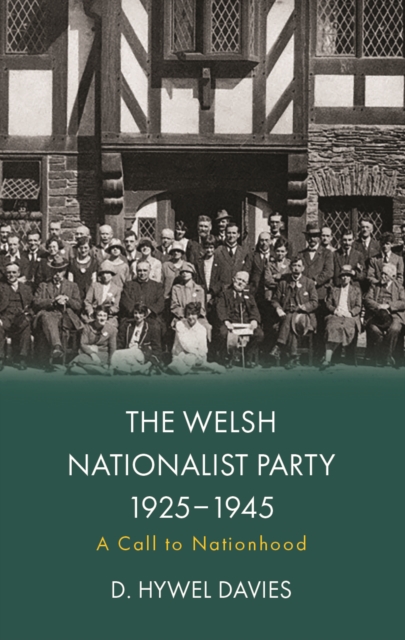
The Welsh Nationalist Party, 1925-1945
This work examines the nature of the Welsh Nationalist Party from its foundation in 1925 to 1945 - the philosophy and policies it embraced, the methods it used, and its organisational character. The author's major conclusion is that the 'party' was not really a political party as such during the period under study, but a culturally oriented.
eBook

Everyday nationhood : theorising culture, identity and belonging after Banal Nationalism
This edited collection explores the continuing appeal of nationalism around the world. The authors' ground-breaking research demonstrates the ways in which national priorities and sensibilities frame an extraordinary array of activities, from classroom discussions and social media posts to global policy-making, as well as identifying the value that can come from feeling part of a national community, especially during times of economic uncertainty and social change. They also note how attachments to nation can often generate powerful emotions, happiness and pride as well as anger and frustration, which can be used to mobilize substantial numbers of people into action.-- Provided by publisher.
Book

Fluid Russia
Fluid Russia offers a new
framework for understanding Russian national identity by focusing
on the impact of globalization on its formation, something which
has been largely overlooked. This approach sheds new light
on the Russian case, revealing a dynamic Russian identity that is
developing along the lines of other countries exposed to
globalization. Vera Michlin-Shapir shows how along with the
freedoms afforded when Russia joined the globalizing world in the
1990s came globalization's disruptions.
Michlin-Shapir describes Putin's rise to power and his project
to reaffirm a stronger identity not as a uniquely Russian diversion
from liberal democracy, but as part of a broader phenomenon of
challenges to globalization. She underlines the limits of Putin's
regime to shape Russian politics and society, which is still very
much impacted by global trends. As well, Michlin-Shapir questions a
prevalent approach in Russia studies that views Russia's experience
with national identity as abnormal or defective, either being too
week or too aggressive.
What is offered is a novel explanation for the so-called Russian
identity crisis. As the liberal postwar order faces growing
challenges, Russia's experience can be an instructive example of
how these processes unfold. This study ties Russia's authoritarian
politics and nationalist rallying to the shortcomings of
globalization and neoliberal economics, potentially making Russia
\"patient zero\" of the anti-globalist populist wave and rise of
neo-authoritarian regimes. In this way, Fluid Russia
contributes to the broader understanding of national identity in
the current age and the complexities of identity formation in the
global world.
eBook


Making Morocco
How did four and a half decades of European colonial intervention transform Moroccan identity? As elsewhere in North Africa and in the wider developing world, the colonial period in Morocco (1912-1956) established a new type of political field in which notions about and relationships among politics and identity formation were fundamentally transformed. Instead of privileging top-down processes of colonial state formation or bottom-up processes of local resistance, the analysis in Making Morocco focuses on interactions between state and society.
Jonathan Wyrtzen demonstrates how, during the Protectorate period, interactions among a wide range of European and local actors indelibly politicized four key dimensions of Moroccan identity: religion, ethnicity, territory, and the role of the Alawid monarchy. This colonial inheritance is reflected today in ongoing debates over the public role of Islam, religious tolerance, and the memory of Morocco's Jews; recent reforms regarding women's legal status; the monarchy's multiculturalist recognition of Tamazight (Berber) as a national language alongside Arabic; the still-unresolved territorial dispute over the Western Sahara; and the monarchy's continued symbolic and practical dominance of the Moroccan political field.
eBook


The Effects of Three Facets of National Identity and Other Socioeconomic Traits on Attitudes Towards Immigrants
The academic literature showed an increasing interest in studying the link between national identity and anti-immigrant sentiment. This work is based on ten countries from the International Social Survey Program (ISSP) dataset for two different waves: 2003 and 2013. The paper aims to analyse the influence of the three facets of national identity (nationalism, political patriotism, and cultural patriotism) and other socioeconomic traits on attitudes towards immigrants (ATI). Untried methods in social science based on the fuzzy-hybrid analysis (FHA) and the fuzzy clustering are used first to analyse citizens according to their levels of openness towards immigrants, nationalism, cultural patriotism, and political patriotism. Then, the ordered probit model is applied to thoroughly examine the intricate relationships connecting the three facets of national identity and individual sociodemographic characteristics with ATI. The results show that the national identity and cultural patriotism constructs negatively influence ATI, while political patriotism positively influences ATI. In addition, country, political orientation, age, religion, economic situation, gender, place of birth, principal status, and education are crucial factors that explain ATI.
Journal Article