
Catalogue Search | MBRL


Are you sure you want to remove the book from the shelf?

{{itemTitle}}
4,960
result(s) for
"NATURAL RATE OF UNEMPLOYMENT"
Sort by:


Structural rate of unemployment, hysteresis, human capital, and macroeconomic data
The relationship between the unemployment rate and the evolution of human capital is different depending on whether one subscribes to a neoclassical logic or to a hysteresis theory. This paper proposes that when the unemployment rate reaches a high level for some time, the persistence phenomenon, or hysteresis, weakens the attractive forces of the natural rate of unemployment. The unemployment rate can then reach a different equilibrium value. However, according to Blanchard and Summers, this equilibrium is unstable and fragile. In the second part of this paper, we propose an indicator to measure the intensity of the attraction forces of the natural rate of unemployment. The empirical values of this index show the weak attraction forces of the natural rate of unemployment in economies with high levels of long-term unemployment.
Journal Article

A Search and Matching Approach to Labor Markets: Did the Natural Rate of Unemployment Rise?
The U.S. unemployment rate has remained stubbornly high since the 2007–2009 recession, leading some observers to conclude that structural rather than cyclical factors are to blame. Relying on a standard job search and matching framework and empirical evidence from a wide array of labor market indicators, we examine whether the natural rate of unemployment has increased since the recession began, and if so, whether the underlying causes are transitory or persistent. Our preferred estimate indicates an increase in the natural rate of unemployment of about one percentage point during the recession and its immediate aftermath, putting the current natural rate at around 6 percent. An assessment of the underlying factors responsible for this increase, including labor market mismatch, extended unemployment benefits, and uncertainty about overall economic conditions, implies that only a small fraction is likely to be persistent.
Journal Article
What We Know and Do Not Know About the Natural Rate of Unemployment
Over the past three decades, much research has attempted to identify the determinants of the natural rate of unemployment. The authors reach two main conclusions about this body of work. First, there has been considerable theoretical progress over the past thirty years. A framework emerged that can be used to think, for example, about the relation between technological progress and unemployment. Second, empirical knowledge lags behind. Economists don't have a good quantitative understanding of the determinants of the natural rate, either across time or countries. The authors look at two issues, the relation of wages to unemployment and the rise of European unemployment.
Journal Article
Retrospectives
This paper addresses two conflicting views in the 1950s and 1960s about the inflation-unemployment tradeoff as given by the Phillips curve. Many economists at this time emphasized the issue of a seemingly unavoidable inflationary pressure at or even below full employment. In contrast, Milton Friedman was convinced that full employment and price stability are not conflicting policy objectives. This dividing line between the two camps ultimately rested on fundamentally different views about the inflationary process: For economists of the 1950s and 1960s cost-push forces are responsible for the apparent conflict between price stability and full employment. On the other hand, Friedman, who regarded inflation to be an exclusively monetary phenomenon, rejected the notion of ongoing inflationary cost-push pressures at full employment. Besides his emphasis on the full adjustment of inflation expectations, this rejection of cost-push theories of inflation, which implied a decoupling of the two previously perceived incompatible policy objectives, was the other important element in Friedman's attack on the Phillips curve tradeoff in his 1967 presidential address to the American Economic Association.
Journal Article
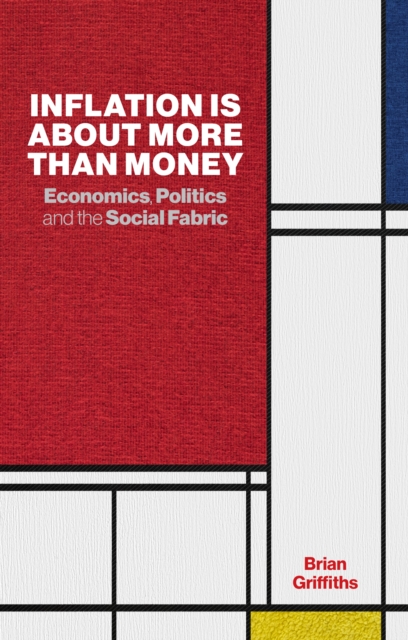
Inflation Is About More Than Money
In \"Inflation Is About More Than Money\", Brian Griffiths charts recent history and policy developments with regard to inflation. He sees inflation as a moral problem: a form of taxation and deceit that those in positions of authority should always seek to address. Considering a range of theoretical approaches to inflation, he advances a pragmatic monetarist approach and offers a series of concrete recommendations for both dealing with inflation and protecting against it in the future. In addition, the author examines the cultural factors at play, such as disillusionment with democracy and social fragmentation. He argues for the importance of a shared moral framework, or \"sacred canopy\", to underpin our collective purpose and provide a foundation for economic, social and political stability. Accessible and engaging, \"Inflation Is About More Than Money\" will appeal to those who are interested in questions of wealth and poverty, the role of central banks and politicians, responsible economic management, and the importance of moral values in economic and political life.
eBook

Hysteresis of unemployment rates in Africa: new findings from Fourier ADF test
We investigate the existence of the unit root hypothesis in the unemployment rates of 42 African countries using the Fourier ADF test. The essence is to clarify if the hypothesis of hysteresis holds or unemployment rate is dubbed as having natural rate, that is, stationarity. Having considered a novel approach that considers the nonlinear Fourier and a structural break in the unit root testing framework, we find the classical unit root test wrongly accepting the hysteresis hypothesis of unemployment rate in selected African countries more than 60% of the cases. Meanwhile, our approach finds fewer cases of hysteresis in the unemployment rate than initially detected by the conventional classical test: the hysteresis hypothesis is found to hold in only seven countries (Algeria, Botswana, Cabo Verde, Congo DR, Guinea-Bissau, Liberia and Tanzania) out of the 42 African countries. This implies that with the exception of the seven countries mentioned, shocks to unemployment will be transitory and strong policy action will not be required to address unemployment challenges. This suggests that hysteresis effects will be offset overall since these are concentrated in smaller African economies and portends for a faster recovery to shocks in the broader African context. Robustness check proves the superiority of the Fourier unit root tests with structural break over other lower alternatives.
Journal Article

Why Inflation Rose and Fell: Policy-Makers' Beliefs and U. S. Postwar Stabilization Policy
This paper provides an explanation for the run-up of U. S. inflation in the 1960s and 1970s and the sharp disinflation in the early 1980s, which standard macroeconomic models have difficulties in addressing. I present a model in which rational policy-makers learn about the behavior of the economy in real time and set stabilization policy optimally, conditional on their current beliefs. The steady state associated with the self-confirming equilibrium of the model is characterized by low inflation. However, prolonged episodes of high inflation ending with rapid disinflations can occur when policy-makers underestimate both the natural rate of unemployment and the persistence of inflation in the Phillips curve. I estimate the model using likelihood methods. The estimation results show that the model accounts remarkably well for the evolution of policy-makers' beliefs, stabilization policy, and the postwar behavior of inflation and unemployment in the United States.
Journal Article

The Spectre of Price Inflation
An accessible and authoritative overview of the role of inflation in the modern economy, from its place in monetary policy and in money supply to its effects on everyday business.
eBook

Endogeneity in Structural Unemployment Equations: The Case of Canada
This paper examines the endogeneity of several structural variables which enter unemployment rate equations - the generosity of unemployment benefits, nonwage labor costs, the relative minimum wage, and the degree of unionization. It finds evidence of reverse causality for these structural variables based on causality tests. The structural unemployment rate equation is then estimated using instruments suggested by the empirical analysis of the structural variables. The paper confirms the earlier finding that the generosity of unemployment benefits, nonwage labor costs, and the relative minimum wage have a significant positive impact on the unemployment rate, but fails to find an effect for the degree of unionization.
Journal Article