Catalogue Search | MBRL


Are you sure you want to remove the book from the shelf?

{{itemTitle}}
150
result(s) for
"NAVIRE"
Sort by:


Shipbuilding and Ship Repair Workers around the World
Maritime trade is the backbone of the world’s economy. Around ninety percent of all goods are transported by ship, and since World War II, shipbuilding has undergone major changes in response to new commercial pressures and opportunities. Early British dominance, for example, was later undermined in the 1950s by competition from the Japanese, who have since been overtaken by South Korea and, most recently, China. The case studies in this volume trace these and other important developments in the shipbuilding and ship repair industries, as well as workers’ responses to these historic transformations.
eBook

Finding Franklin : the untold story of a 165-year search
\"In 2014 media around the world buzzed with news that an archaeological team from Parks Canada had located and identified the wreck of the HMS Erebus, the flagship of Sir John Franklin's lost expedition to find the Northwest Passage. Finding Franklin outlines the larger story and the cast of detectives from every walk of life that led to the discovery, solving of one of the Arctic's greatest mysteries. In compelling and accessible prose, Russell Potter details his decades of work alongside key figures in the era of modern searches for the expedition and elucidates how shared research and ideas have led to a fuller understanding of the Franklin crew's final months. Illustrated with numerous images and maps from the last two centuries, Finding Franklin recounts the more than fifty modern searches for traces of his ships and crew, and the dedicated, often obsessive, men and women who embarked on them. Potter discusses the crucial role that Inuit oral accounts, often cited but rarely understood, played in all of these searches, and continues to play to this day, and offers historical and cultural context to the contemporary debates over the significance of Franklin's achievement. While examination of the HMS Erebus will undoubtedly reveal further details of this mystery, Finding Franklin assembles the stories behind the myth and illuminates what is ultimately a remarkable decades-long discovery.\"-- Provided by publisher.
Book
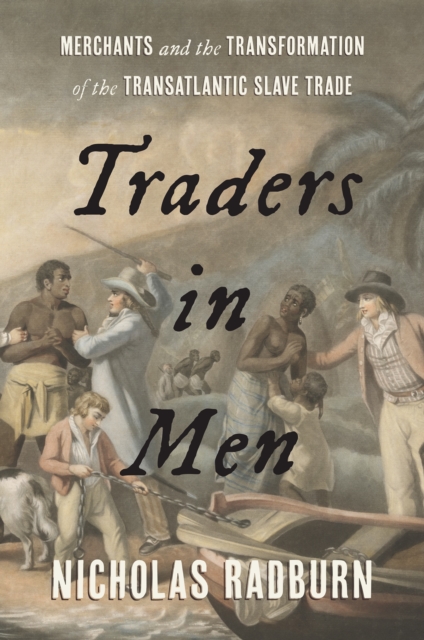
Traders in Men
BA sweeping new history that reveals how British, African, and American merchants developed the transatlantic slave trade/BBR / BR /B\"This is a landmark study given its clear status as easily the best researched and most comprehensive book on the British slave trade to date.\"-David Eltis, coauthor of IAtlas of the Transatlantic Slave Trade/I/BBR / BR /B\"A masterful account of one of the most brutal moments in the history of capitalist modernity. Radburn brilliantly details all aspects of the process of commodification of human beings in the Liverpool slave trade, vividly depicting the long journeys endured by Africans in Africa, across the Atlantic, and in the Americas.\"-Leonardo Marques, Universidade Federal Fluminense/BBR / BR / During the eighteenth century, Britain's slave trade exploded in size. Formerly a small and geographically constricted business, the trade had, by the eve of the American Revolution, grown into a transatlantic system through which fifty thousand men, women, and children were enslaved every year.BR / BR / In this wide-ranging history, Nicholas Radburn explains how thousands of merchants collectively transformed the slave trade by devising highly efficient but violent new business methods. African brokers developed commercial infrastructure that facilitated the enslavement and sale of millions of people. Britons invented shipping methods that quelled enslaved people's constant resistance on the Middle Passage. And American slave traders formulated brutal techniques through which shiploads of people could be quickly sold to colonial buyers. Truly Atlantic-wide in its vision, this study shows how the slave trade dragged millions of people into its terrible vortex and became one of the most important phenomena in world history.
eBook

Shipbuilding and Ship Repair Workers around the World
Maritime trade is the backbone of the world's economy. Around ninety percent of all goods are transported by ship, and since World War II, shipbuilding has undergone major changes in response to new commercial pressures and opportunities. Early British dominance, for example, was later undermined in the 1950s by competition from the Japanese, who have since been overtaken by South Korea and, most recently, China. The case studies in this volume trace these and other important developments in the shipbuilding and ship repair industries, as well as workers' responses to these historic transformations.
eBook

The Divided North
Finalist, 2026 New England Society Book Award in Nonfiction Reuben Ruby and Nathaniel Gordon II were born eleven months apart in 1798 and 1799 and spent much of their boyhoods roaming the noisy, bustling waterfront of Portland, Maine. They lived just blocks from one another, attended school together, and went to the same church with their families. But they were worlds apart, separated by family, culture, and race. Reuben Ruby was Black and Nathaniel Gordon was White. The Rubys became prominent antislavery activists, equal rights advocates, and operatives on the Underground Railroad. Their neighbors, the Gordons, became well-to-do ship masters, owners, and merchants: among them, the most notorious American slave ship captain of the century, Nathaniel Gordon III. As activists, sea captains, businessmen, prospectors, and politicians, members of these two families traveled to New York, California, Texas, Louisiana, Africa, Haiti, and Brazil, where their experiences were shaped by their racial identities. At home in the \"Free North,\" they faced social and political divisions nearly as sharp as those they encountered elsewhere. To understand the issues that divided nineteenth-century America—and, in many ways, still divide the nation—few have looked to the far North. In this compelling narrative history and intimate dual-family biography, Carol Gardner traces the Rubys and Gordons as they navigate the turbulent 1800s. As families and individuals, they demonstrate that the North was a critical proving ground for American notions of freedom and equality, as telling as any town, plantation, or battlefield in the South. Their experiences help reveal what it meant to live in a free state during the age of slavery, with all the promise, disappointment, irony, and hope that the notion entailed.
eBook
Marine Propellers and Propulsion (3rd Edition)
Propulsion technology is a complex, multidisciplinary topic with design, construction, operational and research implications. Bringing together a wealth of disparate information from the field, this book provides comprehensive and cutting edge coverage to equip marine engineers, naval architects and anyone involved in propulsion and hydrodynamics with the knowledge needed to do the job. Drawing on experience from a long and varied career in consultancy, research, design and technical investigation, author John Carlton breaks the subject into three main sections-hydrodynamic theory, materials and mechanical considerations, and design, operation and performance. Connecting essential theory to practical problems in design, analysis and operational efficiency, this is an invaluable resource, packed with hard-won insights, detailed specifications and data.
eBook
American battlefield trust pilot. Floating hospital ship
In this video, viewers will learn about the history of hospital ships and how they have helped save lives throughout the ages.
Streaming Video
Black history series. Slave revolt on the Amistad
Explore the gripping tale of the Amistad! In 1839, this ship departed from Havana, Cuba, carrying 53 African captives bound for slavery. But these captives, belonging to the Mende tribe, bravely rose up, seized control of the ship, and demanded to be sailed back to Africa. They overpowered the captain and cook, yet the plantation owners cunningly altered course, steering the ship toward the United States instead.
Streaming Video