
Catalogue Search | MBRL


Are you sure you want to remove the book from the shelf?

{{itemTitle}}
13
result(s) for
"NPI licensing"
Sort by:

Rhetorical Questions and Polarity Licensing: On Cantonese Modal Sai2
This paper investigates the deontic modal
in Cantonese. I argue that
is an NPI and a negative operator is induced at the sentence-initial position by the SFPs
or
in rhetorical questions. In SAI sentence,
must syntactically agree with the negative operator for licensing, and minimality and locality effects are found in such agreement. This study may provide evidence of a syntactic approach to NPI licensing and rhetorical questions.
Journal Article

The Diverse Landscape of Negative Polarity Items: On the Use of German NPIs as Experimental Diagnostics
The goal of this study is to provide better empirical insight into the licensing conditions of a large set of NPIs in German so that they can be used as reliable diagnostics in future research on negation-related phenomena. Experiment 1 tests the acceptability of 60 NPIs under semantic operators that are expected to license superstrong, strong, weak, and nonveridicality-licensed NPIs, respectively: antimorphic (
not
), anti-additive (
no
), downward entailing (
hardly
), nonveridical (
maybe
, question). Controls were positive assertions. Cluster analysis revealed seven clusters of NPIs, some of which confirm the licensing categorization from the literature (superstrong and weak NPIs). Other clusters show unclear patterns (overall high or medium ratings) and require further scrutiny in future research. One cluster showed high acceptability ratings only with the antimorphic and the question operator. Experiment 2 tested whether the source of this unexpected distribution was a rhetorical interpretation of the questions. Results suggest that rhetoricity was not the sole source. Overall, the results show gradual rather than categorical differences in acceptability, with higher acceptability corresponding to stronger negativity. The paper provides the detailed results for the individual NPIs as a preliminary normed acceptability index.
Journal Article

Finiteness, negation and the directionality of headedness in Bangla
This paper investigates a pattern in the South Asian language Bangla which strongly resembles the finite/non-finite positioning of verbs in English and French reported in Pollock (1989). In finite clauses in Bangla, verbs precede negation, as in English, while in non-finite clauses verbs follow negation, as in French. The paper considers whether the analysis of (leftwards) movement of the verb to Tense/Agreement in finite clauses argued for by Pollock for French should be assumed to operate in the SOV language Bangla as well, potentially supporting a Linear Correspondence Axiom (LCA) head-initial analysis of Bangla, which has elsewhere regularly been taken to be a head-final language. Considering other patterns in the language relating to negative polarity item (NPI) licensing and quantifier scope in finite and non-finite clauses, it is argued that a leftwards head-movement analysis is unable to account for such patterns. A different analysis of the alternating position of negation and verbs is then suggested, which attributes this to the realization of negation either in the specifier or head position of NegP, drawing on Pollock's (1989) analysis of the dual location of negative morphemes in French and on much recent work on alternations between specifier and head lexicalization (van Gelderen 2004 and others).
Journal Article
NPI licensing in temporal clauses
This paper offers a systematic semantically-based approach to NPI licensing in temporal clauses based on Beaver and Condoravdi (2003, in progress). It motivates the presuppositional nature of temporal clauses and shows how temporal ordering induces an ordering of semantic strength in each case. The proposed analysis is uniform across veridical and non-veridical readings of before and brings under the semantic fold seemingly exceptional or pragmatically-based cases of NPI licensing observed with after, since and until.Crucial throughout is the more restricted, presupposition-dependent notion of entailment, Strawson entailment, proposed by von Fintel (1999). The paper also relates Strawson entailment to the alternative-based analysis of NPIs by Krifka (1995), proposing a particular kind of contextual update, Strawson update, for calculating informational strength.
Journal Article

\Before\ and \After\ without coercion: comment on the paper by Cleo Condoravdi
The following contribution was inspired by Cleo Condoravdi's article on NPI licensing in temporal clauses (Condoravdi 2010). Condoravdi gives a coherent and comprehensive account of before which crucially involves coercion of propositions to the earliest or maximal times at which the propositions are true, and a modal component for non-factual interpretations. I argue for a non-modal, non-coercive analysis of clauses like [A before B] as ¢ is the case when  has not been the case', triggering a conversational implicature that  will be the case later. I will also discuss temporal operators involving measure phrases, like three hours before.
Journal Article

Association by movement: evidence from NPI-licensing
'Only' associates with focus and licenses NPIs. This paper looks at the distributional pattern of NPIs under 'only' and presents evidence for the movement theory of focus association and against an in situ approach. NPIs are licensed in the 'scope' (or the second argument) of 'only', but not in the complement (or its first argument), which I will call the 'syntactic restrictor'. While earlier approaches argued that 'only' licenses NPIs in the unfocused part of the sentence it occurs in except in its focus, evidence from DP-'only' shows that NPIs are also not licensed in the unfocused part of the syntactic restrictor. The distribution of NPIs provides a test for the size of the syntactic restrictor, and this test is applied to the case of VP-'only'. The evidence shows that (i) the restrictor can be smaller than the entire VP and is not necessarily identical to the surface complement of 'only'; (ii) in the case of association with a head the restrictor comprises an XP containing the head; and (iii) in cases of association into an island, the restrictor comprises the entire island. Generalizations (i)—(iii) can be captured straightforwardly by a movement approach but are incompatible with an in situ analysis. Contextual domain restriction of the kind used in in situ approaches accounts for the appropriate semantics in cases where the semantic focus is properly contained in the syntactic restrictor of 'only'.
Journal Article
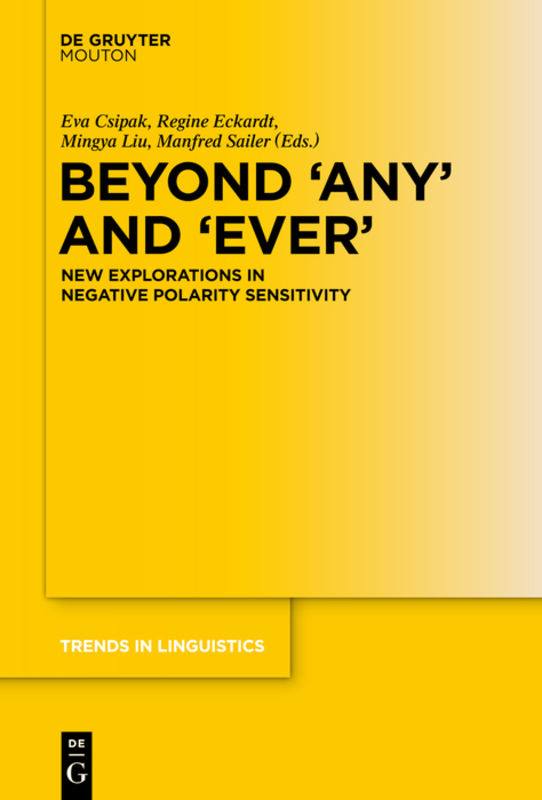
Beyond 'Any' and 'Ever'
The grammar of negative polarity items is one of the challenges for linguistic theory. NPIs cross-cut all traditional categories in grammar and semantics, yet their distribution is by no means arbitrary. Theories of NPI licensing have been proposed in terms of syntax, semantics, and pragmatics - each with its own merits and problems. The volume comprises state-of-the-art studies and suggests an interpolation approach to NPI licensing.
eBook

On the history of NPIs and Negative Concord
This article aims to better understand how Negative Polarity Items (NPIs) come into existence and how they change over time. It argues that an expression can become an NPI if its semantics makes it pragmatically useful in negative or downward entailing contexts, often because the meaning leads to pragmatic strength, but sometimes because its semantics leads to pragmatic attenuation. Special attention is given to two patterns involving pragmatic strength that can emerge historically: Negative Concord (NC) and what I call NPI Dualization. Both patterns, I argue, involve a pairing between an NPI that has an existential-like or low scalar semantics with a homophonous but semantically different expression with a freer distribution; the homophone is semantically negative in Negative Concord but semantically universal in NPI Dualization. The article argues that pragmatic strength plays an important role in the history of NPIs, both in their origin and in NPI Dualization, but is not directly relevant for their licensing synchronically. Instead, it argues for a return to the view that NPIs are lexically marked by a semantically meaningless distributional feature that needs to be valued syntactically. On a conceptual level, the article argues that historical shifts may be matters of likelihood.
Journal Article

When the syntactic bootstrap breaks: Some children think any means no
Children can use distributional information about where words occur to figure out their meanings. But what happens when two very different words not only have most of their distribution in common, but also compose to form indistinguishable sentential meanings in those common cases? As a negative polarity item (NPI), any is selectively licensed by certain linguistic environments, the most common of which is negation. This is the context in which children hear any in around 80% of their input. However, under negation, the meaning of any looks just like a negative quantifier in concord with the higher negation (a negative concord item; NCI). While studies of children's production indicate that they hardly ever produce any without a licensing negation, suggesting competence with its distribution, we hypothesize that some children may have misanalysed its meaning. To investigate what children think any means, we tested 106 monolingual English-speaking children between 2 and 6 years of age, as well as 20 adults, in two picture-choice comprehension tasks. These tasks assessed their interpretation of any without a preceding negation, both in a licensed (free choice) and an unlicensed context. While most children interpreted any the same way adults did, we also found a group of children who systematically responded to any as if it meant no, consistent with a negative concord (mis) analysis. In addition to illustrating how much children rely on distributional information to learn such abstract words, this finding bears on several debates. It raises the question of whether it is possible to represent the licensing conditions of NPIs prior to knowing their meanings. And it suggests that children may be biased to assume that their language uses negative concord constructions even when it does not.
Journal Article