
Catalogue Search | MBRL


Are you sure you want to remove the book from the shelf?

{{itemTitle}}
56
result(s) for
"Nagorno-Karabakh (Azerbaijan) Ethnic relations"
Sort by:


Ethnicity, Nationalism and Conflict in the South Caucasus
This book examines the underlying factors of the Nagorno-Karabakh conflict in the South Caucasus from 1905 to 1994, and explores the ways in which issues of ethnicity and nationalism contributed to that conflict. The author examines the historiography and politics of the conflict, and the historical, territorial and ethnic dimensions which contributed to the dynamics of the war. The impact of Soviet policies and structures are also included, pinpointing how they contributed to the development of nationalism and the maintenance of national identities. The book firstly explores the historical development of the Armenian and Azerbaijani national identities and the overlapping claims to the territory of Nagorno-Karabakh. The author goes on to assess the historical link between ethnicity and territorial location as sources of ethnic identification and conflict. He examines how identity differences shaped the relationsa between Armenians and Azerbaijanis during the different phases of conflict and presents a detailed historical account of Soviet nationalities policy and ethno-territorial federalism - the basis of which ethnic relations were conducted between governing and minority nations in the south Caucasus. This invaluable book offers students and scholars of post-Soviet politics and society a unique insight into the causes and consequences of this long-standing conflict.
eBook

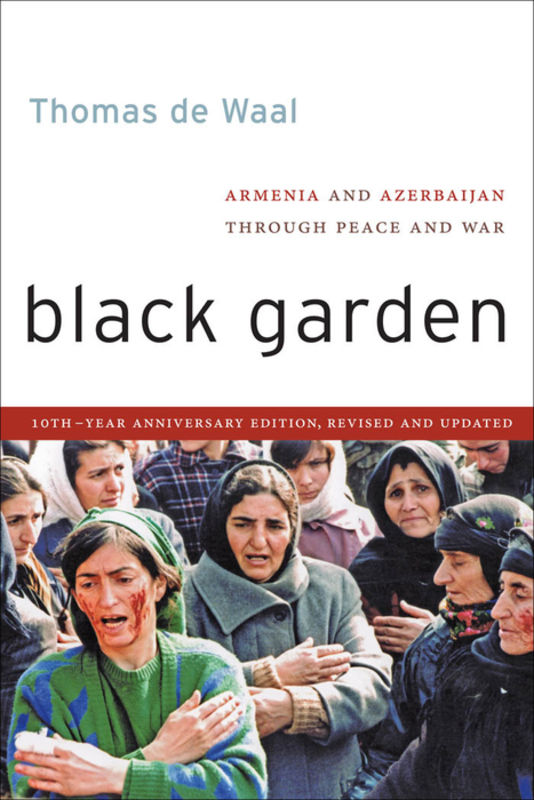
Black garden : Armenia and Azerbaijan through peace and war
No detailed description available for \"Black Garden\".
eBook
THE ESCALATION OF CONFLICT BETWEEN ARMENIANS AND AZERBAIJANIS AND THE PROBLEMS OF PEACEFUL RESOLUTION OF THE NAGORNO-KARABAKH WAR
This article explains why it is so difficult to achieve peace in Nagorno-Karabakh and what factors prevent the peaceful resolution of the conflict. This conflict is very difficult to resolve because the conflicting parties have contradictory geopolitical interests and cannot achieve consensus during negotiations. We have to take into account Russia’s geopolitical interests in South Caucasus that Kremlin is interested in freezing this conflict to weaken both states, Azerbaijan and Armenia, and bring them back to Russia’s orbit. Moscow aims to establish firm control over South Caucasus which was viewed in the past as a ‘Russian backyard’. Russia still views South Caucasus as its zone of influence and tries to bring this region back into Russia’s orbit.
Journal Article
The Influence of Energy Resources in Developing “Pragmatic” Relations between Azerbaijan and the West
The aim of the paper is to research the way energy resources shaped Azerbaijan’s foreign policy and contributed to developing its strategic relations with western actors trying, at the same time, to bring arguments whether or not the democratic deficit in Azerbaijan is related to the “resource na-tionalism”. The author makes a retrospective analysis of the most important events that have influ-enced Azerbaijan’s foreign policy since the collapse of USSR. In this regard, it is assessed the im-pact of the “Contract of the Century” on the evolution of the country, forasmuch the signing of the document is considered the first strategic move made by Azerbaijan since 1991. Because Nagorno-Karabakh is a crucial priority for the country’s territorial integrity, it is examined the manner in which Azerbaijani authorities are trying to make use of the energy resources projects in order to speed up the settlement of the protracted conflict, but without success so far. Last but not least, are analysed the EU-Azerbaijan relations, both on the energy and political level, highlighting on the one hand, the reluctance of Azerbaijan towards the democratic reforms promoted within the Eastern Partnership, but on the other hand, the interest of Baku to negotiate the unwanted agreements with Brussels, counting on its advantage as a supplier of energy resources on the European market. Con-sequently, some key questions have emerged: Is the EU’s strategic objective to ensure its energy security more important than promoting and encouraging its partners to adopt the fundamental val-ues of the EU? What impact may have the Strategic modernization partnership on the EU-Azerbaijan relations? Is European Union’s credibility in danger, by having so diverse approaches towards the Eastern Partnership countries?
Journal Article