
Catalogue Search | MBRL


Are you sure you want to remove the book from the shelf?

{{itemTitle}}
10,958
result(s) for
"Nails"
Sort by:

Designer nails : create art at your fingertips
Offers step-by-step, illustrated instructions for fifty nail art designs, including geometric shapes, lace patterns, and animal prints, with advice on maintaining healthy nails and building a nail art tool kit for home use.
Book

Long-pulsed nd: YAG laser treatment of nail psoriasis: clinical and ultrasonographic assessment
Nail psoriasis is a chronic, inflammatory condition which is difficult to treat, linked with greater psoriasis severity, and may be associated with anxiety and significant functional impairment of the quality of life. The 1064 nm Nd: YAG laser was reported to yield satisfactory results in the treatment of nail psoriasis.
The aim of the study was to assess the clinical and ultrasonographic efficacy of long-pulsed 1064 nm Nd: YAG laser in the treatment of fingernail psoriasis and compare its effect to control fingernails.
This intra-patient randomized controlled trial analyzed 86 fingernails collected from 13 patients suffering from cutaneous and nail psoriasis. The nails were randomized into two groups. Group A was treated with Nd: YAG laser once monthly for three sessions while group B served as control. Assessment took place at baseline, 1 and 3 months after the last treatment session. For scoring, the 32-points target NAPSI scoring systems was used. Additionally, two blinded dermatologists’ score of improvement, patients’ pain assessment by visual analogue score and ultrasonographic assessment were all performed.
At the end of follow up, the medians of tNAPSI score, plate definition, matrix thickness, bed thickness and bed vascularity decreased significantly in the Nd: YAG laser treated group in comparison to baseline (
p = 0.001
,
0.006
,
0.039
,
< 0.001
and
0.010
, respectively). While, there was a non-significant reduction in median tNAPSI score in the control group at last follow up, however, ultrasonography recorded a significant reduction in the medians of plate definition, bed thickness and vascularity (
p = 0.002
,
0.011
and
0.033
, respectively) from the baseline. Comparison of the Nd: YAG laser and the control groups showed no significant difference from baseline regarding the medians of tNAPSI, tNAPSI percentile improvement, pits count, blinded evaluation of photographs and ultrasonographic assessments.
In conclusion, Nd: YAG laser showed clinical and ultrasonographic improvement in fingernail psoriasis. Ultrasonography is a useful noninvasive tool in diagnosing and monitoring the clinical and even the subclinical changes in nail psoriasis. Nail psoriasis although difficult to treat, may show spontaneous improvement.
Journal Article

Here we grow : the secrets of hair and nails
\"Provides comprehensive information on the role hair and nails play in the body science of humans and animals\"--Provided by the publisher.
Book
Combined fractional CO2 laser 10,600 nm with methotrexate 1% gel versus methotrexate 1% gel alone in the treatment of nail psoriasis: a randomized comparative study
Methotrexate injections intralesionally as a treatment for psoriatic nails proved to be effective in large-scale studies as well as individual case reports, but the process is painful and time-consuming. The objective of this study was to compare the efficacy and safety of combined fractional CO2 laser (Fr. CO2) 10,600 nm and methotrexate gel versus methotrexate 1% gel alone in treatment of nail psoriasis. In this intra-patient randomized comparative study, 36 patients were treated for finger nail psoriasis. One hand was randomly selected to be treated with a Fr. CO2 laser at 10,600 nm in monthly sessions in addition to the daily application of methotrexate 1% gel for 4 months
(Fr. CO2 group)
. The other hand was treated with daily application of methotrexate 1% gel alone for the same period
(non-laser group)
. Evaluation was done at the end of 4 months treatment and 3 months after treatment both clinically and dermoscopically. In addition, histopathological evaluation was done 3 months after treatment. At the end of treatment, both hands experienced significant improvement in total nail psoriasis severity index (NAPSI) (
P
= 0.001,for each hand) with no significant difference between both (
p
= 0.593). Three months after treatment, the improvement in NAPSI score in Fr. CO2 group was significantly greater than that in non-laser group (
p
= 0.001). The dermoscopic evaluation showed significant improvement in both hands at the end of treatment and 3 months after treatment. Regarding microscopic examination of nail psoriatic, the mean value of nail plate thickness and subungual thickness significantly decreased, three months after treatment in both
groups
with significant higher improvement in
Fr. CO2 group
compared with
non-laser group
(
p
= 0.011, 0.000), respectively. Nail plate serous lake, subungual serous lake, parakeratosis and Munro’s abscess significantly improved 3 months after treatment. with no significant difference between both sides. Although minimal pain during the session was in 20% and erythema in 37.1% of patients that last less than 24 h were noticed in Fr. CO2 group, patient satisfaction was still higher among patients in this group (
p
= 0.02). It is concluded that topical methotrexate 1% gel is an effective topical treatment for nail psoriasis. However, Fr. CO2 laser-assisted delivery of methotrexate 1% gel is superior to unassisted methotrexate 1% gel application.
Journal Article

How do hair and nails grow?
\"Did you know that hair and nails are actually forms of skin? In this book, readers will learn this and many other intriguing facts about our nails and hair.\"-- Publisher's website.
BOOK
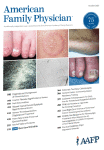
Nail Abnormalities
Nail abnormalities occur in all age groups but are more prevalent in older adults. Nail disorders account for 10% of dermatologic disorders. Nail abnormalities can be categorized as surface texture irregularities, color changes, defects of nail plate attachment/nail shedding, tumors, or a combination of these. Brittle nails affect up to 20% of the population but are most prominent in older women and on fingernails. Different patterns of brittle nails can be seen in the same patient or can coexist in the same nail. Beau lines are transverse grooves caused by decreased keratinocyte activity in the proximal nail matrix. Nail pitting is due to abnormal keratinization in the proximal nail matrix. More than one-half of patients with psoriasis will have some nail involvement, and pitted nails are just one manifestation of nail psoriasis. Color changes may appear in the nail plate, nail bed, or nail matrix. In the nail unit, melanocytes are located only in the nail matrix. Brown-black nail changes are known as melanonychia and are caused by melanocyte activation or proliferation. Melanoma typically presents as longitudinal brown-black nail lines, but in approximately 30% of cases, it may present as a nail mass. Abnormal growth in the nail unit should raise concern for benign or malignant tumors, including the most common malignant tumor, squamous cell carcinoma. Nail clippings, ultrasonography, dermoscopy, and biopsy are useful for the diagnosis of nail abnormalities. Dermoscopy can assist in triaging lesions and differentiating those that can be safely observed from those that should be biopsied.
Journal Article


Leukonychia: What Can White Nails Tell Us?
Changes in nail color can provide important clues of underlying systemic and skin disease. In particular, white discoloration (leukonychia) has a high prevalence with a wide array of potential relevant causes, from simple manicure habits to life-threatening liver or kidney failure. Therefore, a reliable assessment of the patient with leukonychia is essential. In the past, two classifications for leukonychia have been presented. The morphological classifies the nail according to the distribution of the white lines: total, partial, transversal, and longitudinal leukonychia. Mees’ and Muehrcke’s lines are examples of transversal leukonychia, while Terry’s and Lindsay’s nails are examples of total and partial leukonychia. The anatomical classifies according to the structure responsible for the white color: the nail plate in true leukonychia, the nail bed in apparent leukonychia, and the surface only in pseudoleukonychia. In this review, both morphological and anatomical features have been combined in an algorithm that enables clinicians to approach leukonychia efficiently and effectively.
Journal Article
Retrospective Case Series on Risk Factors, Diagnosis and Treatment of Pseudomonas aeruginosa Nail Infections
Background
Pseudomonas aeruginosa
is the most common pathogen causing bacterial nail infections, producing a classic blue-green pigment, known as chloronychia. Clinical examination and dermoscopic findings, as well as diagnosis and treatment, have not been well characterized.
Objective
The aim was to characterize the clinical and dermoscopic findings of
P. aeruginosa
infection of the nails and assess treatment efficacy.
Methods
This is a retrospective study of patients with
P. aeruginosa
nail infection diagnosed between January 27, 2017 and May 28, 2019. Demographics, history, clinical and dermoscopic findings, diagnostics tests, and treatment were documented and analyzed.
Results
Twenty-six patients with
P. aeruginosa
nail infections were analyzed, with 21 patients completing treatment, two lost to follow-up, and three still undergoing treatment. Clinical examination findings were notable for onycholysis in 76.9% of patients. Green discoloration was seen in 38.5% of patients and green-brown discoloration in 30.8%. A majority of the patients had only one nail involved (73.1%). Dermoscopic findings were significant for greenish pigmentation in 37.5% of patients and 88.9% of cases presenting with a fading border. Wound cultures of nail plates were more sensitive (40%) than dermatopathology (16.7%), but the difference was not statistically significant (
p
value = 0.1596). All patients were treated with ophthalmic 0.3% gentamicin topical solution nightly for a 3-month period and those who completed therapy had complete resolution of their infection.
Limitations
The limitations of the study were the retrospective design and the small cohort size.
Conclusion
Clinical examination findings of onycholysis coupled with a green or green-brown discoloration involving one or more digits and dermoscopic findings of greenish discoloration with a fading border are consistent with a diagnosis of
Pseudomonas
nail infection. Gentamicin topical solution is an effective, inexpensive, easy-to-use treatment for this condition. Larger randomized clinical trials are necessary to compare efficacy with other therapeutic options.
Journal Article

Rehabilitation of a 13‐Year History of Habitual Tic‐Induced Nail Dystrophy
Background Habitual tic nail dystrophy is a prevalent condition among adults; however, it has received limited scholarly attention. Aims This study aims to report the case of habitual tic nail dystrophy with a duration of 13 years. Methods The patient was advised to modify his lifestyle habits and was followed up regularly over the course of 1 year to assess changes in the appearance of his nails. Results The appearance of the nails normalized during the 1‐year follow‐up period. Conclusions The appearance of nails in patients with habitual tic nail dystrophy can be significantly improved through lifestyle modifications and by minimizing the stimulation of the nail matrix.
Journal Article