
Catalogue Search | MBRL


Are you sure you want to remove the book from the shelf?

{{itemTitle}}
853
result(s) for
"National Health Insurance, United States - legislation "
Sort by:


THE PATIENT PROTECTION AND AFFORDABLE CARE ACT: IMPLICATIONS FOR PUBLIC HEALTH POLICY AND PRACTICE
Rosenbaum discusses the implications of the Patient Protection and Affordable Care Act. The legislation will take years to implement, and its full meaning can only be conceptualized at this point. But January 2014 will arrive in the blink of an eye. In sum, the Affordable Care Act is transformational, and enormous implementation challenges lie ahead. But the opportunities for major advances in public health policy and practice are simply unparalleled. The Act represents a singular opportunity not only to transform coverage and care, but also to rethink the basic mission of public health in a nation with universal coverage.
Journal Article


Long-Term Implications of Post-ACA Health Reform on State Health Care Policy
In the midst of the COVID-19 outbreak, health care reform has again taken a major role in the 2020 election, with Democrats weighing Medicare for All against extensions of the Affordable Care Act, while Republicans quietly seem to favor proposals that would eliminate much of the ACA and cut Medicaid. Although states play a major role in health care funding and administration, public and scholarly debates over these proposals have generally not addressed the potential disruption that reform proposals might create for the current state role in health care. We examine how potential reforms influence state-federal relations, and how outside factors like partisanship and exogenous shocks like the COVID-19 pandemic interact with underlying preferences of each level of government. All else equal, reforms that expand the ACA within its current framework would provide the least disruption for current arrangements and allow for smoother transitions for providers and patients, rather than the more radical restructuring proposed by Medicare for All or the cuts embodied in Republican plans.
Journal Article

The End of Obamacare
Health care reform in the United States is headed backward. It is uncertain which parts of the Affordable Care Act will survive past 2017 and what will follow it. What is certain is that Obamacare as we know it will end.
Donald Trump’s triumph in the 2016 presidential election marks the beginning of an uncertain and tumultuous chapter in U.S. health policy. In the election’s aftermath, the immediate question is this: Can Republicans make good on their pledge to repeal Obamacare? The Affordable Care Act (ACA) has persisted largely thanks to President Barack Obama’s protection. With Trump in the White House and Republicans maintaining House and Senate majorities, that protection is gone.
Obamacare’s vulnerability reflects not only the 2016 election results, but also its shallow political roots. The ACA has achieved much, including a large reduction in the uninsured population. Still, . . .
Journal Article

Patient Protection and Affordable Care Act of 2010: Reforming the Health Care Reform for the New Decade
The Patient Protection and Affordable Care Act (the ACA, for short) became law with President Obama’s signature on March 23, 2010. It represents the most significant transformation of the American health care system since Medicare and Medicaid. It is argued that it will fundamentally change nearly every aspect of health care, from insurance to the final delivery of care. The length and complexity of the legislation and divisive and heated debates have led to massive confusion about the impact of ACA. It also became one of the centerpieces of 2010 congressional campaigns. Essentials of ACA include: 1) a mandate for individuals and businesses requiring as a matter of law that nearly every American have an approved level of health insurance or pay a penalty; 2) a system of federal subsidies to completely or partially pay for the now required health insurance for about 34 million Americans who are currently uninsured – subsidized through Medicaid and exchanges; 3) extensive new requirements on the health insurance industry; and 4) numerous regulations on the practice of medicine. The act is divided into 10 titles. It contains provisions that went into effect starting on June 21, 2010, with the majority of provisions going into effect in 2014 and later. The perceived major impact on practicing physicians in the ACA is related to growing regulatory authority with the Independent Payment Advisory Board (IPAB) and the Patient Centered Outcomes Research Institute (PCORI). In addition to these specifics is a growth of the regulatory regime in association with further discounts in physician reimbursement. With regards to cost controls and projections, many believe that the ACA does not fix the finances of our health care system – neither public nor private. It has been suggested that the Congressional Budget Office (CBO) and the administration have used creative accounting to arrive at an alleged deficit reduction; however, if everything is included appropriately and accounted for, we will be facing a significant increase in deficits rather than a reduction. When posed as a global question, polls suggest that public opinion continues to be against the health insurance reform. The newly elected Republican congress is poised to pass a bill aimed at repealing health care reform. However, advocates of the repeal of health care reform have been criticized for not providing a meaningful alternative approach. Those criticisms make clear that it is not sufficient to provide vague arguments against the ACA without addressing core issues embedded in health care reform. It is the opinion of the authors that while some parts of the ACA may be reformed, it is unlikely to be repealed. Indeed, the ACA already is growing roots. Consequently, it will be extremely difficult to repeal. In this manuscript, we look at reducing the regulatory burden on the public and providers and elimination of IPAB and PCORI. The major solution lies in controlling the drug and durable medical supply costs with appropriate negotiating capacity for Medicare, and consequently for other insurers. Key words: Affordable Care Act, health care costs, health care regulation, health care reform, Patient Centered Outcomes Research Institute, health exchanges, health care subsidies, health insurance premiums, uninsured, Medicare, cost control
Journal Article
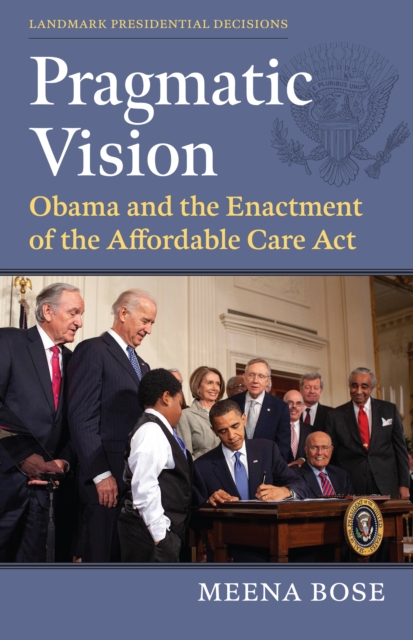
Pragmatic Vision
On March 23, 2010, President Barack Obama signed the Patient
Protection and Affordable Care Act into law, providing every
American with the opportunity to have guaranteed health care
coverage. The Affordable Care Act-frequently referred to as
Obamacare-is almost synonymous with Obama's presidential legacy and
reflects a series of key decisions that he made beginning before he
took office. As Meena Bose shows, it was Obama's particular brand
of pragmatic politics that ultimately shaped the passage of the
Affordable Care Act and made a lasting mark on health care reform
in the United States.
Pragmatic Vision examines eight of Obama's decisions
that resulted in the landmark enactment of health care reform,
starting with his commitment to health care reform in the 2008
presidential campaign and concluding with his decision to allow for
flexibility with its implementation, following technical hurdles
and Supreme Court rulings. Bose shows that Obama's steadfast
commitment to the issue was crucial to its passing, especially
after the Democrats lost their filibuster-proof majority in the
Senate. Obama's direct engagement built key political support for
the legislation and was aided by the senior White House staff and
Democratic leaders in Congress who skillfully navigated the bill to
passage just fourteen months after Obama took office.
The story of Obama's leadership in enacting the Affordable Care
Act is a tale of today's partisan divide and the polarization of
Congress. The legislation passed on a party-line vote and continued
to divide politicians long after its passage. Nevertheless, despite
repeated efforts by Republicans to repeal the law, it is more
popular today than ever and seems destined to remain in force until
the next stage of reform. Pragmatic Vision is an
authoritative guide to this singular achievement of the Obama
administration.
eBook
Unfinished Journey — A Century of Health Care Reform in the United States
200th Anniversary Article: Unfinished Journey — A Century of Health Care Reform in the U.S.
In 1915, reformers issued the first major proposal for national health insurance in the United States. Nearly a century later, Americans are still debating health care reform, the perils of “socialized medicine,” and the tension between individual liberty and government aid.
In 1915, reformers issued the first major proposal for national health insurance in the United States (see timeline). They believed that America should follow European countries such as Germany and England in securing access to medical care for workers and protecting them against the economic burdens of illness. The leadership of the American Medical Association (AMA) initially agreed, and the prospects for reform appeared promising.
Yet by 1920, the health care reform campaign had failed, the victim of intense opposition (from businesses and the insurance industry, among others), bad timing (the American entry into World War I), demagoguery, and xenophobia . . .
Journal Article

The tough luck constitution and the assault on health care reform
Chief Justice John Roberts stunned the nation by upholding the Affordable Care Act--more commonly known as Obamacare. In The Tough Luck Constitution and the Assault on Health Care Reform, Andrew Koppelman explains how the Court's conservatives embraced the arguments of a fringe libertarian legal movement bent on eviscerating the modern social welfare state. They instead advocate what Koppelman calls a \"tough luck\" philosophy: if you fall on hard times, too bad for you. He argues that the rule they proposed--that the government can't make citizens buy things--has nothing to do with the Constitution, and that it is in fact useless to stop real abuses of power. He goes on to dismantle the high court's construction of the commerce clause, arguing that it almost crippled America's ability to reverse rising health-care costs and shrinking access. Ranging from early constitutional history to potential consequences, this is the definitive postmortem of the landmark Obamacare case.
eBook
Which Road to Universal Coverage?
The United States could extend insurance coverage by replacing the current system with a national, tax-financed system or by extending components of our public–private system to fill in coverage gaps. The latter approach would allow us to simultaneously tackle other needs.
Journal Article