
Catalogue Search | MBRL


Are you sure you want to remove the book from the shelf?

{{itemTitle}}
3,609
result(s) for
"National Highway System."
Sort by:


Three Kinds of Motion
Book-length essay chronicles Jackson Pollock, Jack Kerouac, and the origin of America's highway system.
eBook

Adaptive AI-Driven Toll Management: Enhancing Traffic Flow and Sustainability Through Real-Time Prediction, Allocation, and Task Optimization
Efficient toll processing is critical for mitigating traffic congestion and enhancing transportation network efficiency at toll stations. This study explores the Neelamangala Toll Plaza on India’s National Highway 48, employing artificial intelligence (AI) to optimize toll operations. The research integrates a Supervised Learning (SL) time series model for traffic prediction and a Reinforcement Learning (RL) framework based on a Markov Decision Process (MDP), coupled with a randomized algorithm for equitable task distribution. These AI-driven models dynamically adapt to real-time traffic conditions, preventing peak-hour system overload. Key performance metrics—Average Processing Time (APT), Queue Length Reduction (QLR), and Throughput (TP) were used to evaluate the system. Research also demonstrates the model’s superior performance in handling high traffic volumes and reducing congestion. The study underscores the potential of integrating AI and randomized algorithms in modern toll management, offering a scalable and adaptive solution for sustainable transportation infrastructure.
Journal Article

The National Road and the difficult path to sustainable national investment
The National Road is a comprehensive history of the first federally financed interstate highway, an approximately 600-mile span that joined Maryland, Pennsylvania, West Virginia, Ohio, Indiana, and Illinois in the nineteenth century. This book covers the road's contribution to the cultural, economic, and administrative history of the United States, its decline during the second half of the nineteenth century, and its revival in the twentieth century in the form of U.S. Route 40. The story of the National Road embraces an account of its building, its constitutional significance, the unique culture that it represented, the movements and trends that transpired across its route, and the symbolic value that it held, and continues to hold, for the American people. Beyond its status as an American heritage symbol, it serves as a forceful reminder that the United States must continue to pursue the goal of sustainable national investment that began with the National Road and comparable projects during the early republic.
eBook
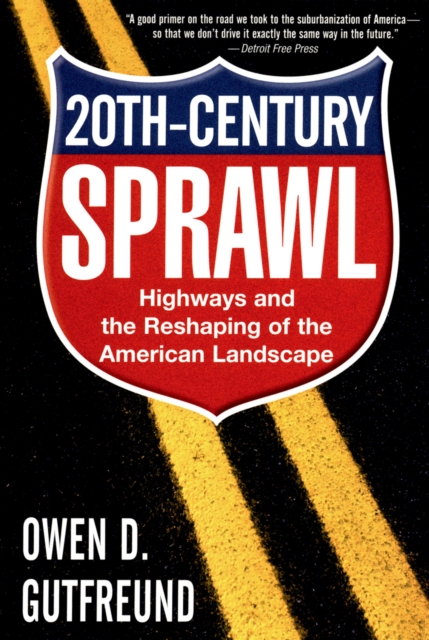
Twentieth-century sprawl : highways and the reshaping of the American Landscape
Owen Gutfreund’s Twentieth-Century Sprawl explains important--and largely unexamined--changes in the American landscape. He offers an illuminating look at how highways have dramatically transformed American communities, aiding growth and development in unsettled areas and undermining existing urban centers. Gutfreund takes a “follow the money” approach to show how government policies--from as early as the 1890s--subsidized the spread of cities and fueled a chronic nationwide dependence on cars and roadbuilding, with little regard for expense, efficiency, ecological damage, or social equity. As federal, state, and local governments invested in toll-free highways, Americans moved in unprecedented numbers to newly accessible open land on the urban periphery. The consequence was the collapse of center cities, ballooning municipal debt, and rapidly increasing air pollution, not to mention profound changes in American society and culture. Gutfreund tells the story via case studies of three communities--Denver, Colorado; Middlebury, Vermont; and Smyrna, Tennessee. Different as these places are, they all show the ways that government-sponsored highway development radically transformed America’s cities and towns. Indeed, though seeming quite dissimilar, both Denver and Middlebury have crippling traffic problems; housing and commercial activity has sprawled outward, leaving downtown areas in danger of decay, while residents have longer commutes, fewer transportation options, and increasing concerns about air quality and environmental problems. Smyrna, once a dusty backwater, is now booming, thanks to its location near three interstate highways, which attracted a huge Nissan factory (the largest auto assembly plant in North America, the size of 92 football fields). Based on original research and vividly written, Twentieth-Century Sprawl makes a major contribution to our understanding of issues that still plague our cities and suburbs today.
eBook
Urbanization beyond municipal boundaries
The report is organized into three chapters: chapter two looks at the pace and patterns of India's urbanization, providing a 100-year perspective on demographic shifts and a 20-year perspective on the spatial distribution of jobs across India's portfolio of settlements. The review is based on a careful, spatially detailed analysis of data from economic and demographic censuses, annual surveys of industry, national sample surveys, and special surveys of freight transport. This chapter provides diagnostics on whether Indian industry is adequately exploiting agglomeration economies and whether there are hints of specific barriers to the natural tendency of standardized industry to reshuffle from large metropolitan areas to smaller urban areas. Chapter three examines specific policy issues and investment bottlenecks that are curbing the pace and benefits of urbanization in India. The policy issues relate to land markets and housing, connectivity (within and between cities), and access to basic services. The purpose of this analysis is to unravel the specific distortions that may be preventing India from reaping the entire range of benefits of urbanization. Chapter four provides some options for policy reform, distilling lessons from relevant international experience. It provides options for establishing the 'rules of the game' that can define the workings of land and property markets as well as coordination of land use and infrastructure in cities. This chapter also provides a framework for policy makers to identify the role of regulatory and price reform in expanding infrastructure services and to make investments that enhance capacity.
eBook