
Catalogue Search | MBRL


Are you sure you want to remove the book from the shelf?

{{itemTitle}}
326
result(s) for
"National characteristics, American, in literature."
Sort by:

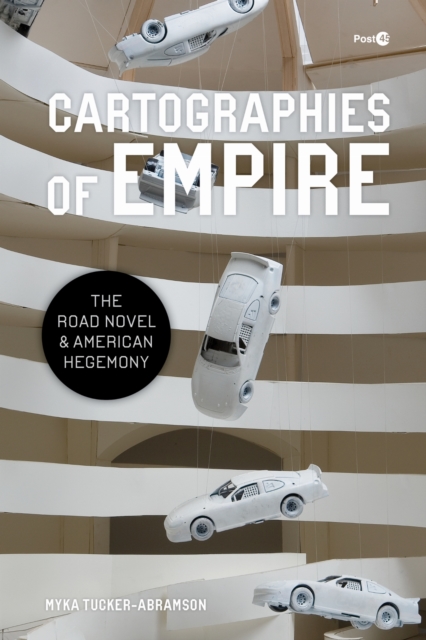
Cartographies of Empire
\"The road novel is often dismissed as a mundane, nostalgic genre: Jack, Sal, and other tedious white men on the road trying to recapture an authentic youth and American past that never existed. Yet, new road novels appear every year, tackling unexpected questions and spanning new geographies, from Mexico, Brazil, Bulgaria, Palestine, Ukraine, and former-Yugoslavia. Why did the road novel emerge and why does it persist? What does it do and why has it traveled so widely? Myka Tucker-Abramson draws from an archive of more than one-hundred-and-forty global road novels from over twenty countries, challenging dominant conceptions of the road novel as primarily concerned with American experiences and subjectivities. Grounding her analysis in materialist theories of genre, world-ecology and commodity frontier frameworks, and post-45 American literary studies, Tucker-Abramson persuasively argues that the road novel is a genre specific to, coterm
eBook
Fathering the Nation
Russ Castronovo underscores the inherent contradictions between America's founding principles of freedom and the reality of slavery in a book that probes mid-nineteenth-century representations of the founding fathers. He finds that rather than being coherent and consensual, narratives of nationhood are inconsistent, ambivalent, and ironic. He examines competing expressions of national memory in a wide range of mid-nineteenth-century artifacts: slave autobiography, classic American fiction, monumental architecture, myths of the Revolution, proslavery writing, and landscape painting. Castronovo theorizes a new American cultural studies which takes into consideration what Toni Morrison calls the \"Africanist presence\" that permeates American literature. He presents a genealogy that recovers those members of the national family whose status challenges the body politic and its history. The forgotten orphans in Melville's Moby-Dick and Israel Potter, the rebellious slaves in the work of Frederick Douglass and William Wells Brown, the citizens afflicted with amnesia in Lincoln's speeches, and the dispossessed sons in slave narratives all provide dissenting voices that provoke insurrectionary plots and counter-memories. Viewed here as a miscegenation of stories, the narrative of \"America\" resists being told of an intelligible story of uncontested descent. National identity rests not on rituals of consensus but on repressed legacies of parricide and rebellion. This title is part of UC Press's Voices Revived program, which commemorates University of California Press's mission to seek out and cultivate the brightest minds and give them voice, reach, and impact. Drawing on a backlist dating to 1893, Voices Revived makes high-quality, peer-reviewed scholarship accessible once again using print-on-demand technology. This title was originally published in 1995.
Many titles in the Voices Revived program are also newly available as ebooks, offered at a discounted price to support wider access to scholarly work.
eBook

Weak nationalisms : affect and nonfiction in postwar America
\"Weak Nationalisms employs affect theory as well as traditional close reading techniques to explore the ways a range of writers negotiate nationalistic feeling that embraces core tenets of American liberalism while resisting and questioning the hierarchies that are often associated with nationalism\"-- Provided by publisher.
Book

Writing for Inclusion
Writing for Inclusion is a study of some of the ways the idea of national identity developed in the nineteenth century in two neighboring nations, Cuba and The United States. The book examines symbolic, narrative, and sociological commonalities in the writings of four Afro-Cuban and African American writers: Juan Francisco Manzano and Frederick Douglass, fugitive slaves during mid-century; and Martín Morúa Delgado and Charles W. Chesnutt from the post-slavery period. All four share sensitivity to their imperfect inclusion as full citizens, engage in an examination of the process of racialization that hinders them in seeking such inclusion, and contest their definition as non-citizens. Works discussed include the slave narratives of Manzano and Douglass, Manzano's poetry and play Zafira, andDouglass's oratory and novella The Heroic Slave. Also considered, within the context provided by Manzano and Douglass, are Morúa and Chesnutt's non-fiction writings about race and nation as well as their second-generation \"tragic mulata\" novels Sofía and The House Behind the Cedars. Based on an examination of the works of these four authors, Writing for Inclusion provides a detailed examination of examples of self-emancipation, the authors' symbolic use of language, their expression of social anxieties or irony within the quest for recognition, and their arguments for an inclusive vision of national identity beyond the quagmires of race. By focusing on the process of racialization and ideas of race and national identity in a comparative context, the study seeks to highlight the artificial and contested nature of both terms and suggest new ways to interrogate them in our present day.
eBook


Exotic Nations
In this highly original and critically informed book, Renata R. Mautner Wasserman looks at how, during the first decades following political independence, writers in the United States and Brazil assimilated and subverted European images of an \"exotic\" New World to create new literatures that asserted cultural independence and defined national identity. Exotic Nations demonstrates that the language of exoticism thus became part of the New World's interpretation of its own history and natural environment.
eBook

Telegraphies : indigeneity, identity, and nation in America's nineteenth-century virtual realm
\"Telegraphies explores the work of such diverse writers as Sarah Winnemucca, Walt Whitman, Frederick Douglass, and Emily Dickinson, to reveal a body of literature in which Americans of all ranks imagine how nineteenth-century telecommunications technologies forever alter the way Americans speak, write, form community, and conceive of the divine\" -- Provided by publisher.
Book

Liberty of the Imagination
InLiberty of the Imagination, Edward Cahill uncovers the surprisingly powerful impact of eighteenth-century theories of the imagination-philosophical ideas about aesthetic pleasure, taste, genius, the beautiful, and the sublime-on American writing from the Revolutionary era to the early nineteenth century. Far from being too busy with politics and commerce or too anxious about the morality of pleasure, American writers consistently turned to ideas of the imagination in order to comprehend natural and artistic objects, social formations, and political institutions. Cahill argues that conceptual tensions within aesthetic theory rendered it an evocative language for describing the challenges of American political liberty and confronting the many contradictions of nation formation. His analyses reveal the centrality of aesthetics to key political debates during the colonial crisis, the Revolution, Constitutional ratification, and the advent of Jeffersonian democracy. Exploring the relevance of aesthetic ideas to a range of literary genres-poetry, novels, political writing, natural history writing, and literary criticism-Cahill makes illuminating connections between intellectual and political history and the idiosyncratic formal tendencies of early national texts. In doing so,Liberty of the Imaginationmanifests the linguistic and intellectual richness of an underappreciated literary tradition and offers an original account of the continuity between Revolutionary writing and nineteenth-century literary romanticism.
eBook