
Catalogue Search | MBRL


Are you sure you want to remove the book from the shelf?

{{itemTitle}}
21
result(s) for
"National characteristics, Japanese, in literature"
Sort by:


Japanese Brazilian Saudades
Japanese Brazilian Saudades explores the self-definition of Nikkei discourse in Portuguese-language cultural production by Brazilian authors of Japanese ancestry. Ignacio López-Calvo uses books and films by twentieth-century Nikkei authors as case studies to redefine the ideas of Brazilianness and Japaneseness from both a national and a transnational perspective. The result suggests an alternative model of postcoloniality, particularly as it pertains to the post-World War II experience of Nikkei people in Brazil. López-Calvo addresses the complex creation of Japanese Brazilian identities and the history of immigration, showing how the community has used writing as a form of reconciliation and affirmation of their competing identities as Japanese, Brazilian, and Japanese Brazilian. Japanese in Brazil have employed a twofold strategic, rhetorical engineering: the affirmation of ethno-cultural difference on the one hand, and the collective assertion of citizenship and belonging to the Brazilian nation on the other. López-Calvo also grapples with the community's inclusion and exclusion in Brazilian history and literature, using the concept of \"epistemicide\" to refer to the government's attempt to impose a Western value system, Brazilian culture, and Portuguese language on the Nikkeijin, while at the same time trying to destroy Japanese language and culture in Brazil by prohibiting Japanese language instruction in schools, Japanese-language publications, and even speaking Japanese in public. Japanese Brazilian Saudades contributes to the literature criticizing the \"cognitive injustice\" that fails to acknowledge the value of the global South and non-Western ways of knowing and being in the world. With important implications for both Latin American studies and Nikkei studies, it expands discourses of race, ethnicity, nationality, and communal belonging through art and narrative.
eBook


The Strong and the Weak in Japanese Literature
This book uses texts from classical to modern Japanese literature to examine concepts of 'respect for the strong', as a notion of an evolutionary society, and 'sympathy for the weak', as a notion of a non-violent and changeless egalitarian society.
The term strong refers not just to those with strength and power. It also includes other ideal attributes such as beauty, youth and goodness. Similarly, the term weak implies not only the weak and infirm, but also the disadvantaged, the indecent, the unsophisticated and those generally shunned by society. The former are associated not only with the power of life, competition, evolution, progress, development, ability, effectiveness, efficiency, individuality, the future, hope and romance, but also with violence, fighting, bullying, discrimination and sacrifice. The latter, in contrast, invoke notions of peace, egalitarianism, anti-discrimination and welfare, as well as stagnation, retreat, retrogression, degeneration and the decline of vital powers.
By using these two concepts Murakami skillfully weaves a narrative that is part literary criticism, part social commentary. As such the book will be of huge interest to not only scholars and students of Japanese literature, but also those of Japanese society and culture.
Fuminobu Murakami is Associate Professor at the Department of Japanese Studies, University of Hong Kong. He is author of Postmodern, Feminist and Postcolonial Currents in Contemporary Japanese Culture (Routledge, 2005), and co-editor of Reading The Tale of Genji (Global Oriental, 2009).
1. Introduction 2. The Strong and the Weak in Japanese Religious, Philosophical and Political Writings 3. Ugly Ladies in The Tale of Genji 4. Women, Humble Men and Insulted People in The Tale of the Heike 5. Sacrifice and Revenge, Love and War, and a World Without Violence in The Eight Dog Chronicles 6. Dancing Girl, Geisha, Mistress and Wife in Kawabata Yasunari’s Stories: The Dancing Girl of Izu, Snow Country, Thousand Cranes and The Sound of the Mountain 7. Conclusion
eBook

Representing Empire
By exploring the rich terrain of Japanese colonial literature in Taiwan and Manchuria, Representing Empire investigates the interplay between imperialism, nationalism, and Pan-Asianism during the era of Japan's territorial expansion in Asia.
eBook

Women adrift : the literature of Japan's imperial body
Womens bodies contributed to the expansion of the Japanese empire. With this bold opening, Noriko J. Horiguchi sets out in Women Adrift to show how womens actions and representations of womens bodies redrew the border and expanded, rather than transcended, the empire of Japan. Discussions of empire building in Japan routinely employ the idea of kokutaithe national bodyas a way of conceptualizing Japan as a nation-state. Women Adrift demonstrates how women impacted this notion, and how womens actions affected perceptions of the national body. Horiguchi broadens the debate over Japanese womens agency by focusing on works that move between naichi, the inner territory of the empire of Japan, and gaichi, the outer territory; specifically, she analyzes the boundary-crossing writings of three prominent female authors: Yosano Akiko (18781942), Tamura Toshiko (18841945), and Hayashi Fumiko (19041951). In these examplesand in Naruse Mikios postwar film adaptations of Hayashis workHoriguchi reveals how these writers asserted their own agency by transgressing the borders of nation and gender. At the same time, we see how their work, conducted under various colonial conditions, ended up reinforcing Japanese nationalism, racialism, and imperial expansion. In her reappraisal of the paradoxical positions of these women writers, Horiguchi complicates narratives of Japanese empire and of womens role in its expansion.
eBook

Dominant narratives of colonial Hokkaido and imperial Japan : envisioning the periphery and the modern nation-state
Recasts the commonly dismissed colonial project pursued in Hokkaido during the Meiji era (1868-1912) as a major force in the production of modern Japan's national identity, imperial ideology, and empire.
eBook

Becoming Yellow
In their earliest encounters with Asia, Europeans almost uniformly characterized the people of China and Japan as white. This was a means of describing their wealth and sophistication, their willingness to trade with the West, and their presumed capacity to become Christianized. But by the end of the seventeenth century the category of whiteness was reserved for Europeans only. When and how did Asians become \"yellow\" in the Western imagination? Looking at the history of racial thinking, Becoming Yellow explores the notion of yellowness and shows that this label originated not in early travel texts or objective descriptions, but in the eighteenth- and nineteenth-century scientific discourses on race.
eBook
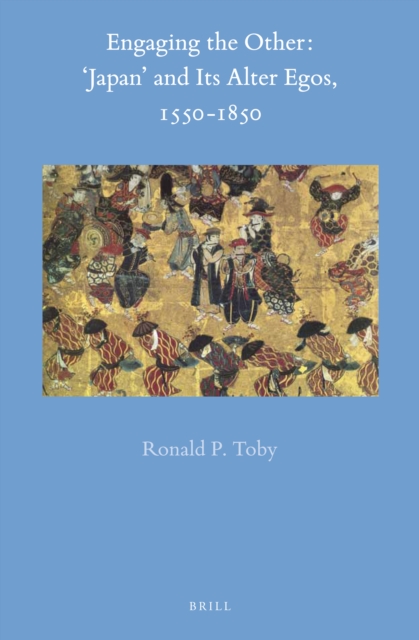
Engaging the other : \Japan\ and its alter egos, 1550-1850
In Engaging the Other: \"Japan and Its Alter-Egos\", 1550-1850 Ronald P. Toby examines new discourses of identity and difference in early modern Japan, a discourse catalyzed by the \"Iberian irruption,\" the appearance of Portuguese and other new, radical others in the sixteenth century. The encounter with peoples and countries unimagined in earlier discourse provoked an identity crisis, a paradigm shift from a view of the world as comprising only \"three countries\" (sangoku), i.e., Japan, China and India, to a world of \"myriad countries\" (bankoku) and peoples. In order to understand the new radical alterities, the Japanese were forced to establish new parameters of difference from familiar, proximate others, i.e., China, Korea and Ryukyu. Toby examines their articulation in literature, visual and performing arts, law, and customs.
eBook